Website relaunch: when it makes sense, what it costs and how to protect your rankings
The guide to website relaunches: reasons, costs, timelines, SEO risks and how to decide whether a relaunch, redesign or optimisation is the right approach.

A website relaunch is not a design project that gives your site a fresh coat of paint. It means intervening in a live system: structure, content, technology, rankings and leads all depend on it. This guide answers the questions that come up before every relaunch: when it makes sense, what it costs, how long it takes, what the risks are and how to avoid them.
What is a website relaunch?
A relaunch is a fundamental rebuild of an existing website under the same domain. Unlike a redesign, which only changes the surface, it involves rebuilding the site structure, content, technology and usually the CMS. The domain stays; everything beneath it is replaced.
| Approach | What happens | Effort | SEO risk |
|---|---|---|---|
| Optimisation | Individual pages, copy, loading speed | low | very low |
| Redesign | New layout on the existing structure | medium | low |
| Relaunch | New structure, technology, content, CMS | high | medium to high |
| New domain | Relaunch plus domain change | very high | high |
This distinction determines the budget and schedule. If your only issue is a slow homepage, you do not need a relaunch, but two weeks of technical work.
When a relaunch genuinely makes sense
There are five triggers that make the effort worthwhile:
- The structure no longer fits the business. New services, audiences or locations no longer fit into the old navigation.
- The technology is holding you back. The CMS is outdated, updates break layouts, and nobody dares to make changes any more.
- The brand has changed. After a rebrand, the old website feels out of place.
- The website does not convert. Traffic is there, but enquiries are not, and the cause lies in the structure and user journeys, not individual pieces of copy.
- Legal requirements. Accessibility under the BFSG, data protection or consent requirements cannot be properly retrofitted into the existing site.
Not a good reason: "The site is three years old." Age alone is not an argument. What matters is whether the website currently does what your sales team needs it to do.
Most relaunch enquiries we receive are actually structural problems. Only when we map out the site architecture together does it become clear whether we really need to rebuild, or whether three well-structured landing pages and a faster homepage will do. In roughly one in four cases, we advise against a relaunch.
What does a website relaunch cost?
The price almost never comes down to design, but to the number of pages, content and integrations. A rough guide for German SMEs:
| Scope | Typical budget | What is included |
|---|---|---|
| Small relaunch (5–10 pages) | 6.000–12.000 € | Structure, design, CMS, basic SEO, migration |
| Medium relaunch (10–30 pages) | 12.000–25.000 € | plus content work, landing pages, tracking |
| Large relaunch (30+ pages, integrations) | from 25.000 € | plus interfaces, multilingual support, editorial system |
| Ongoing support afterwards | 250–1.500 € / month | Updates, hosting, content, optimisation |
There are also ongoing costs that are often missing from the quote: hosting, licences, photography, copy and further development after launch. Budget at least ten per cent of the project total per year for maintenance. Our article on commissioning a website: process and costs explains in detail how pricing generally breaks down.
How long does a relaunch take?
Eight to sixteen weeks is realistic. The bottleneck is rarely the agency, but the content: copy, images, approvals. A typical process:
- Analysis (1–2 weeks): Audit, rankings, page inventory, goals.
- Planning (2–3 weeks): Site architecture, wireframes, content plan.
- Design (2–4 weeks): Visual designs for key pages, components, design system.
- Implementation (3–5 weeks): CMS build, content, technical setup, integrations.
- Migration and launch (1 week): Redirects, testing, switchover.
- Post-launch support (4–8 weeks): Monitoring, bug fixes, refinements.
You can find the practical step-by-step process, including a test protocol, in our website relaunch checklist. This article deliberately stays at the level above: decisions, budget, risk.
The biggest risk: losing visibility
The most common damage caused by a relaunch is a loss of organic rankings. The cause is almost always the same four mistakes: missing 301 redirects, URL changes without a plan, reduced text on important pages, and a test environment that accidentally remains on noindex or gets indexed.
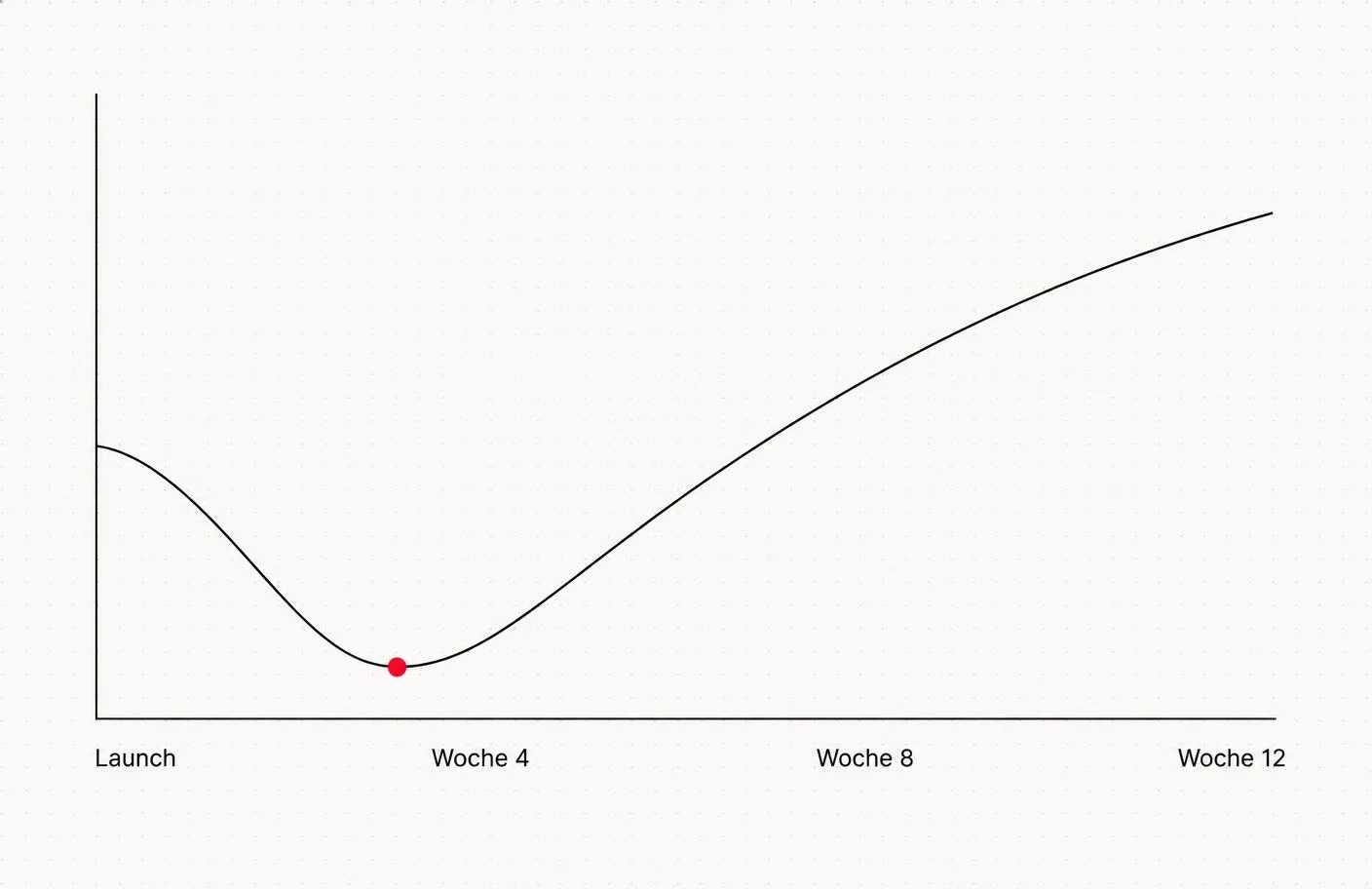
A brief dip immediately after launch is normal, because Google needs to reassess the new structure. It becomes a concern if the trend does not reverse after four to six weeks. That points to an implementation error, not a Google effect.
What helps:
- A complete URL export of the old site before the project starts, including traffic and ranking data
- A maintained redirect map from old to new, with no chains and no blanket redirects to the homepage
- Retaining at least equivalent content on important pages, rather than cutting it
- Measuring Core Web Vitals before launch, not afterwards[1]
- Monitoring Search Console and Analytics from day one
Practical example: BxC Security
"BxC Consulting" became "BxC Security". The rebrand was the trigger, but the old website also had a structural problem: services were scattered across nested subpages, and the site felt technical and unapproachable. We supported the relaunch and made the site brighter, clearer and more welcoming, without completely discarding the existing corporate design. Clean silver tones, friendly colour accents, new layouts for service pages and navigation that follows the offering rather than the internal organisation.

View the full case study: BxC Security →
A second example from 2026: at Gateway Factory, the core idea behind the internally built website was good, but it lacked a central styling system, and its disorganised structure was costing it visibility. Instead of a complete rebuild, we refreshed the design and tidied up the technical setup: clear site structure, a proper heading hierarchy, consistent components. Exactly the kind of case where a full relaunch would have wasted money.
Relaunch with or without an agency?
If you have in-house capacity for planning, copy, design, technology and migration, you can manage a relaunch yourself. In practice, one of these is usually missing, and migration ends up suffering, which is the part with the greatest risk.
How to recognise a suitable agency:
- They ask about your current rankings and traffic figures before preparing a quote
- Redirect planning and a testing phase are included in the quote, not treated as extras
- You see a site architecture before design is discussed
- There is a plan for the first eight weeks after launch
- You can maintain the website yourself afterwards
If you want a shorter route from your existing site to a new one: our Maluure-Page™ is a fixed-price website product with a defined scope and schedule, including redirect planning when moving from an existing site.
Seven mistakes that make relaunches expensive
- Design before structure. If you start with visual designs, you end up fitting content into layouts rather than creating layouts for content.
- Content left too late. Copy and images are almost always underestimated. If you only start writing during implementation, you lose four weeks.
- No page prioritisation. Not every subpage needs the same attention. The ten pages with the most traffic and enquiries determine the outcome.
- Redirects as the last item on the to-do list. They belong in the planning stage, not the night before launch.
- Forgotten tracking. New site, new forms, old goal settings. Afterwards, it is unclear whether the relaunch achieved anything.
- Too many decision-makers without defined roles. Feedback from five departments without an approval process adds weeks to any project.
- No budget for afterwards. Launch is the beginning, not the end. Without maintenance, the new site will be the old problem again in two years.
A relaunch as an opportunity to address compliance
A relaunch is the most cost-effective time to tackle requirements that are expensive to address on an existing site. Accessibility under the BFSG can be implemented in a new build with proper semantics, sufficient contrast and keyboard navigation at almost no extra cost, while retrofitting an established site can quickly run into five figures. Our article on accessible websites under the BFSG explains the specific requirements.
The same applies to your choice of technology. If you are rebuilding anyway, this is the time to choose your system deliberately rather than inherit it. We compare which CMS suits which use case in our tech stack comparison. And if you want to get the fundamentals in order before a relaunch, our article on website planning provides the framework.
The work begins after launch
A relaunch is only successful when the numbers confirm it. In the first twelve weeks, monitor: indexed pages, organic clicks by page type, 404 errors, mobile loading speed and form enquiries. Compare these against the figures you recorded before launch. Without that baseline, every assessment is just a matter of instinct.
Frequently asked questions
What is a website relaunch?+
What does a website relaunch cost?+
How long does a website relaunch take?+
What is the difference between a relaunch and a redesign?+
Will I lose my Google rankings during a relaunch?+
How often should you relaunch a website?+
What SEO factors need attention during a relaunch?+
Do I need an agency for a relaunch?+
Sources
- Core Web Vitals, web.dev (Google) (2025)

Josef leads the strategic and creative development of brands at Maluure. For over a decade, he has guided medium-sized businesses from brand positioning to digital delivery.
Managing Director of Maluure GmbH, Cologne. Specialising in corporate design, brand strategy and digital brand experiences.
Weiterlesen

Using a corporate film on social media: twelve weeks of content from one shoot day
A corporate film is not a one-off asset, but a bank of source material. How to turn one shoot into formats for LinkedIn, Instagram, your website and sales, with an editing plan, content calendar and practical example.

Corporate video scripts: storytelling that works in 90 seconds
The script determines whether your corporate video makes an impact or just looks good. Structure, narrative, common mistakes and a shot list that saves the shoot day.

Officially certified: Maluure is a Lovable Partner
Since 16. September 2026, Maluure has been an officially certified Lovable Partner, Expert Website Builder and Expert App Builder. What the certification involves and what it means for your project.
Explore more blog topics
Corporate film or recruitment video: What your company really needs
Both films cost a similar amount but have very different effects. This comparison shows which format suits which goal and how to produce both in a single day of filming.

LinkedIn Video: Formats, Lengths and Best Practices for Businesses
What works for LinkedIn video: formats from 1:1 to 9:16, the right length for each objective, subtitles, hooks and upload strategy. A concise guide for businesses.

Recruitment video: showing employees as they really are
How a recruitment video shows real employees rather than glossy clichés, what it costs and why authenticity brings in more applications.