Website relaunch checklist: How to plan your relaunch properly
The complete website relaunch checklist 2026: From audits and goal setting to SEO, redirects, Core Web Vitals, accessibility, GEO/AI search and post-launch monitoring. An agency guide to help your relaunch gain visibility rather than lose it.

This checklist covers the practical work. If you are still deciding whether a relaunch is worthwhile, what it costs and how long it takes, start with our overview article Website relaunch: When it makes sense, what it costs and how to protect your rankings.
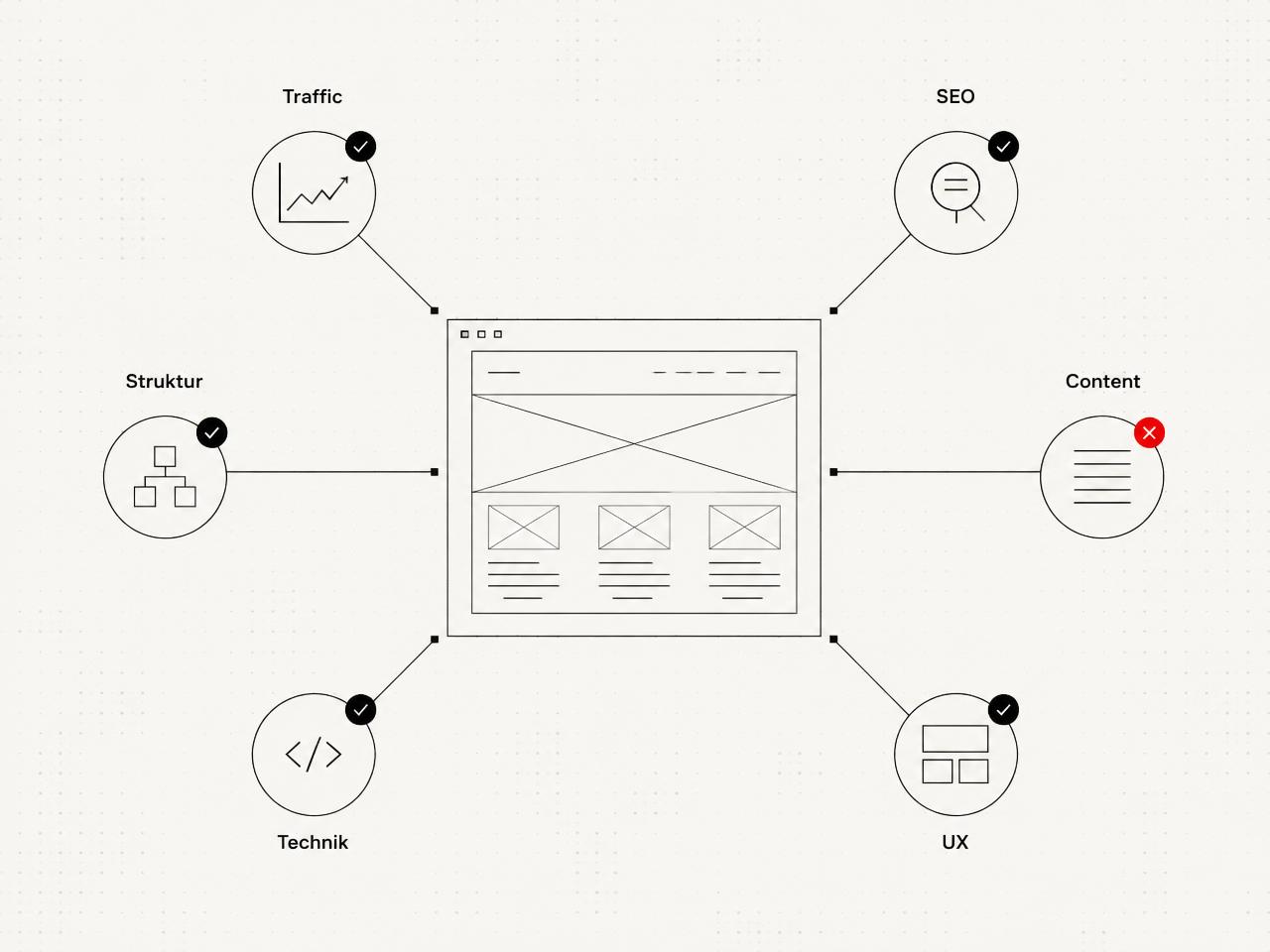
The success of a website relaunch is determined not on launch day, but in the weeks before it. If you do not understand the old site, you will recreate the same problems with a new look. This checklist is the working framework we use at Maluure GmbH to start every relaunch project: analyse first, then plan, then build, then deliver properly.
1. Initial audit: Really understand the old site
Before anyone thinks about colours, fonts or layouts, we take a close look at your current site. What already works well? Which pages drive traffic, enquiries or revenue? Where are the technical weaknesses, outdated content or dead links?
We supplement this data with a comprehensive questionnaire: What do you like? What frustrates you? Where does the site no longer represent you? Only once we understand the old site and its problems can we make targeted improvements with the new one.
Data sources for a reliable audit
- Google Search Console: Top pages, top keywords, clicks, impressions, crawl errors
- Google Analytics or Plausible: Traffic sources, conversions, bounce rates
- Screaming Frog or a similar crawler: Internal links, redirect chains, metadata, duplicate content
- PageSpeed Insights and Lighthouse: Core Web Vitals, accessibility, best practices (our guide Accessible websites: What the BFSG requires from 2025 explains the specific BFSG requirements)
- Backend analysis: Editorial workload, maintenance obstacles, outdated plugins
Our questionnaire at a glance
- What works particularly well on the current site?
- Which pages generate the most traffic and conversions?
- What frustrates you in the backend or in day-to-day content management?
- Which features are missing that your competitors already offer?
- Where does the visual design no longer represent you?
- Which content is outdated, redundant or simply no longer correct?
- Which URLs consistently bring you organic traffic and are essential?
2. Goal setting: What should the relaunch achieve?
A relaunch without clear goals is an expensive design exercise. Together, we define measurable goals: more qualified enquiries, faster load times, a higher conversion rate, easier maintenance or more modern technology. These goals will guide every technical and design decision.
We always document goals in measurable terms, for example: "Load time below 2 seconds on mobile", "Contact form conversion rate from 1,2 to 2,5 per cent", "40 per cent less editorial work per blog post". This gives us a reliable way to assess after launch whether the relaunch was worth the investment.
3. When does a website relaunch really make sense?
Not every website needs rebuilding. Often, redesigning individual sections or making a technical update is enough. A full relaunch is worthwhile if at least two of the following apply:
- The site is more than five to seven years old and technically outdated.
- The design no longer fits the current brand or target audience.
- Mobile performance and Core Web Vitals are consistently poor.
- The CMS is confusing, insecure or no longer maintained.
- New requirements such as a shop, customer portal or AI search cannot be integrated properly.
- Achieving BFSG accessibility compliance is not economically viable with the current setup.
- The site is outgrowing its structure and becoming difficult to navigate.
4. Costs: What you should realistically expect
"What does a website relaunch cost?" is the most common question in an initial consultation, and an honest answer requires a review of the scope, features and migration. As a rough guide, the following price ranges provide a realistic framework for the German market.
| Project type | Scope | Price range | Typical duration |
|---|---|---|---|
| Small company website | 5 to 10 pages, no shop | 6.000 to 15.000 EUR | 4 to 8 weeks |
| Mid-sized corporate website | 15 to 40 pages, blog, forms | 15.000 to 40.000 EUR | 8 to 16 weeks |
| Complex platform | Shop, portal, custom tools | 40.000 to 150.000 EUR | 3 to 9 months |
| Enterprise relaunch | Multilingual, ERP integration, extensive compliance requirements | from 100.000 EUR | 6 to 18 months |
These figures cover the concept, design, development, SEO migration and launch support. They do not include ongoing costs for hosting, maintenance, content creation and further development. For a realistic assessment of relaunch costs, our article on website costs provides more detailed figures and example calculations.
5. Timeline: How long does a relaunch take?
A professional relaunch needs time for analysis, concept development, building and migration. The following phase overview shows how the weeks are allocated and where your team needs to be involved.
| Phase | Duration | Who is involved | Outcome |
|---|---|---|---|
| Audit and goal setting | 1 to 2 weeks | Client, project management, SEO | Audit report, goals document |
| Concept and screen design | 2 to 4 weeks | Design, UX, client | Clickable prototype |
| Development | 3 to 10 weeks | Development, CMS | Staging version |
| Content migration and SEO | 2 to 4 weeks | Editorial, SEO | Migrated content, redirect matrix |
| Testing, QA and launch | 1 to 2 weeks | Everyone | Live site |
| Post-launch monitoring | 4 to 12 weeks | SEO, development | Stable rankings, no errors |
Producing content in parallel saves weeks. Writing content only after launch means losing those important first weeks of SEO. Plan editorial work and assets as early as possible.
6. Concept and clickable design: Experience it before it is built
We create a design you can explore, as a clickable prototype or screen design. This is guided by the initial audit and your goals: better information architecture, new backend tools and a polished design that stays true to your brand.
The Helix Combat Series project is a good example: we delivered not only a new frontend, but also a bespoke backend tool that lets the client manage content and dates independently. That is the value of a well-planned relaunch: not just a fresh look, but a better system.
7. Technical update: Faster, more secure, ready for the future
A relaunch is the ideal opportunity to put the technology in order. That means faster load times, modern frameworks, better mobile performance and a backend that no longer holds your team back.
There is no one-size-fits-all solution when choosing technology. In our blog post comparing web design tech stacks, we explain when Webflow, WordPress, Lovable or other systems make sense. For many clients, we now use modern, performance-optimised stacks with clean code, server-side rendering and an intuitive content management system.
Core Web Vitals as firm targets
Google assesses user experience using measurable values. Neglecting them after a relaunch means losing rankings, even if the design looks better.
| Metric | Target | What it measures |
|---|---|---|
| LCP (Largest Contentful Paint) | below 2,5 seconds | Load time of the largest visible element |
| INP (Interaction to Next Paint) | below 200 ms | Response time to user interaction |
| CLS (Cumulative Layout Shift) | below 0,1 | Visual stability during loading |
Images are delivered in modern formats such as AVIF or WebP, JavaScript is bundled and lazy-loaded, and fonts are self-hosted. These are not nice-to-haves, but essentials for a relaunch that lasts.
8. SEO relaunch: Protect and improve rankings
SEO is where relaunches most often fail. SEO is not an add-on to a relaunch; it runs through the entire project.
- URL strategy: Short, descriptive URLs, consistent separators, no session IDs.
- Information architecture: Topic clusters with clear hub and detail pages rather than a disorganised mix.
- Metadata: Titles below 60 characters, descriptions below 160, a clear hierarchy with a single H1 per page.
- Internal linking: New internal links to revenue-driving pages, no isolated content.
- Structured data: Schema.org for organisations, products, articles, FAQs and reviews.
- Indexing controls: Properly maintained robots.txt, XML sitemap and canonical tags.
- AI search signals: Clear answers in the opening paragraphs, definitions, lists and tables.
Existing rankings are not lost because of a relaunch itself, but because of poor preparation. An SEO audit before concept development is essential, not an optional extra.
9. Redirect management and content migration: No link should lead nowhere
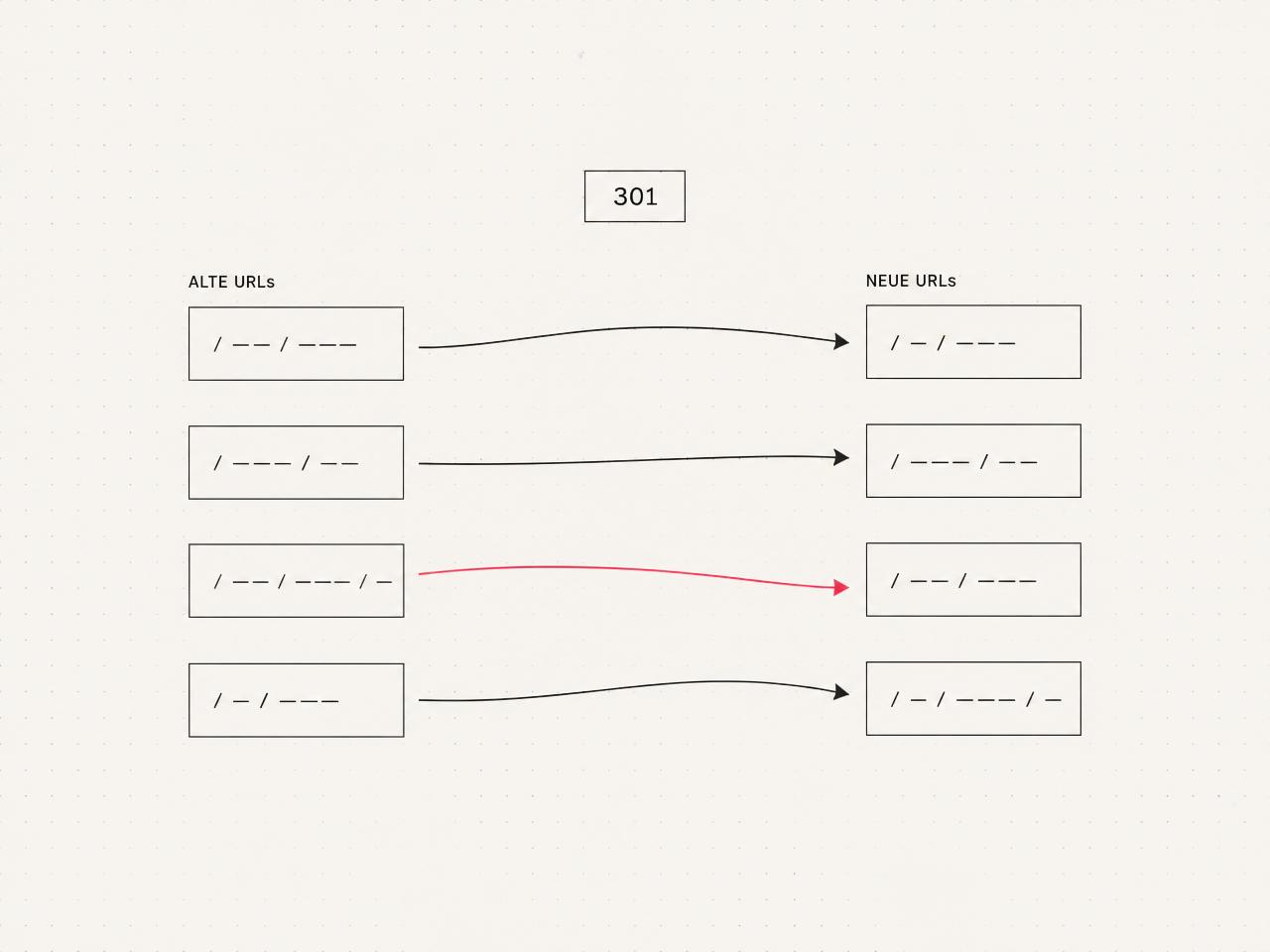
This step is critical, especially for sites that already rank on Google or are very large. If the URL structure changes, old addresses must redirect correctly to new pages.
We check every URL, compare sitemaps and implement targeted 301 redirects. This preserves the authority built up by existing pages and prevents visitors from landing on 404 pages. We have seen severe drops in many client projects because this work was underestimated. That must not happen.
| Risk | Consequence | Our measure |
|---|---|---|
| URLs not redirected | Loss of rankings and traffic | 301 redirect matrix before launch |
| Content missing from new pages | Indexing gaps | Content mapping and 1:1 transfer |
| Metadata lost | Drop in CTR | Check SEO export and import |
| Broken internal links | Reduced crawlability | Link check after migration |
| Redirect chains | Wasted crawl budget | Direct destination instead of a chain |
| Images migrated without alt text | Loss of visibility in Google Images and reduced accessibility | Check alt text during migration |
As a rule of thumb: every old URL should have either a relevant new URL with a 301 redirect or a deliberate 410 status. Nothing is left to lead nowhere by accident.
/sitemap.xml on both the new and old domains. A properly maintained sitemap lets you see all indexed routes at a glance and create the 301 redirect matrix in minutes rather than hours. This requires a dynamically generated sitemap that genuinely includes all relevant URLs, including blog, product and landing pages.10. Accessibility: BFSG as a requirement, not a bonus
Since 28. Juni 2025, many websites in Germany have been required to be accessible under the Barrierefreiheitsstärkungsgesetz (BFSG). A relaunch is the best time to implement this properly, rather than make expensive changes later.
Key checkpoints:
- Colour contrast in line with WCAG 2.2 AA (at least 4,5:1 for body text).
- Keyboard accessibility: All interactive elements accessible without a mouse.
- Semantic HTML: Landmarks, heading hierarchy, correct form labels.
- Alt text for all images relevant to the content.
- Visible, consistent focus states.
- Videos with subtitles, complex content with text alternatives.
Accessibility is not just about compliance; it also matters for SEO. Google rates well-structured, semantically correct pages more highly, and AI search systems extract content more reliably.
11. GEO and AI search: Visibility in ChatGPT, Perplexity and Google AI Overviews
Traditional SEO is no longer enough. More and more users search directly in AI systems that summarise answers from websites. If you do not address this during your relaunch, you will remain invisible in this new search environment.
Practical measures we consider in every relaunch:
- Direct answers in the first 100 words of every page.
- Short-answer boxes and definitions as standalone blocks.
- FAQ sections with structured data using FAQPage schema.
- Visible authorship and E-E-A-T signals on every post.
- llms.txt or similar controls for AI crawlers.
- Clear topic clusters rather than disconnected individual pages.
Ignoring these points means missing out on precisely the visibility that will matter in the coming years.
A relaunch is a chance to improve everything, but only if you really understand the old site first. Ignore what you already know about it, and you can quickly end up rebuilding the same problems.
12. Launch: As little downtime as possible
For clients, launch is often the most exciting moment. We make sure it runs smoothly: technical testing, DNS switchover, SSL certificate and a final content review before going live.
Launch-day checklist
- Backup of the old site and database created.
- DNS TTL set to a low value 24 hours before launch.
- SSL certificate configured and tested on the new hosting.
- Redirect matrix live and verified through spot checks.
- XML sitemap submitted to Google Search Console.
- Analytics and Tag Manager checked on the new site.
- Contact forms, payment flows and external integrations tested live.
- 404 monitoring enabled.
A lot can go wrong at this stage: hosting changes, failed deployments or third-party system outages. That is why we are on hand as your technical contact and respond immediately if anything unexpected happens.
13. After launch: Ongoing support, not abandonment
We do not disappear after launch. Many errors only emerge in the first few days and weeks: display issues on certain devices, slow page loading or search engine indexing problems. We stay involved and resolve these issues.
Typical monitoring points in the first 90 days:
- Search Console: Crawl errors, coverage, lost keywords.
- 404 logs: New dead links from external references.
- Core Web Vitals in the field: Real-world data from the CrUX report.
- Conversion paths: Form completions, CTA clicks, drop-offs.
- Rankings: Comparison of weeks 1, 4 and 12 against the baseline.
For long-term peace of mind, choose a maintenance or SEO package. This lets us keep your site technically healthy while also targeting visibility in AI search, with GEO-optimised content and a structured data foundation.
14. The most common website relaunch mistakes
Even with the best intentions, relaunches repeatedly fall into the same traps. If you take away just one section of this checklist, make it this one.
- No SEO audit before concept development, resulting in the loss of ranking URLs.
- Content last rather than first, resulting in a launch with half-finished pages.
- Redirect chains instead of clean 1-to-1 redirects.
- Design before structure, resulting in attractive pages without clear user journeys.
- No staging environment, with development carried out directly on the live system.
- No content freeze: Editors change content during migration.
- No post-launch monitoring, leaving gradual traffic losses unnoticed.
- Accessibility treated as a retrofit rather than considered from the start.
15. Master website relaunch checklist: The complete overview
This table brings together all the tasks involved in a professional website relaunch in one overview. Use it as a working document from the initial audit through to 90 days after launch.
| # | Phase | Task | Responsible | Critical for |
|---|---|---|---|---|
| 1 | Audit | Initial SEO audit (rankings, top pages, backlinks) | SEO | Preserving rankings |
| 2 | Audit | Content inventory of all URLs (Screaming Frog) | SEO / Editorial | Redirect matrix |
| 3 | Audit | Analyse backlink profile (e.g. Semrush, Ahrefs) | SEO | Preserving authority |
| 4 | Audit | Core Web Vitals baseline (LCP, INP, CLS) | Development | Performance targets |
| 5 | Audit | Gather backend and editorial pain points | Client | CMS selection |
| 6 | Audit | Accessibility check (WCAG 2.2 AA) | Design / Dev | BFSG compliance |
| 7 | Strategy | Define measurable relaunch goals | Client / PM | Measuring success |
| 8 | Strategy | Update personas and user journeys | UX / Marketing | User journeys |
| 9 | Strategy | Define keyword strategy and topic clusters | SEO / Content | Visibility |
| 10 | Strategy | Finalise budget and timeline | Client / PM | Project management |
| 11 | Concept | New information architecture (sitemap plan) | UX / SEO | SEO structure |
| 12 | Concept | URL strategy with redirect mapping (old → new) | SEO | Preserving rankings |
| 13 | Concept | Wireframes for core templates | UX | User journeys |
| 14 | Concept | Clickable prototype with client approval | Design / UX | Error prevention |
| 15 | Design | Visual design and design system | Design | Brand consistency |
| 16 | Design | Contrast and accessibility check of the design | Design | BFSG compliance |
| 17 | Content | Content migration and copy revision | Editorial | SEO / User value |
| 18 | Content | Rewrite meta titles and descriptions | SEO / Editorial | CTR |
| 19 | Content | Maintain alt text for all images | Editorial | SEO / A11y |
| 20 | Content | FAQ blocks and short answers per page | Editorial / SEO | AI search |
| 21 | Development | Frontend build (SSR-capable, high-performing) | Development | Core Web Vitals |
| 22 | Development | CMS setup and editorial training | Development / PM | Maintainability |
| 23 | Development | Forms, payments and third-party integrations | Development | Conversion |
| 24 | Development | Cookie banner and consent management | Development / Legal | GDPR |
| 25 | Development | Structured data (Organization, Product, FAQ, Article) | SEO / Dev | Rich results |
| 26 | Development | Image optimisation (AVIF/WebP, lazy loading) | Development | Load time |
| 27 | SEO | Generate and maintain XML sitemap | Development / SEO | Indexing |
| 28 | SEO | Check robots.txt and canonicals | SEO | Crawl budget |
| 29 | SEO | Set up server-level 301 redirects | Development | Preserving rankings |
| 30 | SEO | Internal linking to revenue-driving pages | SEO / Editorial | Visibility |
| 31 | SEO | hreflang for multilingual sites | SEO / Dev | Country-specific rankings |
| 32 | SEO | llms.txt and AI crawler controls | SEO / Dev | GEO visibility |
| 33 | Testing | Staging tests of all templates across all devices | QA | Error-free operation |
| 34 | Testing | Lighthouse and PageSpeed checks of core pages | Development | Performance |
| 35 | Testing | Accessibility testing (screen reader, keyboard) | QA / A11y | BFSG compliance |
| 36 | Testing | Cross-browser and mobile testing | QA | User experience |
| 37 | Testing | Redirect spot checks from top-100 URLs | SEO | Ranking protection |
| 38 | Testing | Analytics and Tag Manager debugging | Analytics | Data quality |
| 39 | Launch | Reduce DNS TTL in good time | Development | Downtime |
| 40 | Launch | Secure backup of old site and database | Development | Emergency rollback |
| 41 | Launch | SSL certificate active on new host | Development | Security |
| 42 | Launch | Submit sitemap to Google Search Console | SEO | Indexing |
| 43 | Launch | Enable 404 monitoring | SEO / Dev | Traffic protection |
| 44 | Launch | Change of address in GSC (if changing domain) | SEO | Ranking transfer |
| 45 | Launch | Test all forms live | QA | Conversion |
| 46 | Post-launch | Monitor Core Web Vitals using CrUX field data | Development | Performance |
| 47 | Post-launch | Ranking comparison in weeks 1, 4 and 12 | SEO | Success tracking |
| 48 | Post-launch | Identify lost keywords and improve content accordingly | SEO / Editorial | Visibility |
| 49 | Post-launch | Request updates to external backlinks pointing to dead destinations | SEO | Authority |
| 50 | Post-launch | Set up maintenance and SEO retainers | PM / Client | Long-term continuity |
Frequently asked questions
What is a website relaunch?+
When does a website relaunch make sense?+
What does a website relaunch cost?+
How long does a website relaunch take?+
How often should you relaunch a website?+
Can I preserve my SEO rankings during a relaunch?+
What is redirect management during a relaunch?+
What happens after launch?+
Does my website have to be accessible under the BFSG?+
How do I prepare my website for AI search?+
Do I need to change hosting provider when relaunching?+

Josef leads the strategic and creative development of brands at Maluure. For over a decade, he has guided medium-sized businesses from brand positioning to digital delivery.
Managing Director of Maluure GmbH, Cologne. Specialising in corporate design, brand strategy and digital brand experiences.
Weiterlesen

Using a corporate film on social media: twelve weeks of content from one shoot day
A corporate film is not a one-off asset, but a bank of source material. How to turn one shoot into formats for LinkedIn, Instagram, your website and sales, with an editing plan, content calendar and practical example.

Corporate video scripts: storytelling that works in 90 seconds
The script determines whether your corporate video makes an impact or just looks good. Structure, narrative, common mistakes and a shot list that saves the shoot day.

Officially certified: Maluure is a Lovable Partner
Since 16. September 2026, Maluure has been an officially certified Lovable Partner, Expert Website Builder and Expert App Builder. What the certification involves and what it means for your project.
Explore more blog topics
Corporate film or recruitment video: What your company really needs
Both films cost a similar amount but have very different effects. This comparison shows which format suits which goal and how to produce both in a single day of filming.

LinkedIn Video: Formats, Lengths and Best Practices for Businesses
What works for LinkedIn video: formats from 1:1 to 9:16, the right length for each objective, subtitles, hooks and upload strategy. A concise guide for businesses.

Recruitment video: showing employees as they really are
How a recruitment video shows real employees rather than glossy clichés, what it costs and why authenticity brings in more applications.