Web & Design

    A Website for Dental Practices: What Really Matters in 2026

    Which content a dental website needs, how local SEO brings inquiries, and what a practice website really costs.

    of Josef KujawskiUpdated: 13 October 20266 min read1.019 Words
    A Website for Dental Practices: What Really Matters in 2026
    Short answer
    A good website for dentists needs four things: understandable services, real team photos, an easy appointment request and clean local SEO. Studies show that local searchers usually visit a practice within a day. If you cannot be found there, or show an outdated website, you lose inquiries to competitors. The website is not a display case but a working tool that must be maintained.

    What does a website for a dental practice need to do?

    A practice website has one main job: It shows people in your region that there is a team here they can trust with their teeth. For that it needs no effects and no filler phrases, but three things: clear services, real photos, and a way to request an appointment in under a minute. Everything else is secondary.
    Most practices have some kind of website today. Often it dates from the opening phase, was never updated, and therefore barely appears in search. Studies show that most people who search for a local provider visit a business or practice within a day [1]. If you cannot be found then, or your website shows no phone number and no opening hours, you lose inquiries to the practice two streets away.
    Kernaussage
    A practice website is not a display case, it is a working tool. It must generate inquiries, not impressions.

    What content does a dental practice website need?

    The content should answer exactly the questions patients have before their first appointment. In our work with practices and healthcare providers, a compact set that works on just a few pages has proven itself:
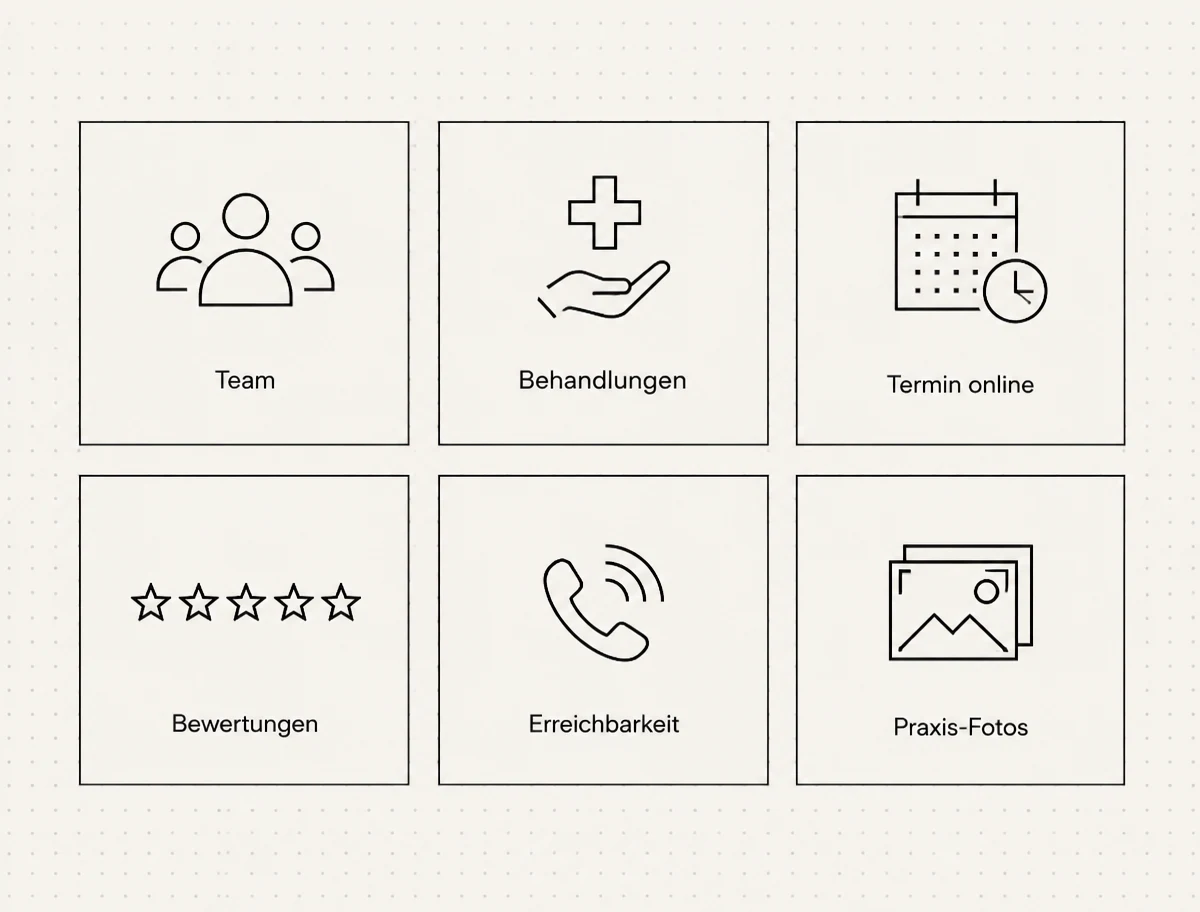
    1. Services with short explanations. Prophylaxis, implantology, tooth preservation, children and anxious patients. Each area explains in three to five sentences what happens and who it is for.
    2. Team page with real photos. People choose practitioners, not buildings. A portrait with a name and a short introduction works better than any stock photo.
    3. Opening hours and contact. Visible on every page, not just in the footer. Emergencies belong there too, with the phone number.
    4. Appointment request. A form or online booking where the patient states their preferred time and concern.
    5. Practice photos. Reception, treatment rooms, exterior. This lowers barriers, especially for anxiety-laden treatments.
    6. Reviews. Quotes from real patients with a source, linked to your Google profile.
    ElementPatient's questionTypical mistake
    ServicesDoes the practice treat my problem?Technical terms without explanation
    TeamCan I trust this person?Stock photos instead of real faces
    AppointmentHow fast can I get a slot?Only a phone number, no form
    DirectionsHow do I find you?Map missing or outdated
    ReviewsHow satisfied are others?Reviews not visible anywhere
    Six building blocks of a dental website: team, treatments, online appointment, reviews, availability, practice photos
    The six building blocks that carry a practice website.

    Why does a practice lose inquiries even though it is good?

    Because the decision happens on the website, not in the treatment. A patient googles "dentist near me", sees five results and opens two. If the first website is hard to read, shows no opening hours, or breaks on mobile, the decision is made in seconds.
    Healthcare is also one of the most heavily searched website topics overall [2]. An outdated website is therefore not a neutral detail but an active disadvantage.

    What is local SEO and why does it matter so much for dentists?

    Local SEO ensures your practice appears when someone searches in your area. Three levers carry most of the weight:
    1. Google Business Profile. Fully completed, with services, photos, opening hours and current replies to reviews. The profile appears above the normal search results.
    2. Website with local context. Address, directions, parking and catchment area clearly named. This helps Google understand where the practice is and whom it serves.
    3. Consistent data. Same name, same address, same phone number everywhere: website, profiles, directories.
    If you want to go deeper, we explain the basics in our article Local SEO explained. Medical practices follow the same logic, we describe it in A website for medical practices.
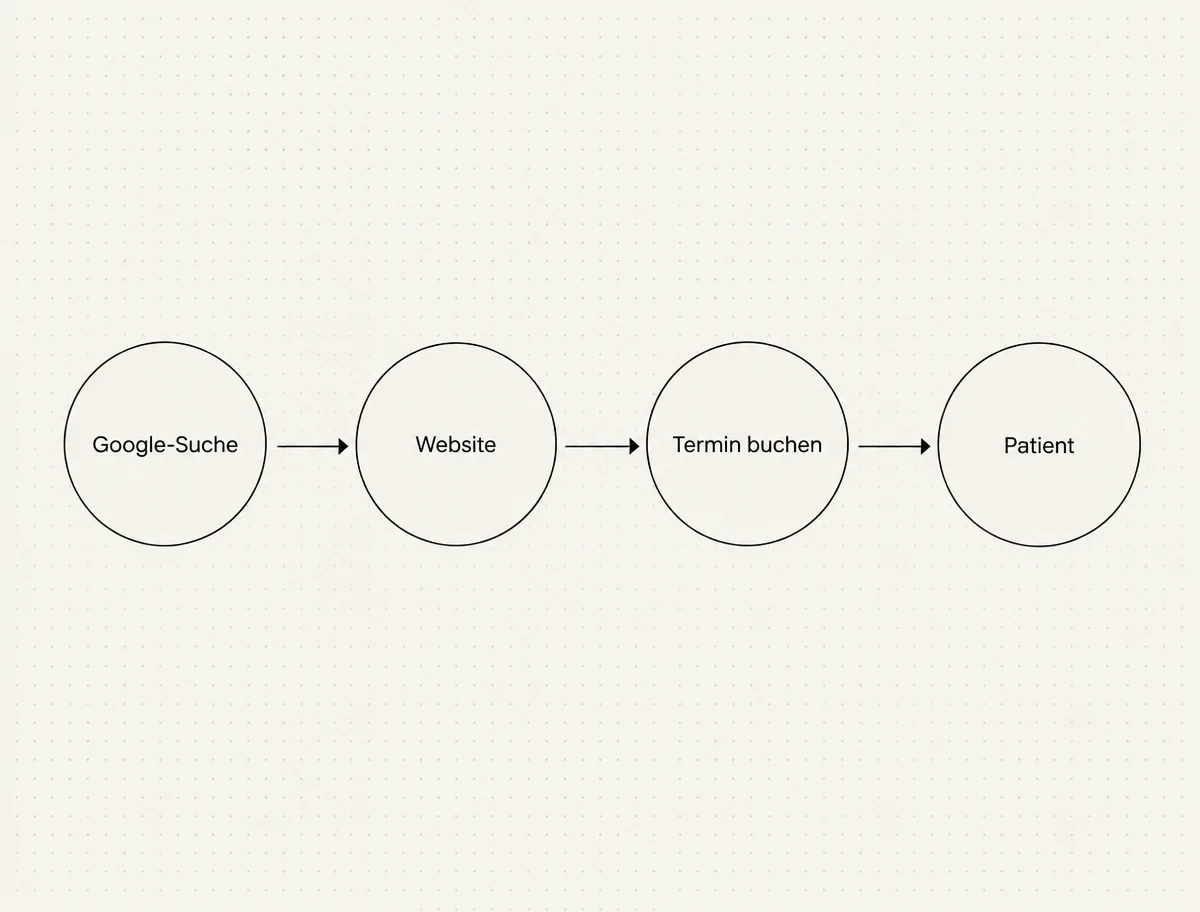
    Four steps of the patient journey: search, Google result, practice website, appointment request
    The path from search term to appointment request.

    How much does a website for a dental practice cost?

    That depends on scope and provider. For an honest orientation without skewed promises, see our article What does a website cost?. What matters less is the initial number and more what happens afterwards: Who updates content, maintains the Google profile and reacts to technical changes? Without maintenance, any website visibly ages within two years.

    Why do practices work with an agency?

    Because the effort is underestimated. Writing texts, planning photos, setting structure, checking privacy and accessibility, maintaining the Google profile: those are five trades a practice can hardly run alongside daily work. An agency that understands healthcare communication delivers that as one package.
    With practices we keep seeing the same mistake: The website explains treatments but not why someone should feel comfortable here. Trust comes from authenticity, not from jargon.
    – Josef Kujawski, Geschäftsführer Maluure

    What makes a good practice website concrete?

    • Mobile first: Most searches come from a phone.
    • Appointment request in one step, without login.
    • Reviews visibly integrated, not hidden.
    • Clear, calm design without effects that distract from content.
    • Updated content: opening hours, team and services match reality.
    Kernaussage
    The best practice website is not one that impresses, but one that never looks outdated.

    How does a practice start without prior knowledge?

    The path is simple but needs structure. First clarify goals: New patients, better utilization of a second treatment room, more prophylaxis appointments? Then collect content: photos, team texts, service descriptions. Only then design and technology, not the other way around. Whoever starts with design ends up with textual gaps that are hard to fill.
    If you plan to renew your practice website, first read our article Having a website built. There we explain how the process and choosing an agency actually work.

    Conclusion: What really matters?

    A dental website wins through clarity, not effects. Services understandable, team real, appointment easy, local SEO clean. Anyone who meets these four points collects inquiries even in a tight competitive environment. Anyone who does not loses them to neighbours who do.
    You want your practice website reviewed or rebuilt? Write us a short note, we will tell you honestly what is worth doing.
    Plan a practice website

    Frequently asked questions

    How much does a website for a dental practice cost?+
    Depending on scope, from a low four-figure sum for a compact practice website to significantly more with online booking and multilingual content. What matters most is the ongoing effort: maintenance and the Google profile need regular care.
    Does a practice website need online booking?+
    Not necessarily, but an appointment request form should exist. Many patients write outside opening hours. What matters is that requests arrive reliably and get answered quickly.
    Which content is essential for dentists?+
    Services with explanations, a team with real photos, opening hours, emergency number, directions, practice photos and reviews. Everything else is optional.
    How important are reviews for a dental practice?+
    Very important. Reviews are often the first thing patients see before clicking. A maintained Google profile with current replies builds trust with new patients.
    What is local SEO for dentists?+
    Local SEO makes the practice visible for searches in the area. The three levers are a complete Google profile, a website with clear local context, and consistent business data.
    How often should a practice website be updated?+
    Check content at least once per quarter: opening hours, team, services and reviews. Technically, the site should be maintained so security and load times stay healthy.
    Can I build the practice website myself?+
    Technically yes, with website builders. The practical effort lies in texts, photos, privacy and upkeep. Many practices hand that to an agency to have it done reliably.
    Are practice websites especially sensitive under privacy law?+
    Yes, health data is specially protected. Forms, cookies and analytics tools must be integrated accordingly, and consent is mandatory.
    How do I find a suitable agency for my practice?+
    Look at references from healthcare and ask how maintenance and Google profile care are billed. Our article on having a website built explains the process.
    Will a new website bring more patients immediately?+
    It creates the prerequisites: visibility in search and trust at the click. Additional patients come when content, Google profile and reviews align and are maintained over time.

    Sources

    1. Google Consumer Insights: Local Search Statistics, Think with Google (2024)
    2. Semrush Keyword Research: Website-Themen Gesundheitswesen, Semrush (2026)

    Want to see our articles more often in Google's Top Stories? Add Maluure as a preferred source.

    Add on Google

    #dentist#webdesign#local-seo#healthcare
    Josef Kujawski
    Author
    Josef Kujawski
    Managing Director & Creative Director at Maluure

    Josef leads the strategic and creative development of brands at Maluure. For over a decade, he has guided medium-sized businesses from brand positioning to digital delivery.

    Managing Director of Maluure GmbH, Cologne. Specialising in corporate design, brand strategy and digital brand experiences.

    Newsletter

    New articles straight to your inbox.

    A newsletter when we genuinely have something new to share. No noise.