What does a website really cost? An honest guide to pricing
Website prices from 699 € to 50.000 € – why the range is so wide, which types of providers are behind it and when each solution is genuinely worth it.
Website prices at a glance
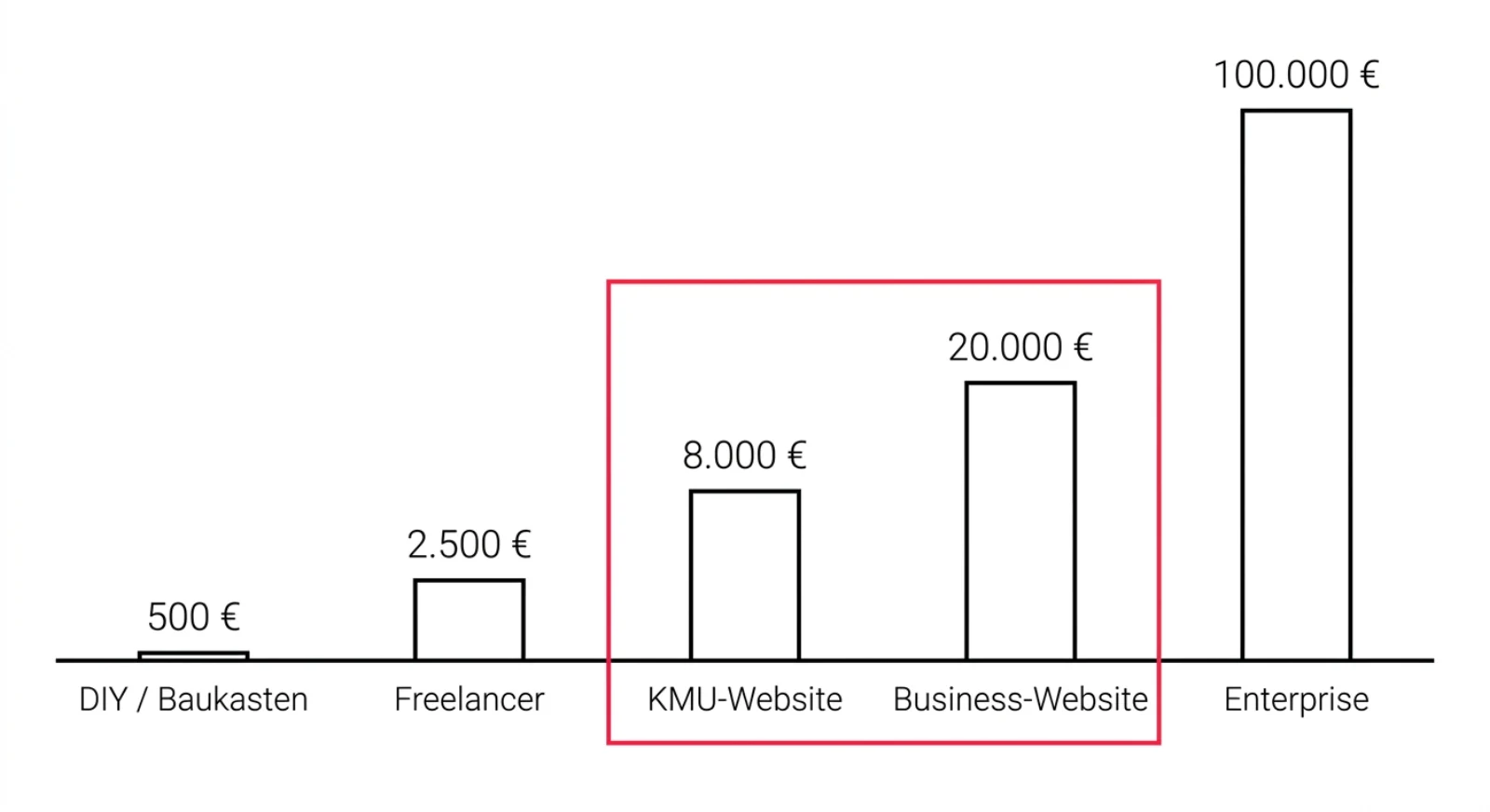
| Price range | What you get | Suitable for |
|---|---|---|
| 0–500 € | Website builder (Wix, Jimdo, WordPress template), do-it-yourself | Hobbies, clubs, very small test projects |
| 500–1.500 € | Lightly customised template, no strategy | Clubs, small side businesses |
| 1.500–8.000 € | Freelancer, bespoke design or sound technical implementation – rarely both | Sole traders, small businesses |
| 8.000–25.000 € | Full-service team: strategy, design, development, SEO, maintenance | SMEs, brands, established B2B providers |
| 25.000–50.000 €+ | Platforms, shops, multiple languages, custom backend | Mid-sized businesses, enterprises, complex portals |
What keeps coming up in Reddit discussions about website prices
In subreddits such as r/webdev, r/selbststaendig and r/kleinunternehmer, a pattern repeats itself: users post quotes ranging from 800 € to 30.000 € for the same requirements and ask why the range is so wide. The most honest answers from the community match our experience: the price almost always comes down to the invisible work – who writes the content, who maintains the site after launch, whether technical SEO is actually implemented or simply ticked off in the quote. Search forums for “website too expensive" and in 80 % of cases you will find projects where precisely these points were missing from the quote.
Why prices vary so much
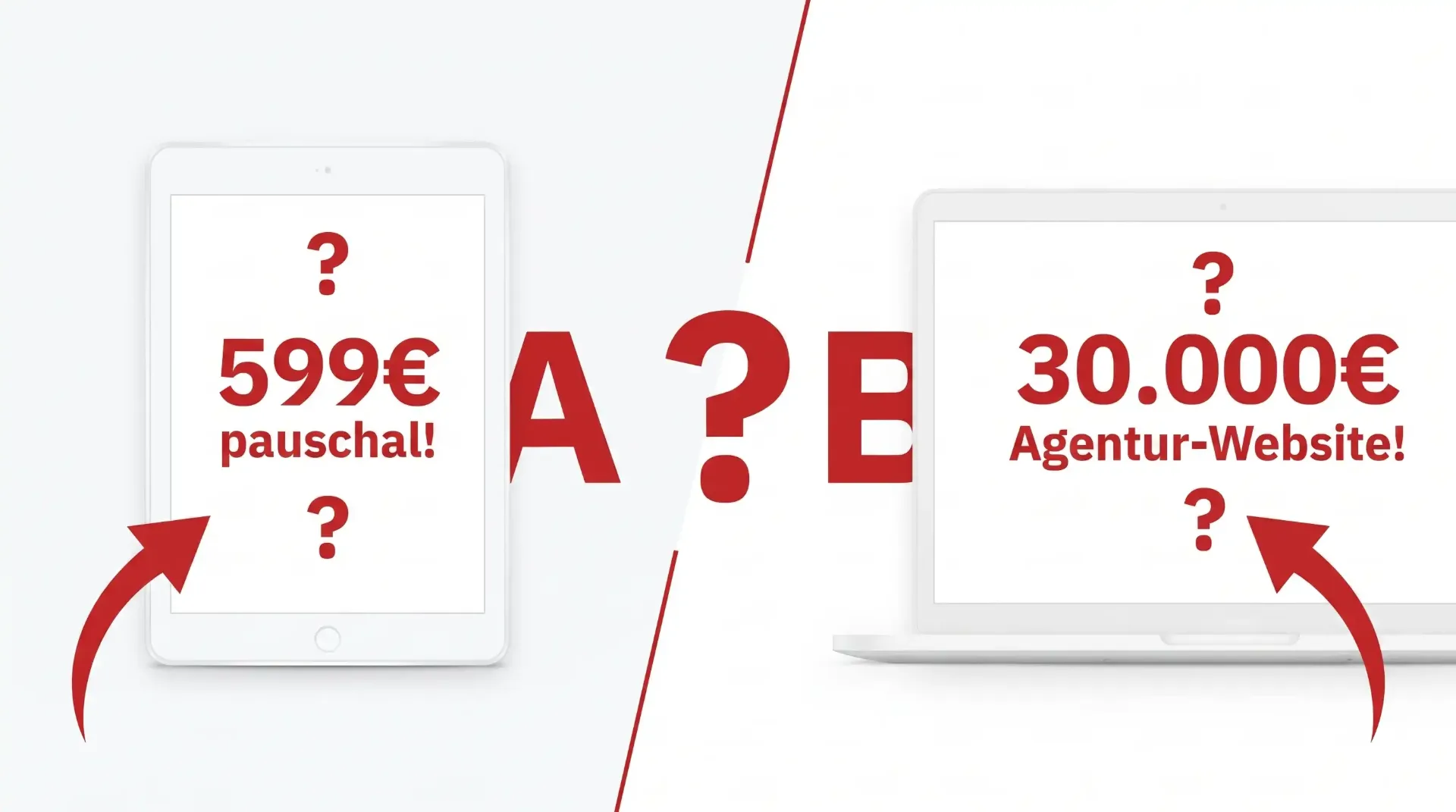
"Website" is not a standardised product. A single-page site built with a website builder for 599 € and a strategically developed business platform for 25.000 € are both called a "website" – but they solve completely different problems.
Before we break down the price brackets and typical provider types, it is worth looking at what every website costs, whether it uses WordPress, Webflow, an AI website builder or a Maluure-Page:
- Domain & hosting – ongoing, usually 10–50 € per month
- Technical foundations – framework, deployment, backups
- Content – copy, images, videos, often seriously underestimated
- Maintenance & updates – plugins, security vulnerabilities, adjustments
- Analytics & SEO – no optimisation without measurement; realistic budgets are covered in SEO costs
If these five points are not clearly included in your quote, you will pay for them twice later. Fixed-price websites shows what a genuine fixed price with a complete scope looks like.
What makes up the price of a website?
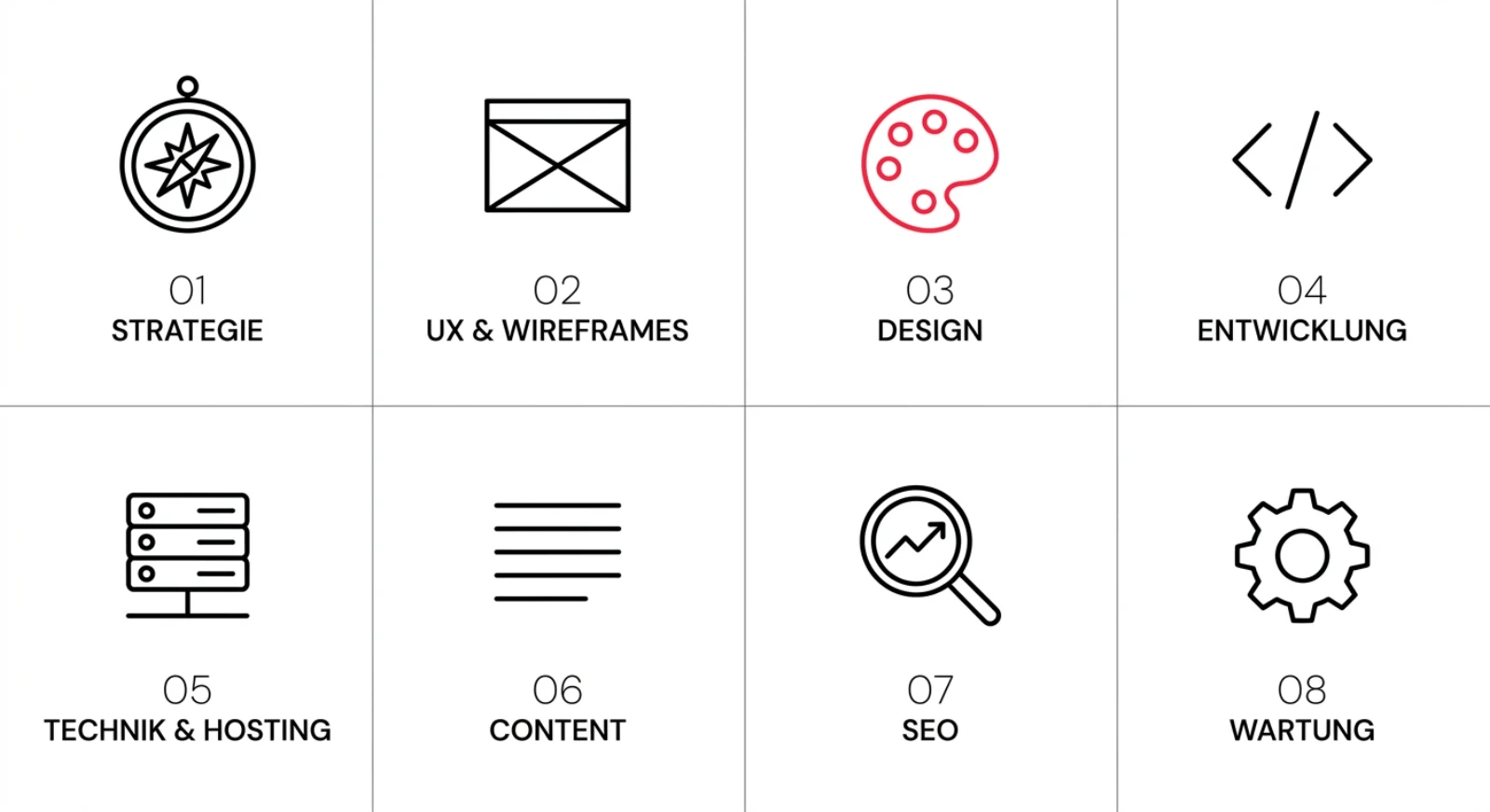
To understand why having a website built costs between 500 € and 50.000 €, it helps to break the price down into its individual components. Every properly planned website includes these eight items – whether explicitly or implicitly:
Strategy & positioning – 500–5.000 €
Who is your target audience, what are you really selling, and how do you stand out from the competition? Without answers, you end up with an attractive but interchangeable website. Freelancers usually skip this step entirely. Agency, freelancer or website builder explains which type of provider suits you. Agencies invest 500–5.000 € here before drawing the first line.
UX & concept – 500–4.000 €
Wireframes, user journeys, information architecture. This determines whether visitors get in touch or leave. Often confused with "design", but a discipline in its own right.
Design – 1.500–10.000 €
The visual elements: layout, typography, colours, imagery, animations. Free with a template, easily 3.000–10.000 € for a bespoke brand design.
Development & implementation – 2.000–20.000 €
The technical implementation of the design. WordPress, Webflow, a headless setup or a proprietary system such as Maluure-Page™. Price differences come down to complexity, custom features and performance requirements.
Technology, hosting & deployment – 100–1.000 € one-off, 10–200 € monthly
Domain, hosting, SSL, backups, deployment pipeline, monitoring. Included but limited with website builders; modular and scalable with professional setups.
Content – 500–10.000 €
Copy, images, videos. The most frequently underestimated item. Free if you write it yourself – but rarely good. A copywriter for an SME website: 1.500–6.000 €. Photo shoot: from 1.000 €.
SEO foundations – 500–3.000 €
Technical foundations: well-structured metadata, sitemap.xml, robots.txt, structured data, loading speed, mobile optimisation. Without these foundations, no website ranks – however good it looks.
Maintenance & support – 50–400 € monthly
Security updates, plugin updates, backups, minor adjustments. Cut this cost and you will pay many times more when the first outage or hack happens.
Bracket 1 – Typical market price categories
If you research website costs online, you will find roughly three price tiers. All three are legitimate – but they deliver completely different results.
Flat-rate offers: "Website from 599 €"
A Google Ads classic: "Your professional website from 599 €". What is behind it:
- Pre-built templates with minimal customisation
- No strategy, no real positioning
- Little understanding of what you want to achieve with your customers
- Often weak technical foundations with limited scope for future development
- No considered SEO, no content structure
- Every subsequent change becomes cumbersome and expensive

That is enough for a club's basic online presence. For a business that actually wants to grow online, it is a foundation you will have to tear down again in 12–24 months.
Freelancers in the 1.500–10.000 € range
That is already a huge range. Why? Because "freelancer" can mean anything: a design student working part-time, a seasoned professional with 15 years of experience, a former agency employee with their own studio. The price range reflects the person more than the product.
Typical hourly rates in Germany in 2026 as a guide: web designers 60–120 € per hour, web developers 80–150 € per hour, specialist senior freelancers 120–180 € per hour.
The real problem: one person rarely covers every discipline a good website needs (see Bracket 2). Whatever is missing gets patched in – or simply left out.
In our experience, there are excellent freelancers on the market – talented designers, smart strategists and developers. But finding the right talent for the right job during an ongoing project is often difficult on a limited project budget. That is why we recommend agile, well-established agency teams such as the team at Maluure GmbH.
Agencies from 10.000 €
"Why so expensive? Are they just taking my money?" A fair question. The honest answer: it depends on the agency. What you can expect from an agency in this price bracket:
- A team of several specialists
- Strategic groundwork (positioning, target audience, competition)
- Design that fits the brand
- Technically sound, maintainable implementation
- SEO, analytics, support after launch
Whether an agency actually delivers this is clear from its previous work and how it talks about the process – not from the price alone.
Bracket 2 – The six types of website service providers
Price differences among freelancers and smaller providers usually arise because each comes from a different professional background. They all claim to "build websites" – but each only covers part of the work really well and tries to hide the rest as best they can. Here are the six types in detail, so you can recognise them straight away when discussing a quote.

The designer
Quick definition: A web designer is a visual specialist who primarily sees a website as a design object – layout, typography, colour, motion.
Typical strengths: Strong visual imagination, a good eye for typography and whitespace, a fine sense of animation and modern design trends. Portfolios look like Awwwards submissions.
Typical weaknesses: Technology and performance are often afterthoughts. Loading times suffer under animations and large assets. SEO is rarely considered. After launch, maintainability deteriorates: minor changes cause unexpected bugs because the structure is poorly built.
Signs to look for in a proposal: Talks almost exclusively about look & feel. Shows moodboards, but no sitemap. Mentions frameworks such as Framer or Figma – but not how the site will be deployed and maintained.
Typical price range: 2.500–8.000 € for a marketing site.
Best suited to: Portfolios, short campaign landing pages, design-led brands without complex requirements.
Warning signs: "Maintenance? Google Analytics already takes care of that" or "We'll do SEO later".

The developer
Quick definition: A web developer is a technical specialist who sees a website as software – clean code, high-performance systems, reliable deployments.
Typical strengths: Robust technology, good loading speeds, maintainable structure, clean API integrations, secure deployments, scalability.
Typical weaknesses: Design often looks like 2014 – functional, but with no brand expression. Positioning, target audience and content strategy are not considered. The result: the site works perfectly from a technical perspective, but sells nothing.
Signs to look for in a proposal: Talks about the stack, framework, hosting and CI/CD. Shows GitHub repositories rather than screenshots of past work. Rarely asks about the target audience or brand.
Typical price range: 3.000–12.000 €, hourly rate usually 80–150 €.
Best suited to: Internal tools, technical platforms, clearly specified builds with an existing design.
Warning signs: "You're supplying the design, right?" or "Content isn't my job".

The strategist
Quick definition: A strategist is a brand or marketing specialist who defines positioning, target audiences and communication with absolute clarity – the website is simply a medium for expressing them.
Typical strengths: Positioning, competitor analysis, messaging, wording, communication architecture. After a project, the brand is sharper, clearer and more recognisable.
Typical weaknesses: Design and development are outsourced – often without real quality control. The website rarely looks as good as the strategy behind it, and the technical implementation often becomes a patchwork.
Signs to look for in a proposal: Brings a workshop plan. Talks about brand, purpose, target audiences, positioning. Shows case studies with lots of text-heavy slides.
Typical price range: 4.000–15.000 € (strategy + outsourced implementation).
Best suited to: Brands preparing for a rebrand, businesses without clear positioning.
Warning signs: "I'll pass the implementation to someone in my network" – without specific, verifiable examples of their work.

The technician
Quick definition: A technician is a systems or CMS specialist with a fixed toolkit they have perfected over many years – usually TYPO3, WordPress or a proprietary system.
Typical strengths: Very deep knowledge of their chosen system. Reliable implementation of standard requirements. Predictable maintenance – as long as you stay within the system.
Typical weaknesses: Always recommends their own system, whether it fits or not. Design and brand are secondary, often template-led. New technologies (headless, static sites, modern frontends) are rejected out of hand.
Signs to look for in a proposal: Offers a flat-rate price after a short phone call. Talks more about plugins and versions than about your customers. Warns against anything newer than their own setup.
Typical price range: 3.500–15.000 €, often with a long-term maintenance contract.
Best suited to: Highly technical edge cases, conventional WordPress projects with many standard plugins.
Warning signs: "Webflow is a toy" or "You don't need React for a website" – without genuinely considering your project.

The high performer
Quick definition: A high performer is a performance marketer and funnel builder who sees the website purely as a conversion machine.
Typical strengths: Clear conversion logic, well-built funnels, A/B testing, tracking setup, ad integration. Often measurably effective for direct-response projects.
Typical weaknesses: No feel for the brand. Sites look like scam landing pages – loud buttons, big numbers, endless testimonial blocks. For premium brands, consultancies or trade businesses, this often destroys trust.
Signs to look for in a proposal: Talks in terms of "funnels", "conversion", "CPL", "ROAS". Immediately sends wireframes with a series of CTA buttons. Shows screenshots of sales pages, not brand websites.
Typical price range: 3.000–15.000 € plus ongoing ad management.
Best suited to: Information products, courses, traditional performance marketing niches.
Warning signs: "Brand is nice to have; leads are what matter" or a website that looks as though you have already seen it 200 times on Instagram.

The jack of all trades
Quick definition: An all-round freelancer who covers a little of every role above – usually the most pragmatic freelance option.
Typical strengths: One point of contact, a manageable budget, often experienced in several disciplines. Can be a sensible compromise for smaller projects.
Typical weaknesses: A little depth is missing everywhere. Design is fine, but not outstanding. The technology works, but is rarely truly modern or high-performing. Strategy remains superficial.
Signs to look for in a proposal: Promises "everything from one source". Past work looks inconsistent – every project looks different, but none is particularly strong.
Typical price range: 2.500–10.000 €.
Best suited to: Small projects with limited budgets, start-ups before their first growth phase.
Warning signs: No clear common thread across past work.
The only two solutions
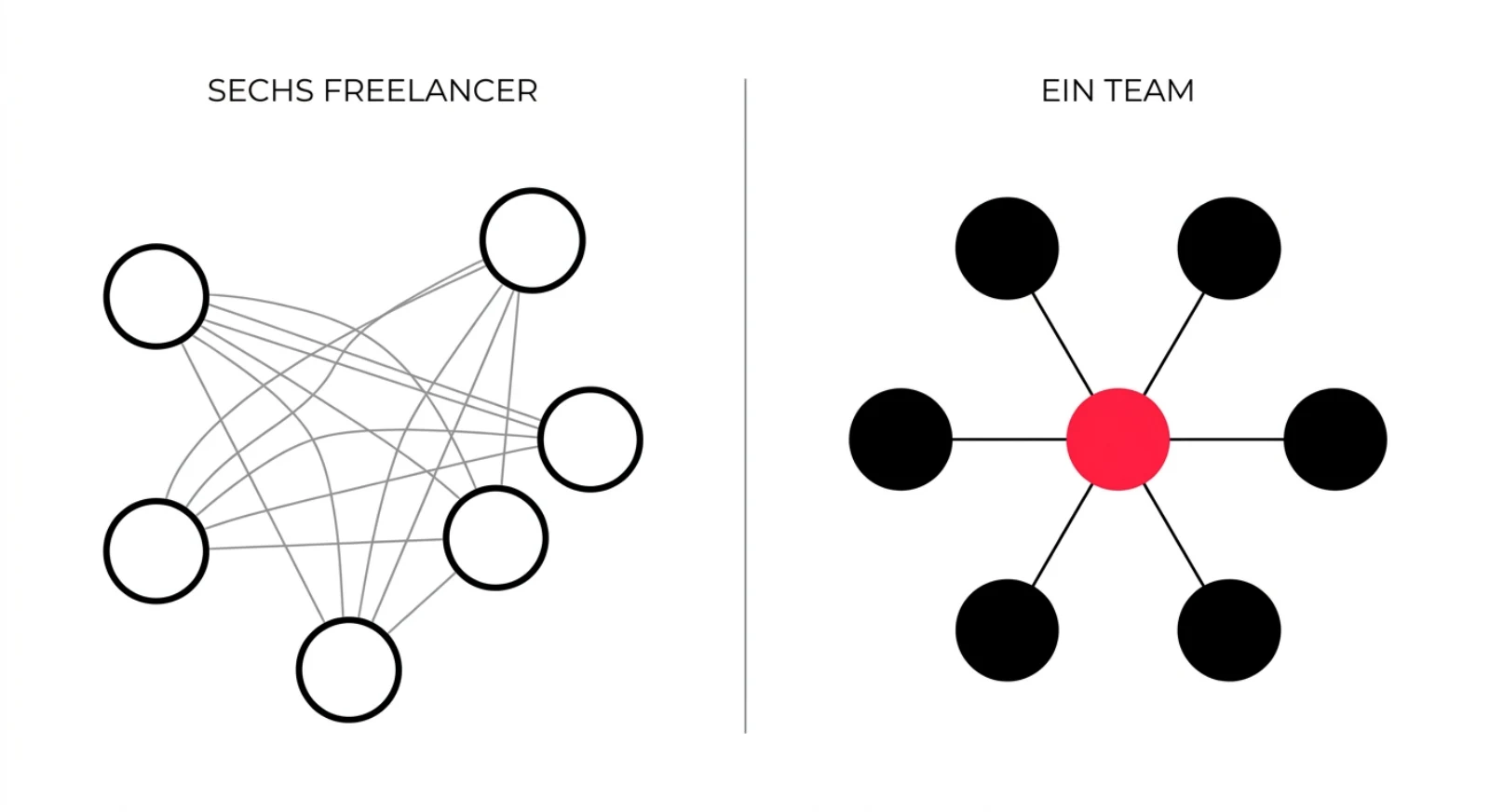
If you want your website to genuinely cover strategy, design, technology, performance and maintenance, there are exactly two ways to do it.
Coordinate a team of specialists yourself
You individually find:
- a strategist for positioning
- an excellent designer
- a developer who understands the design and implements it properly
- a technician who supports the project long term
- a high performer for marketing and funnels
- and a project management prodigy to coordinate everything
This can work. The honest questions are: do you understand good design well enough to identify the right designer? Do you know whether TYPO3, WordPress, Webflow or a Maluure-Page™ is better suited to your project? Can you judge whether the handover between design and development runs smoothly?
Usually: probably not. And that is exactly where it gets expensive.
A full-service done-for-you website agency
The second route: a team built around precisely these roles. All the specialists have already been sourced, work well together and regularly deliver results of a consistent quality. You have one point of contact, one quote, one outcome.
How do you recognise credible website proposals?
Use this checklist before signing. A credible proposal meets at least six of these eight criteria:
- It lists strategy, design, development, technology, SEO and maintenance as separate items.
- The provider asks about your target audience before quoting a price.
- It shows consistently high-quality past work (not one highlight and a string of makeshift solutions).
- It makes clear statements about loading speed, mobile optimisation and SEO foundations.
- It explains who handles maintenance after launch and what it costs.
- It specifies a fixed price or a transparent cost breakdown – not just "from X €".
- It explains which system (WordPress, Webflow, custom) will be used and why that particular system suits your project.
- It gives you a specific schedule with milestones, not just "3 months".
How much does a website cost in Germany in 2026?
Realistic prices by project type:
| Project type | One-off investment | Ongoing (monthly) |
|---|---|---|
| Template-based single-page site | 500–2.000 € | 20–50 € |
| Bespoke single-page site | 2.500–6.000 € | 50–150 € |
| SME website (5–10 pages) | 6.000–15.000 € | 100–300 € |
| Professional business website | 12.000–25.000 € | 200–400 € |
| Multilingual platform | 20.000–40.000 € | 300–600 € |
| E-commerce shop (Shopify / custom) | 8.000–60.000 € | 150–800 € |
| Enterprise platform | 40.000–150.000 €+ | from 800 € |
These figures come from our own project experience with mid-sized clients in Cologne and the German-speaking market – and align with the market prices of other reputable full-service agencies.
Our example: Maluure-Page™
To finally give the question "What will my website cost?" a clear answer, we developed our own fixed-price system with Maluure-Page™. It includes:
- Strategy – positioning, target audiences, competitor analysis
- Design – on-brand, editorial, carefully considered for desktop and mobile
- Development – high-performance implementation on a modern stack
- Technology & hosting – deployment, backups, monitoring
- SEO foundations – clean structure, metadata, sitemap.xml, robots.txt
- Maintenance – clear, predictable monthly support
No "depending on the work involved". No costs spiralling later. One price, one outcome, one team.
Conclusion
Website prices are not arbitrary. They reflect how honestly a provider considers the whole system: strategy, design, development, technology, maintenance. When you know which of these six roles your provider genuinely covers and which they only pretend to, you can assess their price.
The quickest shortcut: choose a provider with all the roles under one roof – and a fixed price before you sign.
Costs specific to Webflow projects
If your project is specifically intended to run on Webflow, you can find the system-specific cost breakdown, including licence and hosting costs, here: What does a Webflow website cost? Pricing and cost breakdown.
Frequently asked questions
What does a website cost in Germany in 2026?+
What does a website cost at an agency?+
What does a professional website cost?+
What does it cost to have a website built?+
What does a website cost per month?+
What does a WordPress website cost?+
What does a simple website cost?+
How much does a web designer cost?+
What is the difference between a web designer and a web developer?+
Why is an agency more expensive than a freelancer?+
What does a landing page cost?+
How long does it take to build a website?+
Why is a website more expensive than a website builder?+

Josef leads the strategic and creative development of brands at Maluure. For over a decade, he has guided medium-sized businesses from brand positioning to digital delivery.
Managing Director of Maluure GmbH, Cologne. Specialising in corporate design, brand strategy and digital brand experiences.
Weiterlesen
Using a corporate film on social media: twelve weeks of content from one shoot day
A corporate film is not a one-off asset, but a bank of source material. How to turn one shoot into formats for LinkedIn, Instagram, your website and sales, with an editing plan, content calendar and practical example.
Corporate video scripts: storytelling that works in 90 seconds
The script determines whether your corporate video makes an impact or just looks good. Structure, narrative, common mistakes and a shot list that saves the shoot day.

Officially certified: Maluure is a Lovable Partner
Since 16. September 2026, Maluure has been an officially certified Lovable Partner, Expert Website Builder and Expert App Builder. What the certification involves and what it means for your project.
Explore more blog topics
Corporate film or recruitment video: What your company really needs
Both films cost a similar amount but have very different effects. This comparison shows which format suits which goal and how to produce both in a single day of filming.
LinkedIn Video: Formats, Lengths and Best Practices for Businesses
What works for LinkedIn video: formats from 1:1 to 9:16, the right length for each objective, subtitles, hooks and upload strategy. A concise guide for businesses.
Recruitment video: showing employees as they really are
How a recruitment video shows real employees rather than glossy clichés, what it costs and why authenticity brings in more applications.