Fixed-price websites: When they really work and when you risk miscalculating
A fixed-price website sounds reassuring. In reality, everything depends on which essentials the base package covers. We explain when a fixed price is fair and how to tell.
“Fixed-price website" is one of the most searched terms when businesses want a new website. The promise is understandable: one price, one scope, no surprises. In practice, this very desire for predictability is also where many projects fail, because the fixed price turns out not to be fixed at all, or the result lacks the substance it needs to work effectively.
At Maluure GmbH in Cologne, we have been building websites for small and medium-sized businesses for years, and we deliberately designed our website product Maluure-Page™ around a genuine fixed price. Drawing on that experience, we explain when a fixed-price website really offers fair value, where problems start and how to distinguish credible offers from bait pricing. For the points small businesses should pay particular attention to, see Web designers for small businesses.
Fixed-price websites: What the promise really means
A fixed price always says two things at once: what you pay and what you get. The two are interdependent; one without the other is worthless. “999 € fixed-price website" without an itemised scope is not a quote, but a marketing signal. “12.500 € fixed price including concept, design, copy, development, GDPR, SEO basics and three months of maintenance" is a quote.
Credible fixed-price quotes always have three characteristics: the scope is broken down into individual items, the process is described (kick-off, concept, design, implementation, go-live), and additions have clear day rates or module prices. Anything else is a price indication with no firm commitment.
A fixed price is only credible if it covers every essential. When I see 990 Euro, my first question is not ‘How cheap?', but ‘What's missing?'.
Where fixed-price offers work well and where they fall apart
Not every website project is equally suited to a fixed price. A small brochure website with a clear purpose can be costed precisely. A portal with a login area, payment integration and user roles almost never can, at least not without a thorough discovery phase. The following overview helps you assess your project.
| Project type | Fixed price suitable | Why |
|---|---|---|
| Standard business website (5–10 pages) | Yes | Scope, structure and technology can be costed clearly. |
| Landing page with a campaign objective | Yes | Narrow scope, defined conversion goal, clear assets. |
| Website with a blog and newsletter | Usually yes | CMS integration, categories and templates are standard. |
| Website with a shop of up to 20 products | With conditions | Only for standard setups (e.g. Shopify integration), otherwise module pricing. |
| Custom web app / portal | No | Process logic, roles and integrations are project-specific. |
| Relaunch with migration and redirects | With conditions | Can only be costed fairly following a URL and content analysis, see Website relaunch. |
Why cheap fixed prices often end up costing more
The most common mistake when comparing fixed-price quotes is looking only at the total. A “complete website package for 990 €" is almost impossible to deliver if it is meant to include concept, design, copy, development, GDPR essentials and at least a sound SEO foundation. There are three typical ways providers make these figures appear to work:
- A template with no customisation. A ready-made theme is populated with your content, without considering your brand, user journey or positioning.
- Extra charges through change requests. The initial scope is deliberately limited. Every additional section, form or privacy adjustment is charged separately.
- Missing essentials. Meta titles, canonicals, Open Graph images, structured data, legal notice, cookie consent, Search Console – often “not included in the scope".
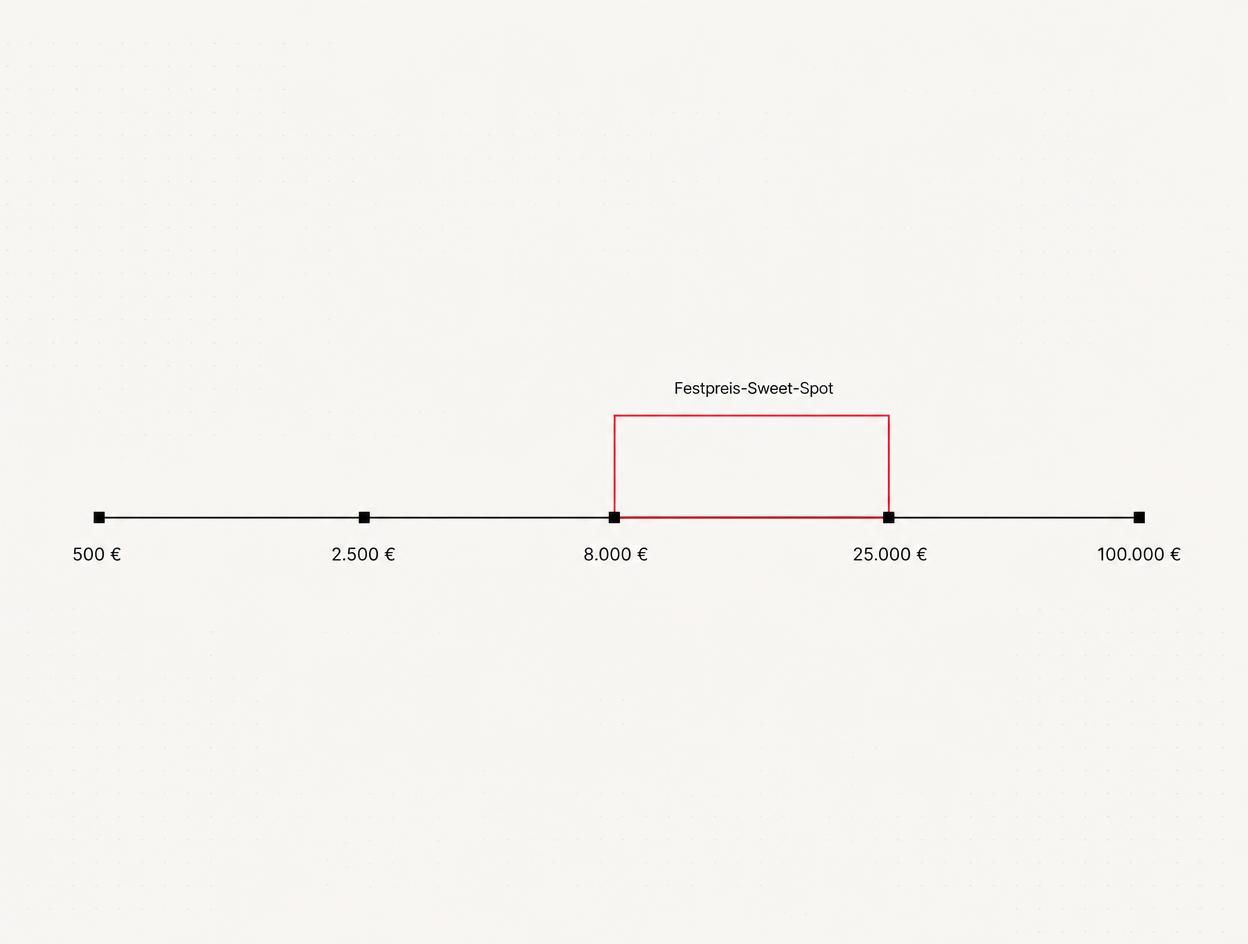
If you compare three quotes and one is dramatically cheaper, the right question is not “Why are the others so expensive?", but “What does this quote leave out?". You can find an overview of realistic price ranges in How much does a website cost. In most cases, the final invoice total is similar. The difference is that the cheap provider gets there through ten extra charges, while the credible provider sets it out in one clear order confirmation.
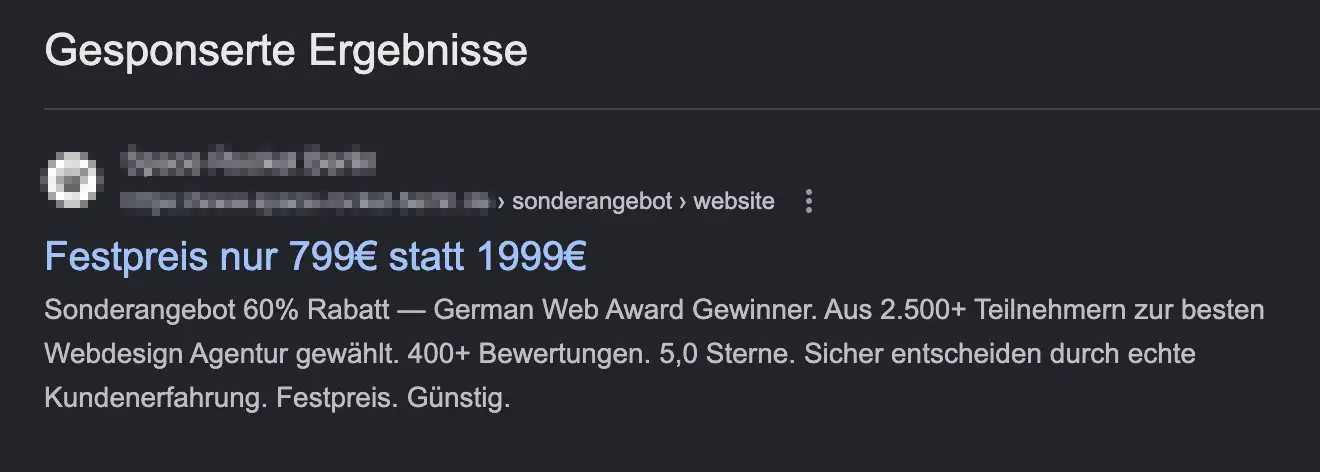
This example from sponsored search results shows the pattern in its purest form: an aggressively low anchor price, a crossed-out comparison price, awards and ratings, but not a word about the actual scope. Anyone who clicks these ads and checks the landing page will generally find limited items such as “up to 5 subpages", “template-based design" or “text to be supplied by the client". The actual website work a business needs to go live is charged through additional packages once the project starts.
The sweet spot: A fixed price covering every essential
In our experience, a genuinely fair fixed website price depends on three conditions. First: the provider has a structured process with clear phases and milestones. Second: the base package contains every essential, so you do not have to piece together a website from modules just to go live. Third: optional extras are priced openly, so you can make an informed decision about whether you need them.
Our Maluure-Page™ is built on exactly this principle. The base price of 3.425 Euro excluding VAT already includes everything a medium-sized business website needs for a professional launch. Additional modules such as advanced animations, multilingual content or a CMS for editors are priced separately and transparently, rather than hidden away.
What a fixed-price website base package must actually include
When assessing a fixed-price quote, the decisive question is not the price, but whether the base service is complete. Over more than a decade of agency work, these items have emerged as the absolute minimum. If any are missing, it is not a fixed price for a website, but a fixed price for a shell.
- Concept and structure: Kick-off workshop, sitemap, copy framework
- Design: Homepage design and subpage layouts based on your brand, not a template
- Copywriting: SEO-ready copy for all standard pages
- Development: Responsive implementation, reliable performance, 404 page, staging environment, go-live
- SEO basics: Technical SEO, Open Graph and social meta tags, Search Console integration
- Legal: Privacy audit, privacy policy, legal notice, cookie consent, SSL
- Operations: Domain and DNS setup, hosting including the initial standard term
- Basic icons and animations for a contemporary look
All these items are included as standard in our Maluure-Page™ base package. When comparing quotes, print this list and tick off what each provider actually delivers. In nine out of ten cases, you will immediately see where the price difference comes from.
Practical example: Schwaben Aesthetic
One example from our own work is the new website for aesthetic surgery practice Schwaben Aesthetic. The client wanted a calm, high-quality website with a clear path to enquiries and appointment bookings, without months of concept development or an open-ended budget. We set the project up as a Maluure-Page™ with a clearly defined fixed-price scope: kick-off, sitemap, bespoke design reflecting the corporate identity, all legal essentials, SEO basics and operations from a single provider.

View the full case study: Schwaben Aesthetic →
Because the quote already covered the full scope, there were no unexpected extra charges. Instead of “how much will this one extra thing cost now", there was an invoice that matched the quote exactly. That is the real value of a fixed price: not the amount, but its reliability.
When a fixed price does not work
As valuable as this model is for standard websites, it is rarely suitable for bespoke digital products. As soon as a project involves its own process logic, roles, integrations or payment flows, a flat fixed price is often a warning sign. In these cases, credible agencies use a short paid discovery phase to establish a fixed implementation price, or price each component separately. Anyone offering you a fixed price for a complex portal without a discovery phase is either building in a substantial contingency or assuming that extra charges will follow anyway.
Conclusion: Yes to a fixed price, but only if it covers every essential
A fixed-price website is not a marketing trick, but a fair model for the vast majority of standard business websites. What matters is not the amount, but completeness. If concept, design, copy, development, SEO basics, legal essentials and operations are already included in the base package, you get a price that remains your price at the end.
If you want to know what a fixed price could look like for your specific project, you can put together a package yourself using our price calculator or request a consultation directly. Both are non-binding, and both show you straight away where your project sits within a realistic investment range.
Frequently asked questions
How much does a fixed-price website cost?+
What must a fixed website price include?+
Is a cheap website for 990 Euro worth it?+
When does a fixed website price not work?+
What is Maluure-Page™?+
How do I recognise a credible fixed-price quote?+
What is the difference between fixed-price and hourly billing?+
Are hosting and maintenance included in the fixed price?+
How long does a fixed-price website take?+
Can I add features later?+

Josef leads the strategic and creative development of brands at Maluure. For over a decade, he has guided medium-sized businesses from brand positioning to digital delivery.
Managing Director of Maluure GmbH, Cologne. Specialising in corporate design, brand strategy and digital brand experiences.
Weiterlesen
Using a corporate film on social media: twelve weeks of content from one shoot day
A corporate film is not a one-off asset, but a bank of source material. How to turn one shoot into formats for LinkedIn, Instagram, your website and sales, with an editing plan, content calendar and practical example.
Corporate video scripts: storytelling that works in 90 seconds
The script determines whether your corporate video makes an impact or just looks good. Structure, narrative, common mistakes and a shot list that saves the shoot day.

Officially certified: Maluure is a Lovable Partner
Since 16. September 2026, Maluure has been an officially certified Lovable Partner, Expert Website Builder and Expert App Builder. What the certification involves and what it means for your project.
Explore more blog topics
Corporate film or recruitment video: What your company really needs
Both films cost a similar amount but have very different effects. This comparison shows which format suits which goal and how to produce both in a single day of filming.

LinkedIn Video: Formats, Lengths and Best Practices for Businesses
What works for LinkedIn video: formats from 1:1 to 9:16, the right length for each objective, subtitles, hooks and upload strategy. A concise guide for businesses.
Recruitment video: showing employees as they really are
How a recruitment video shows real employees rather than glossy clichés, what it costs and why authenticity brings in more applications.