Agency, freelancer or website builder: who should build your website?
Website builder, freelancer or agency? An honest comparison of budget, speed, continuity risk and scalability – with a guide to choosing the right option for your next website project.

The question is not "who is cheaper", but "who carries the risk"
Website builder, freelancer or agency: the three options differ less in what you get on launch day than in what happens afterwards. Who is accountable if the site does not rank? Who can you reach if the contact form stops working? Who considers accessibility, data protection and loading speed when nobody asks about them?
That is why we compare them here not by price, but by four factors: budget, speed, continuity risk and scalability. Use this article as a decision-making guide. You will find specific price ranges in What does a website really cost?, and the full project process in Having a website built.
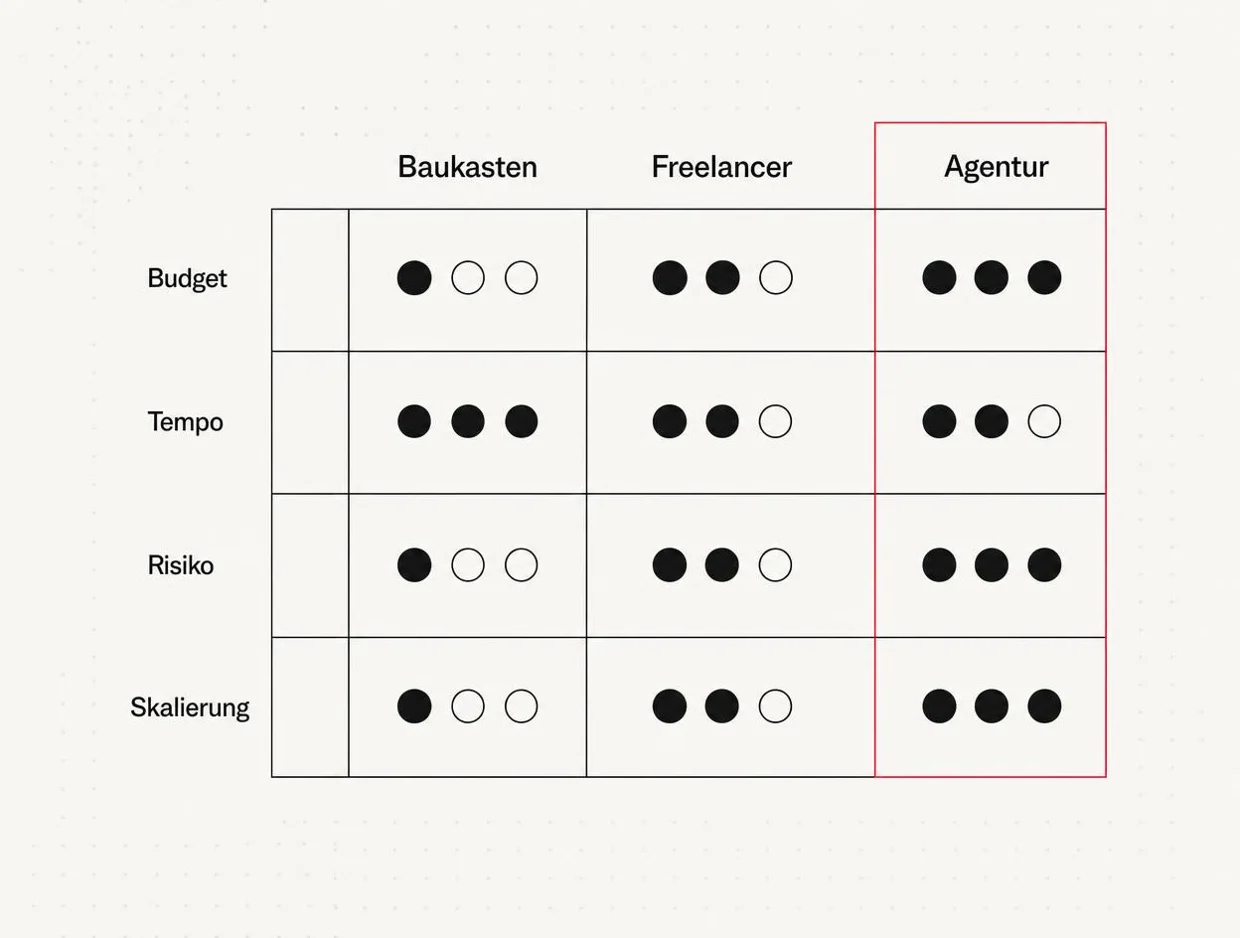
Website builders: fast, predictable, limited
Wix, Squarespace, Jimdo or your hosting provider's website builder can get you online in a few days. You pay a monthly fee, do not need to brief anyone and can change the copy yourself. That is a real advantage when time and budget are tight.
The limitations emerge later: restricted structure beyond 10 to 15 pages, little control over loading speed and semantic HTML, templates already used several times in your industry, and a migration that takes work later because your content is tied to the system. We have a separate article on the technical capabilities of each system: Web design tech stack comparison.
A good fit if: you need an online business card, your business does not depend on the website, and you are willing to maintain everything yourself.
Freelancers: direct, affordable, but reliant on one person
Good freelancers work faster and more affordably than any agency because there are no overheads in the way. You speak directly to the person building the site. For clearly defined projects – a landing page, a redesign using an existing structure, an expanded template – this is often the most efficient solution.
The risk lies in capacity and breadth of expertise. One person rarely covers strategy, copy, design, development, SEO and accessibility at the same time. And everything depends on that one person: holidays, illness or a larger assignment for another client can delay your deadline. If nobody responds after launch, you have a website without support.
A good fit if: the scope is clear, you have someone in-house to manage the project, and you put a maintenance agreement in writing.
Agencies: more expensive upfront, better value over time
An agency brings several disciplines to the table: strategy, design, development, copy, SEO and support. The quote is higher because it explicitly charges for roles that a freelancer either absorbs or leaves out. Is it worth it? Whenever the website needs to generate revenue rather than simply exist.
The second point is continuity. If one person is unavailable, another takes over. There is documentation, a design system and a point of contact with cover. And there is someone who thinks about redirects, Core Web Vitals[1] and accessibility even when the brief does not mention them.
A good fit if: the website needs to generate leads or sales, several stakeholders are involved, or the brand, website and content are being developed together.
The most expensive website is almost never the one with the highest invoice. It is the one that has to be rebuilt after two years because nobody considered structure, ownership rights and future development.
Side-by-side comparison
| Criterion | Website builder | Freelancer | Agency |
|---|---|---|---|
| Typical investment | 15–50 € / month | 1.500–8.000 € one-off | 6.000–30.000 € one-off or monthly |
| Time to launch | Days | 3–6 weeks | 6–12 weeks |
| Strategy & positioning | not included | partially included | integral part |
| SEO fundamentals | template defaults | depends on the person | part of the process |
| Accessibility (BFSG) | limited control | depends on the person | can be implemented and verified |
| Continuity | depends on provider | one person | team with cover |
| Scalability (languages, shop, tools) | limited | depends on project | planned for |
These figures are based on our experience with projects for small and medium-sized businesses, not list prices. A website builder becomes expensive once you put agency work into it. An agency becomes good value once you factor in the follow-on costs of three attempts.
How to decide in five minutes
- Assess the revenue impact: Do enquiries or orders come through the website? If so, rule out a website builder.
- Clarify project management: Do you have someone in-house who can supply content, consolidate feedback and meet deadlines? If not, you need a team that takes the lead.
- Set the time horizon: Should the site last three years or bridge a gap for one year? A short-term solution can justify a website builder.
- Plan for ongoing work: Who will maintain, update and measure performance after launch? Without an answer, every option is a risk.
- Allocate your budget realistically: Allow 20 to 30 per cent of the initial budget each year for support and further development.
The middle ground: fixed scope, clear monthly payment
Between a website builder and a traditional agency project, there is a third model: a professionally built website with a defined scope and ongoing support for a fixed monthly payment. That is exactly what we created Maluure-Page™ for. To find out when this makes sense and when a one-off price is a better fit, read Website leasing and website subscriptions and Fixed-price websites.
Practical example: Balltastic
Balltastic is a good example of the point at which a website builder is no longer enough. This service business needed more than a website: it needed a brand first. The underlying rationale, colour palette, visual language and tone of voice had to be established before layouts could serve a purpose. We developed the branding and website in a single process so that the digital presence would not feel like a template added as an afterthought.
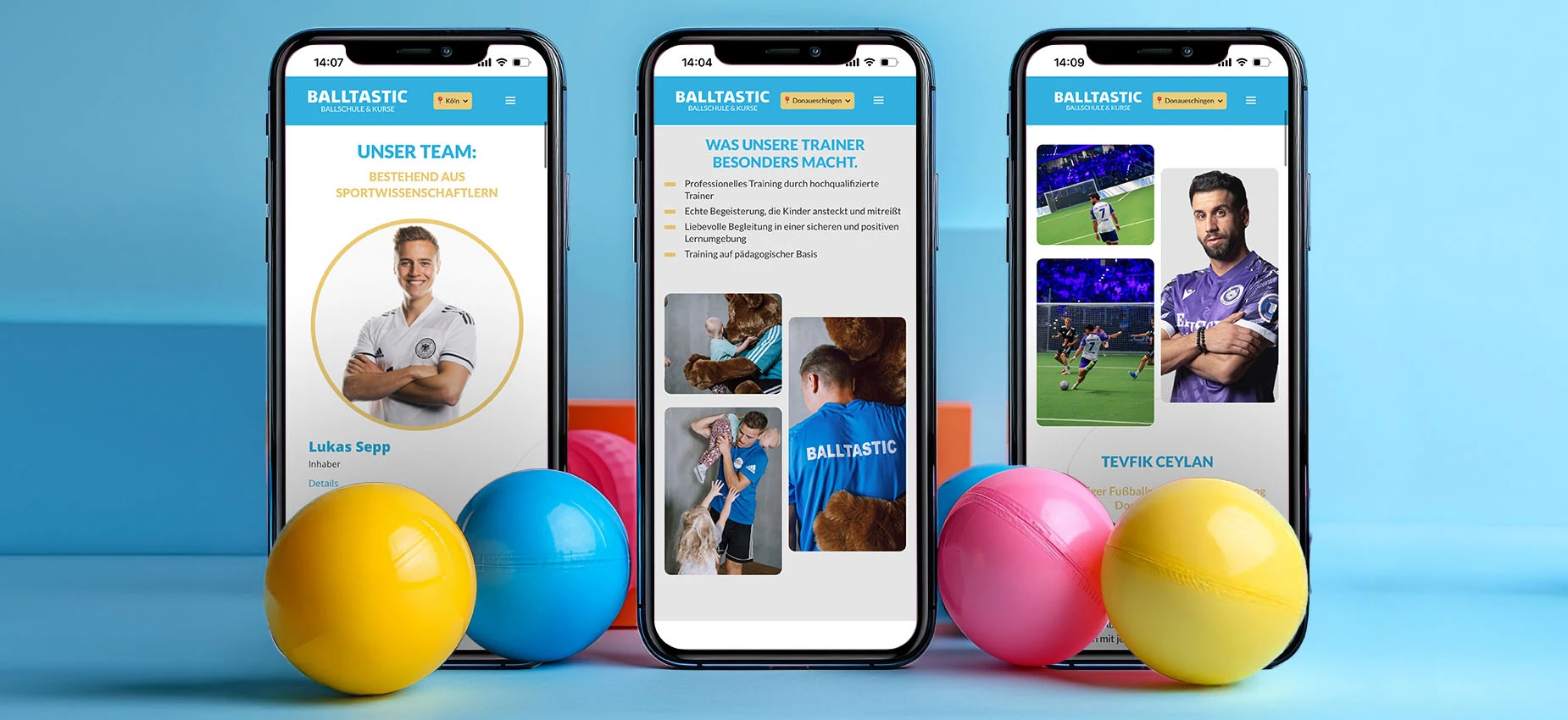
Read the full case study: Balltastic →
This combination is exactly what sets it apart from working with a freelancer: one person could have delivered the design or the build, but rarely both to the same depth alongside the branding work.
How to recognise a professional approach
Regardless of whom you choose, the same checks apply: a written scope of work rather than verbal promises, clear rights to the design and source code, access to the domain and hosting in your name, a documented handover and a specified response time for faults. If any of these are missing, the price is beside the point.
For help choosing a local provider, we have also written Digital agencies: services, costs and how to find the right one and Web designers for small businesses.
Frequently asked questions
Which is better: an agency, a freelancer or a website builder?+
How much cheaper is a freelancer than an agency?+
Can I switch from a website builder to an agency-built solution later?+
Is a website builder enough for SEO?+
What does an agency-built website cost?+
How do I protect myself when working with a freelancer?+
Does an agency make sense for a small business?+
Who looks after the website after launch?+
Sources
- Core Web Vitals, Google / web.dev (2024)

Josef leads the strategic and creative development of brands at Maluure. For over a decade, he has guided medium-sized businesses from brand positioning to digital delivery.
Managing Director of Maluure GmbH, Cologne. Specialising in corporate design, brand strategy and digital brand experiences.
Weiterlesen

Using a corporate film on social media: twelve weeks of content from one shoot day
A corporate film is not a one-off asset, but a bank of source material. How to turn one shoot into formats for LinkedIn, Instagram, your website and sales, with an editing plan, content calendar and practical example.

Corporate video scripts: storytelling that works in 90 seconds
The script determines whether your corporate video makes an impact or just looks good. Structure, narrative, common mistakes and a shot list that saves the shoot day.

Officially certified: Maluure is a Lovable Partner
Since 16. September 2026, Maluure has been an officially certified Lovable Partner, Expert Website Builder and Expert App Builder. What the certification involves and what it means for your project.
Explore more blog topics
Corporate film or recruitment video: What your company really needs
Both films cost a similar amount but have very different effects. This comparison shows which format suits which goal and how to produce both in a single day of filming.

LinkedIn Video: Formats, Lengths and Best Practices for Businesses
What works for LinkedIn video: formats from 1:1 to 9:16, the right length for each objective, subtitles, hooks and upload strategy. A concise guide for businesses.

Recruitment video: showing employees as they really are
How a recruitment video shows real employees rather than glossy clichés, what it costs and why authenticity brings in more applications.