Having a website built: process, costs and how to identify a good agency
What does it cost to have a website built, how does a project work and how do you identify a reputable agency? Realistic price ranges, the process and a checklist.

What does “having a website built" actually involve?
When you commission a website, you are rarely buying just design. You are buying a series of decisions: who should read the site, what should that person do, what content is needed to make that happen, how will visitors find the site in the first place and who will maintain it in two years’ time.
This is exactly where quotes differ. A 900-Euro quote will usually get you a template with your logo. A properly costed project delivers structure, copy, a technical foundation and a plan for life after launch. Either can be right, but only if you know what you are buying.
Typical scope when you have a website professionally built:
- Goals and target audience, including the question of what kind of enquiry the site should generate
- Site structure and navigation, based on real search queries
- Copy and imagery, either supplied by you or developed with editorial support
- Design and development, responsive and built with accessibility in mind
- Technical setup: hosting, domain, SSL, data protection, tracking
- Search engine basics: titles, descriptions, clear headings, loading speed
- Handover, training and ongoing support
What does it cost to have a website built?
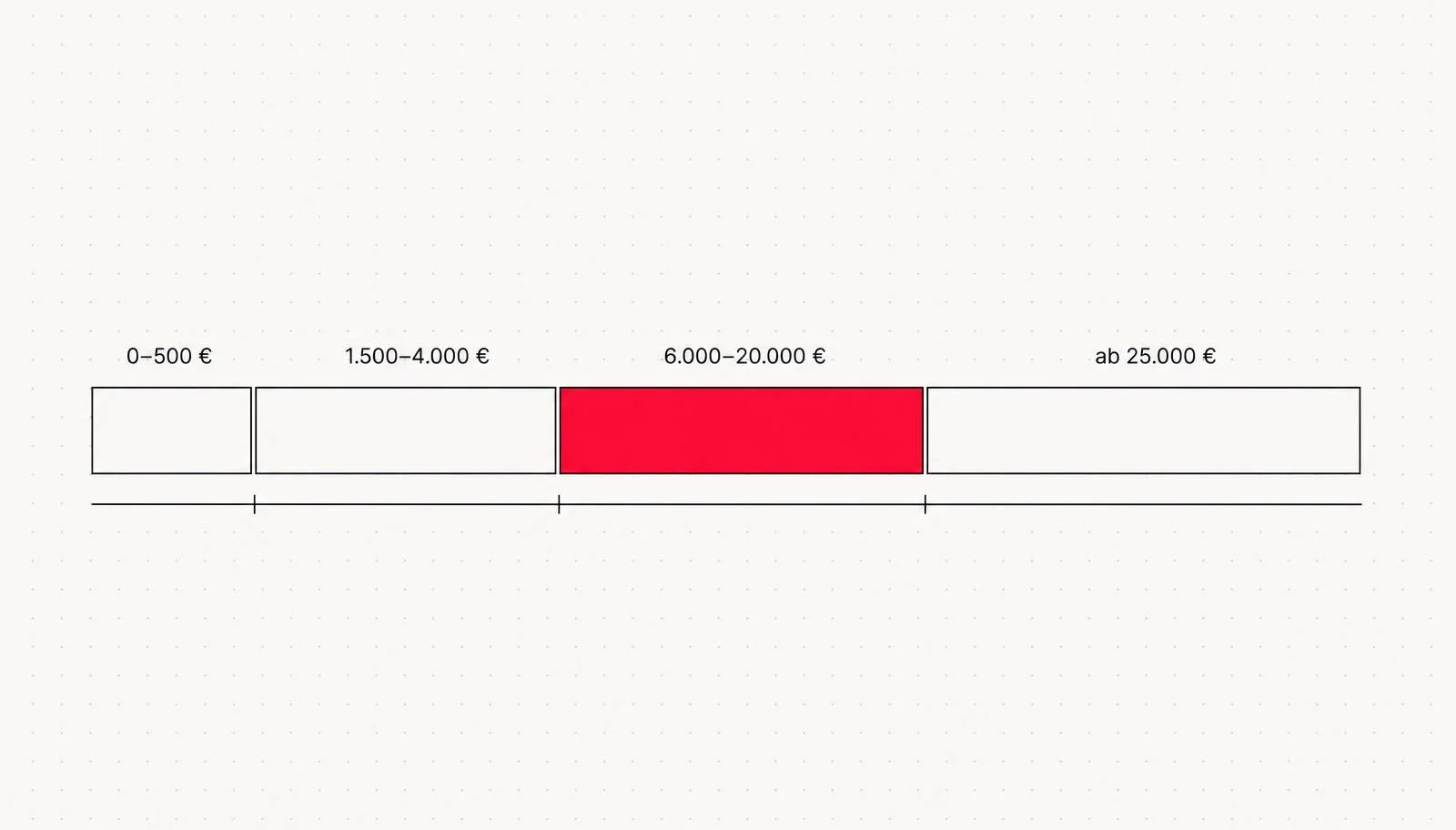
The honest answer: between around 500 Euro and 50.000 Euro, depending on scope. Since that is not much help to anyone, here are the price ranges we see in practice.
| Scope | Price range | What you get | Who it suits |
|---|---|---|---|
| DIY website builder | 0 to 500 € per year | Template, your own time, no strategic concept | Testing an idea, side project |
| Small brochure website | 1.500 to 4.000 € | 3 to 5 pages, standard design, basic SEO | Sole traders, local trades businesses |
| Professional company website | 6.000 to 20.000 € | Strategy, bespoke design, copy, CMS, SEO foundation | SMEs, B2B, services that need explaining |
| Bespoke platform | from 25.000 € | Custom features, integrations, portals, online shops | Businesses with a core digital process |
Then there are ongoing costs that tend to get overlooked in quotes: hosting and domain (around 10 to 60 Euro per month), maintenance and updates, and content management. If you have a website built and invest nothing afterwards, you will be facing another relaunch project in three years.
For a closer look at how the costs break down, see our article Fixed-price website and our price list.
Website builder, freelancer or agency: which is right for you?
| Route | Cost | Your time | Strength | Weakness |
|---|---|---|---|---|
| Website builder | low | high | quick start | structure, copy and visibility stay on your plate |
| Freelancer | medium | medium | direct contact, flexible | availability risk, rarely covers every discipline |
| Agency | higher | low | strategy, design, tech and copy from one team | only pays off with a real business goal |
The question is not which route is better, but how much of your own time you want to invest and what the site needs to achieve commercially. A site that brings in two additional enquiries a month pays for itself within a year for almost any SME. A site that nobody finds is too expensive even at 900 Euro.
For more on comparing providers, see Web designers for small businesses.
How does a website project work?
A project that stays on track always follows the same stages:
- Kick-off and goals. What kind of enquiry, which customer, which region. Without these answers, design becomes a matter of taste.
- Structure and content. Site architecture, keywords, copy outline. This phase determines future visibility.
- Design. The homepage and one type of internal page first, then the rest. Approval in stages rather than all at once at the end.
- Development. CMS build, responsiveness, performance, accessibility considerations, data protection.
- Testing. Forms, loading times, mobile views, spelling, redirects for a relaunch.
- Launch. Switchover, Search Console, indexing, monitoring.
- Ongoing support. Updates, content, analysis, refinements.
Realistic timeframe: four to ten weeks for a company website, provided content arrives on time. The most common cause of delays is not the technology, but missing copy and images from the client.
What to prepare before your first agency meeting
- One sentence on the goal: “The site should generate qualified enquiries for X."
- Two to three websites you like, with reasons why
- Your existing figures, if available: visitors, enquiries, sources
- Who makes decisions internally and who supplies content
- A rough budget range. This does not weaken your negotiating position; it saves both sides two rounds of discussion
What content does your website need as a minimum?
Many projects fail not because of budget, but because of missing content. Plan these building blocks before you commission a website:
- Homepage with a clear sentence explaining what you do and for whom
- One page per service, rather than putting every service on a single page
- References or projects with context: starting point, implementation, outcome
- About us with real people, photos and responsibilities
- Contact with a form, phone number and address
- Legal notice and privacy policy, maintained and up to date
Local businesses also need a location page that mentions the area naturally. For advice on doing this without keyword stuffing, see Having a website built in Cologne.
How do you make sure people find the site?
Having a website built and then waiting for visitors does not work. Search engines and AI answer systems need substance, structure and signals:
- Structure based on search intent: One page per search need, clear headings, descriptive URLs.
- Server-delivered content: If your text only loads via JavaScript, many crawlers see an empty page.
- Google Unternehmensprofil and consistent business details across directories.
- Regular content that answers your customers’ real questions.
- Measurement through Search Console and Analytics, so that after three months you know what works.
Skip this part and you have an expensive online brochure. An SEO audit identifies the specific obstacles within a few days.
Project example: Sourisseaux / Partners
Sourisseaux / Partners is an international consultancy. The starting point was typical of services that need explaining: plenty of substance, but a website that did not reflect the quality of the work and bundled complex services into a single overloaded page.
We rebuilt the website from the ground up. Each consulting service received its own clearly structured page, alongside an interactive world map showing all locations with team and partner profiles. The visual concept, featuring glowing orbs, expresses the firm’s philosophy: good leadership radiates out to those around it.

Read the full case study: Sourisseaux / Partners →
The takeaway for you: separate pages for each service were a visibility decision, not a design decision. Put all your services on one page and none of them will rank effectively.
How do you identify a good agency?
- It asks about your business model before discussing colours
- It sets out prices and scope clearly in writing
- It shows real projects with context, not just attractive screenshots
- It talks about life after launch: maintenance, content, measurement
- It is willing to say when something is unnecessary
Warning signs include fixed prices without any questions, “SEO included" without an explanation of what that means, and contracts that leave you without ownership of the domain or source code. Always check this point: the domain, hosting access and content must be under your control.
Most clients do not come to us because their website is ugly. They come because it delivers nothing. Design is the result of asking the right questions, not the starting point.
Have a website built or build it yourself?
Building it yourself makes sense if you have time rather than money, your offering is easy to explain and the site mainly serves as a digital business card. Commissioning a website makes sense once it becomes part of your customer acquisition, several services need to be presented clearly, or you want to appear in search engines and AI answers.
A pragmatic middle ground is a fixed-price product with a clear scope. That is exactly what our Maluure-Page™ offers: defined deliverables, fixed costs and professional implementation, without embarking on an enterprise project.
The technical foundation still matters. Loading speed, mobile display and stable layouts have been ranking factors for years and are measured by Google as Core Web Vitals [1]. An attractive site that takes three seconds to load loses visitors before they have read your first sentence.
Frequently asked questions
What does it cost to have a website built?+
How long does it take to have a website built?+
What do I need to provide to an agency?+
Is a website builder like Wix or Squarespace worth it?+
What ongoing costs are there after launch?+
Do I own the website once it is finished?+
Is SEO automatically included?+
Should I have a website built or build it myself?+
Sources
- Core Web Vitals und Seitenerfahrung in der Google Suche, Google Search Central (2025)

Josef leads the strategic and creative development of brands at Maluure. For over a decade, he has guided medium-sized businesses from brand positioning to digital delivery.
Managing Director of Maluure GmbH, Cologne. Specialising in corporate design, brand strategy and digital brand experiences.
Weiterlesen
Using a corporate film on social media: twelve weeks of content from one shoot day
A corporate film is not a one-off asset, but a bank of source material. How to turn one shoot into formats for LinkedIn, Instagram, your website and sales, with an editing plan, content calendar and practical example.
Corporate video scripts: storytelling that works in 90 seconds
The script determines whether your corporate video makes an impact or just looks good. Structure, narrative, common mistakes and a shot list that saves the shoot day.

Officially certified: Maluure is a Lovable Partner
Since 16. September 2026, Maluure has been an officially certified Lovable Partner, Expert Website Builder and Expert App Builder. What the certification involves and what it means for your project.
Explore more blog topics
Corporate film or recruitment video: What your company really needs
Both films cost a similar amount but have very different effects. This comparison shows which format suits which goal and how to produce both in a single day of filming.
LinkedIn Video: Formats, Lengths and Best Practices for Businesses
What works for LinkedIn video: formats from 1:1 to 9:16, the right length for each objective, subtitles, hooks and upload strategy. A concise guide for businesses.
Recruitment video: showing employees as they really are
How a recruitment video shows real employees rather than glossy clichés, what it costs and why authenticity brings in more applications.