Creating a website concept: Our strategy process before design and code
How we plan a website at Maluure before a designer or developer starts: briefing, goals, sitemap, navigation and project plan. The strategic groundwork that determines the success of every website.
Why a website concept comes before design and code
Most website projects do not fail because of design or technology. They fail because of what is missing beforehand: a clear website strategy and a sound concept. Anyone who jumps straight into layouts, templates or lines of code is designing without direction and will later optimise the wrong things. The Standish Group has also shown for years that the most important success factor in digital projects is clear requirements before implementation begins.[3]
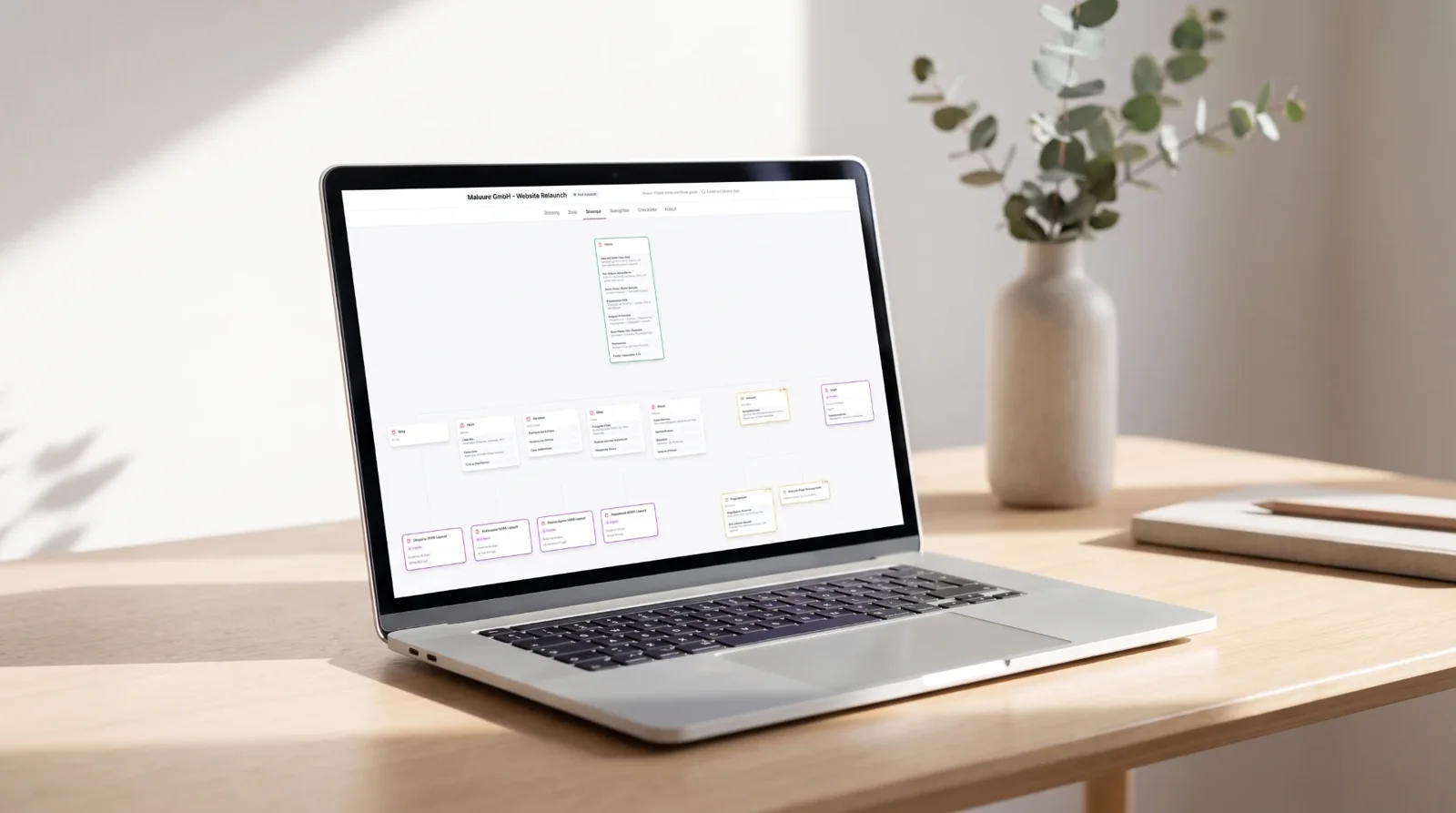
At Maluure, we therefore take a different approach. Before a designer chooses a colour and before a developer writes a line of code, we take every project through a structured strategy process. This process is not a box-ticking exercise, but the foundation for everything that follows. We have developed our own internal tool for this groundwork, which we use during the onboarding meeting and then share with you via a public link so we can work on the scope together. You can see exactly what a shared onboarding space looks like in our own example project: buzzz-hub.com/project/maluure-demo – where we analysed the Maluure website itself and openly documented every step.
Website planning: What belongs in a professional concept?
A robust website concept answers five questions before design and development: who you are, who you want to reach, what the site should achieve, how it is structured and how we get there. Each of these steps has its own section in our onboarding process.
| Step | What happens | Outcome |
|---|---|---|
| 1. Briefing | Company, target audience, competition, look | Shared understanding of the project |
| 2. Goal setting | Specific goals plus actions | Measurable website goals |
| 3. Sitemap | Page structure and connections | Website architecture |
| 4. Navigation | Main menu, sub-items, behaviour | Wayfinding system for visitors |
| 5. Project plan | Timeline, tasks, responsibilities | Agreed roadmap |
Only once these five steps are complete do we hand the project over to the design team, who can then work from a clear information base. If you want to see what this looks like in detail, Maluure-Page™ explains the packaged service behind it.
Step 1: What makes a good website briefing?
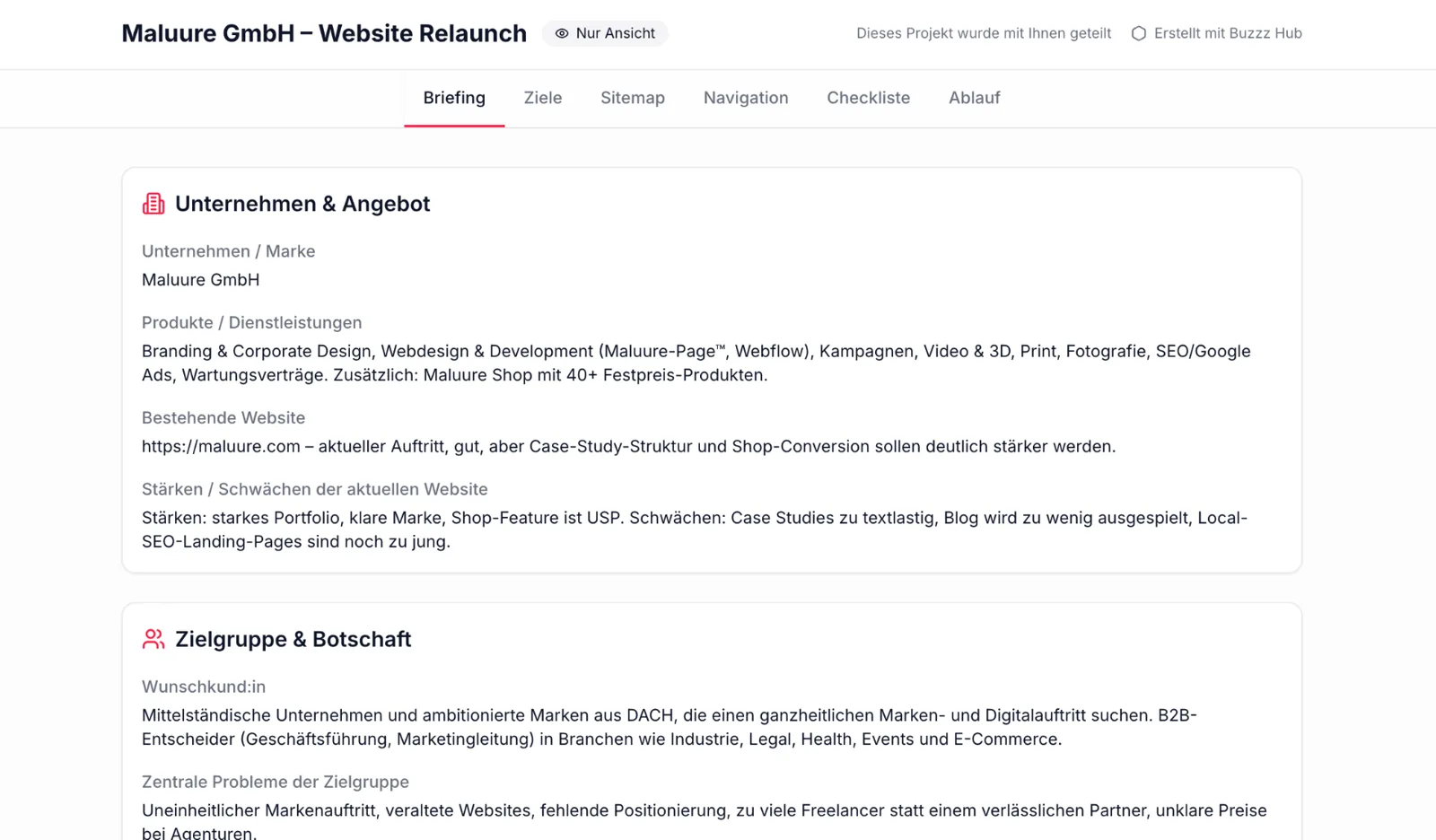
The website briefing is the longest and most important phase of the kick-off. We deliberately ask plenty of questions here because every answer makes later decisions easier. A briefing finished in 15 minutes will cost weeks of rework later.
Company and offering
- What is the company or brand called, and what does it stand for?
- Which products or services does it offer?
- Is there already a website, and if so, what works and what does not?
Target audience and message
- Who is the primary target audience, and who are the ideal customers?
- Which three key problems or questions matter to this audience?
- What should visitors have understood after 10 seconds on the homepage?
- Why should someone choose this offering rather than a competitor's?
- Which objections or uncertainties typically arise before an enquiry?
- What specific action should visitors take at the end of the page?
- Which direct competitors should the brand distinguish itself from visually and through its content?
Look, impact and tone of voice
- Which two to five websites do you like, and why exactly?
- Which one to three websites do you dislike, and why?
- Which qualities should dominate: editorial, warm, minimal, high-end, playful, bold, soft, modern tech or organic?
- Which five terms describe the look and impact in your own words?
- How should the website speak: factually, personally, directly, poetically?
You can see how these questions later translate into a concrete visual system in our Branding service.
Content, assets and requirements
- What content, copy, images or videos are already available?
- Are new professional photos or videos needed?
- Is there a corporate visual identity or style guide?
- Are there any desired features, technical requirements or systems that need to be integrated?
Step 2: Developing a website strategy – how do we define measurable goals?
After the briefing, we record each goal individually and immediately pair it with a specific action. This turns an ambition into a design or technical decision that can be evaluated later. This is precisely where basic website planning becomes a real website strategy.
A few examples of what this looks like:
- Goal: Attract and convince customers in the luxury segment. Action: High-quality, understated design with generous white space, a calm rhythm and editorial typography.
- Goal: Sell tickets for an event. Action: A ticket button permanently visible in the navigation, plus a promotional banner during early-bird periods.
- Goal: Generate enquiries from medium-sized businesses. Action: Clear CTA boxes at the end of every service page and a contact form with no more than five fields.
- Goal: Increase applications for open positions. Action: A dedicated careers page with team portraits, benefits and a clearly visible quick application form.
- Goal: Build trust with new customers. Action: Case studies with real figures, testimonials with full names and portraits, and logos of well-known clients.
- Goal: Reduce support enquiries. Action: A prominent FAQ section, a searchable knowledge base and self-explanatory pricing tables.
Each goal then has a direct counterpart in the later implementation. This is the point where design stops being a matter of taste and starts becoming a tool.
A website without defined goals is a business card on the internet. A website with clear goals is a tool. The difference is not made in the layout, but in the hour before it.
Step 3: How is a website sitemap created?
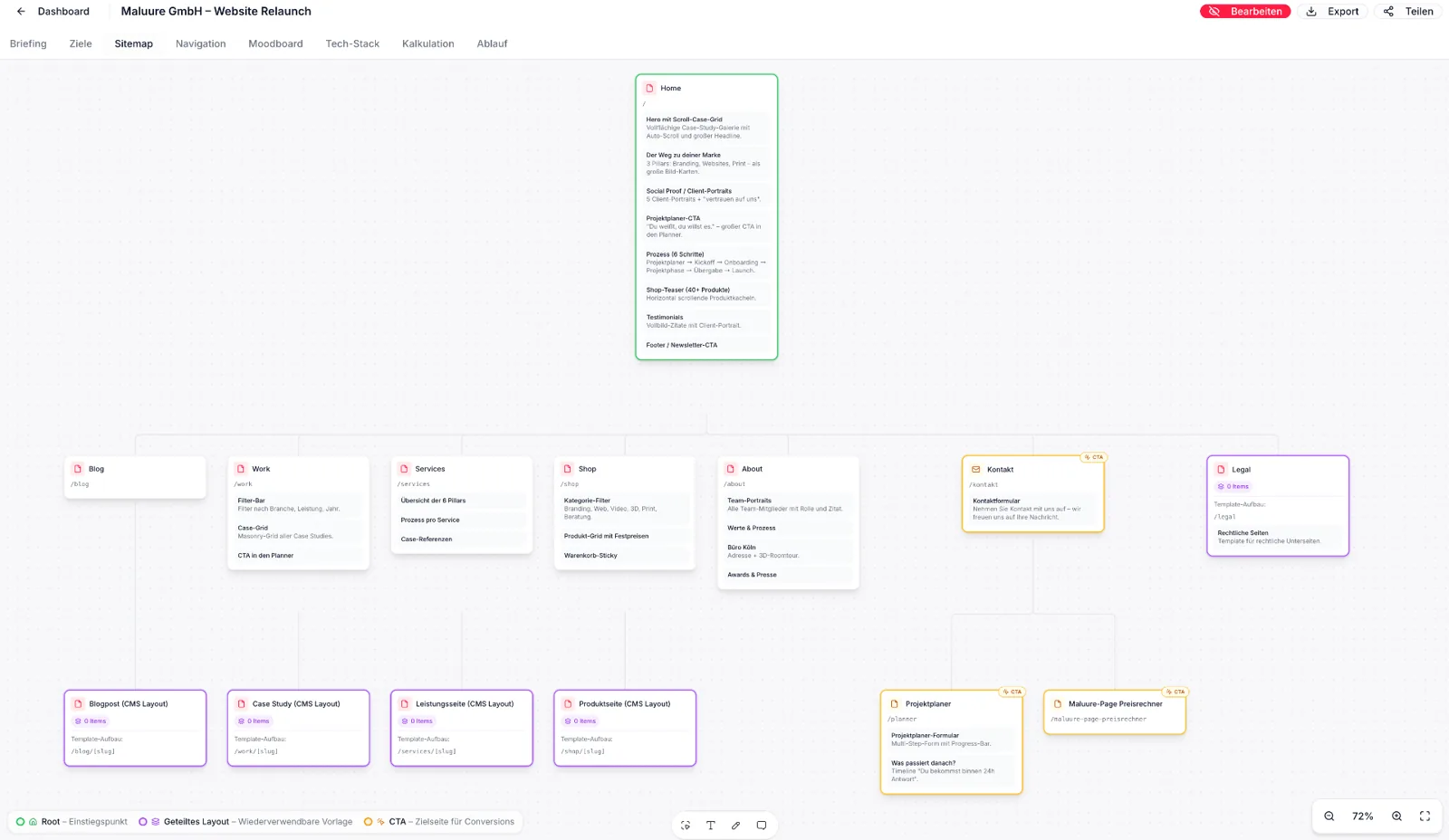
Once the direction is clear, we build the sitemap together in our online tool. The sitemap is the website's blueprint and answers four key questions:
- Which pages does the website actually need, and which are being requested out of habit?
- How are these pages connected, and which paths should visitors take?
- Which dynamic pages are there, such as blog posts, case studies, products or locations?
- Which page is the main conversion point, and how do all paths lead there?
A good sitemap is not the longest, but the clearest. We check every page against the goals from step 2. Anything that serves no goal is removed or merged. This saves discussions during the design process about pages nobody would ever have visited. Google also recommends a flat, thematically organised structure because it is easier for both people and crawlers to understand.[2]
Step 4: How do we plan the navigation?
Navigation is the website's wayfinding system. It determines which pages get found at all. Here, we specify:
- Which items belong in the main navigation, and which stay at sub-menu or footer level?
- Does the site need a mega menu with previews, classic dropdowns or a flat structure?
- Where does the primary CTA sit, and is it permanently visible or dependent on scrolling?
- How does the navigation behave on mobile: sticky or standard, with a full-screen overlay or an off-canvas menu?
Navigation is not an afterthought, but the second most important building block after the sitemap. It translates structure into behaviour.
Step 5: Planning a website – process, timeline and responsibilities
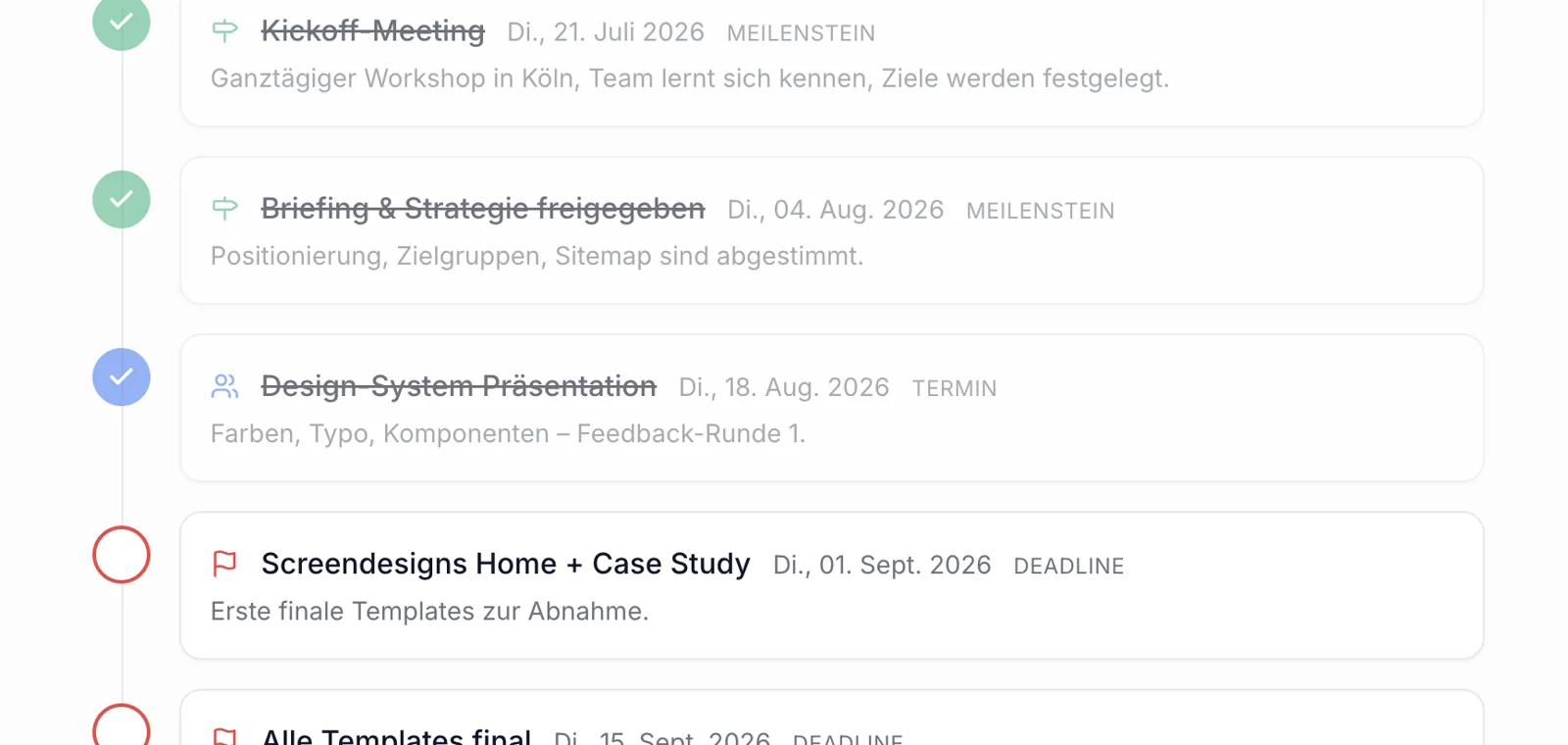
Onboarding produces specific tasks for both sides. We record them in the same tool so nobody has to guess what is held up where. This makes it possible to plan a website realistically, rather than simply hope for one.
- Review and organise assets: logos, fonts, existing photos, videos.
- Produce content: new photos or videos, plan shoots, finalise copy.
- Collect access details: domain, hosting, analytics, social accounts.
- Prepare legal information: legal notice, privacy policy, terms and conditions, consent plan.
- Clarify internal approvals: who in the team makes decisions on design, copy and launch.
- Confirm external dependencies: translators, photographers, tax advisers for the legal notice.
Because our onboarding tool is accessible at any time via a public link, everyone involved can always see the latest status. No “I couldn't find the email", no Excel chaos, no endless back-and-forth with questions. The scope stays visible.
Our team handles the subsequent implementation through our Web design service.
Website concept template: A checklist to copy
If you want to build your own website concept template, follow this structure. Each row is a chapter in the concept document:
| Chapter | Content | Who provides it |
|---|---|---|
| 1. Starting point | Brand, offering, competition, current website | Client + agency |
| 2. Target audiences | Primary and secondary audiences, needs | Client |
| 3. Goals & KPIs | 3–6 goals with measurable metrics | Together |
| 4. Look & tone of voice | Mood board, references, things to avoid | Together |
| 5. Sitemap | All pages, hierarchy, conversion point | Agency |
| 6. Navigation | Main navigation, sub-navigation, footer, mobile behaviour | Agency |
| 7. Content plan | Per page: sections, copy length, media | Together |
| 8. Technology & SEO | CMS, integrations, URL structure, redirects | Agency |
| 9. Timeline | Milestones, approvals, launch date | Together |
| 10. Roles | Who decides what, who provides what | Together |
Common mistakes in website concepts
After dozens of website projects, we keep seeing the same patterns holding good ideas back:
- Jumping into design too early. Colours and fonts are discussed before the target audience and goals are clear.
- Goals without metrics. “More customers" is not a goal. “30 qualified enquiries per month" is.
- Adding every requested page to the sitemap. Pages that serve no goal dilute the impact of the important ones.
- Treating navigation as an afterthought. If you leave navigation decisions until the design phase, you will rebuild it three times later.
- Underestimating content work. Copy, photos and videos do not create themselves – without a content plan, every launch is delayed.
- No point of contact on the client side. Without clear decision-making authority, every approval becomes a bottleneck.
We have never seen a project fail because of too much planning. But we have seen many fail because of too little.
How long does a website concept take?
For small to medium-sized business websites, we allow 2 to 3 weeks from the onboarding meeting to the approved sitemap. For platforms, multilingual websites or complex user flows, 4 to 6 weeks is realistic. The time is roughly divided as follows:
- Week 1: Kick-off, briefing, goal setting.
- Week 2: Sitemap, navigation, initial content sections.
- Week 3: Refinement, approval, handover to design.
Important: Elapsed time depends less on our work than on feedback from decision-makers. That is why we define at the outset who approves things on the client side and how often.
What only happens after the strategy process?
Only once the briefing, goals, sitemap, navigation and project plan are agreed do we hand over to the design team. They no longer work on gut feeling, but on an information base developed jointly by the client and strategy team.
The result: a faster design phase, fewer rounds of revisions and fewer later changes during development. What many see as overhead is actually the reason projects finish on time and on budget.
We have described in detail how this strategic foundation becomes a concrete interface – from corporate identity and interactive prototypes to the final screen design – in the second part of this series: Web design process: From concept to screen design. There, we show why the choice of platform (WordPress, Webflow, Lovable) is secondary during the design phase and how we link every design decision back to the goals in the concept.
Conclusion: Why the groundwork always pays off
A website concept is not an academic exercise, but the least expensive phase of a project, when mistakes still cost almost nothing. Investing time here saves weeks later in design, content and development. And the result is a website that does not just look good, but works.
If you are planning a new website and want to follow this process in a structured way, we support you from kick-off to launch, with our onboarding tool as a shared workspace.
Related reading
- Commissioning a website – prices 2026 (with calculator): Get a transparent estimate of your project budget.
- Service: Branding: How to create a brand that underpins the concept.
- Service: Print: Translate the concept consistently into a printed experience.
FAQ: Creating a website concept
What belongs in a website concept? A robust website concept includes goals, target audiences, key messages, a sitemap, navigation logic, a content structure for each page type, technical requirements and an editorial or SEO plan. Design and implementation only come afterwards.
How much does a professional website concept cost? Depending on scope, between 1.500 € (a compact concept for landing pages) and 8.000 €+ (a corporate concept with personas, content strategy and an SEO plan). At Maluure, the concept phase is part of every Maluure-Page project and is transparently included in the price calculator.
How long does a website concept take? For a medium-sized business website, we allow 1–3 weeks: one week for research and a workshop, one to two weeks for development of the concept and approval. Compact landing page concepts are ready in a few days.
Concept before or after design? Always before. Without goals, target audiences and structure, screen design is a matter of taste. That is why we start every project with a strategy workshop and only then translate it into screen design.
Does a small website need a concept too? Yes. Even a 5-page website needs clear goals, target audiences and a sitemap. The process is simply shorter: one workshop, one concept page, one approval meeting – then design.
Frequently asked questions
What is a website concept?+
How do I create a website concept step by step?+
What belongs in a professional website concept?+
How much does a website concept cost?+
How long does a website concept take?+
Does a small website need a concept too?+
What is the difference between a website concept and a website strategy?+
How does a website briefing differ from a questionnaire?+
Is there a template for a website concept?+
What are common mistakes in a website concept?+
Is there a live example of your onboarding tool?+
Sources
- Nielsen Norman Group: Information Architecture Basics, Nielsen Norman Group (2022)
- Google Search Central: Site Structure Guidelines, Google (2024)
- Standish Group CHAOS Report – Projekterfolg durch klare Anforderungen, Standish Group (2020)

Josef leads the strategic and creative development of brands at Maluure. For over a decade, he has guided medium-sized businesses from brand positioning to digital delivery.
Managing Director of Maluure GmbH, Cologne. Specialising in corporate design, brand strategy and digital brand experiences.
Weiterlesen
Using a corporate film on social media: twelve weeks of content from one shoot day
A corporate film is not a one-off asset, but a bank of source material. How to turn one shoot into formats for LinkedIn, Instagram, your website and sales, with an editing plan, content calendar and practical example.
Corporate video scripts: storytelling that works in 90 seconds
The script determines whether your corporate video makes an impact or just looks good. Structure, narrative, common mistakes and a shot list that saves the shoot day.

Officially certified: Maluure is a Lovable Partner
Since 16. September 2026, Maluure has been an officially certified Lovable Partner, Expert Website Builder and Expert App Builder. What the certification involves and what it means for your project.
Explore more blog topics
Corporate film or recruitment video: What your company really needs
Both films cost a similar amount but have very different effects. This comparison shows which format suits which goal and how to produce both in a single day of filming.
LinkedIn Video: Formats, Lengths and Best Practices for Businesses
What works for LinkedIn video: formats from 1:1 to 9:16, the right length for each objective, subtitles, hooks and upload strategy. A concise guide for businesses.
Recruitment video: showing employees as they really are
How a recruitment video shows real employees rather than glossy clichés, what it costs and why authenticity brings in more applications.