Webflow vs. WordPress: A comparison for businesses
Webflow or WordPress? An honest comparison of performance, maintenance, costs, security and scalability – including a decision guide for businesses.
The question of “Webflow or WordPress" is often treated as a matter of faith. In reality, it is a straightforward operational question: who will maintain the site, how often, with what functionality and with what budget for the next three years? Both systems can produce excellent business websites. They simply fall short in different areas.
The core difference
WordPress is an open-source CMS that you host yourself and assemble using themes and plugins. You get maximum freedom, but take responsibility for updates, security, performance and compatibility.
Webflow is a closed platform: the visual editor, CMS and hosting come from a single provider. You get fewer building blocks, but a system that stays consistent without accumulating layers of plugins.
If you would like an introduction first: What is Webflow? Pros and cons for businesses explains the platform without the comparison.
Comparing the six relevant criteria
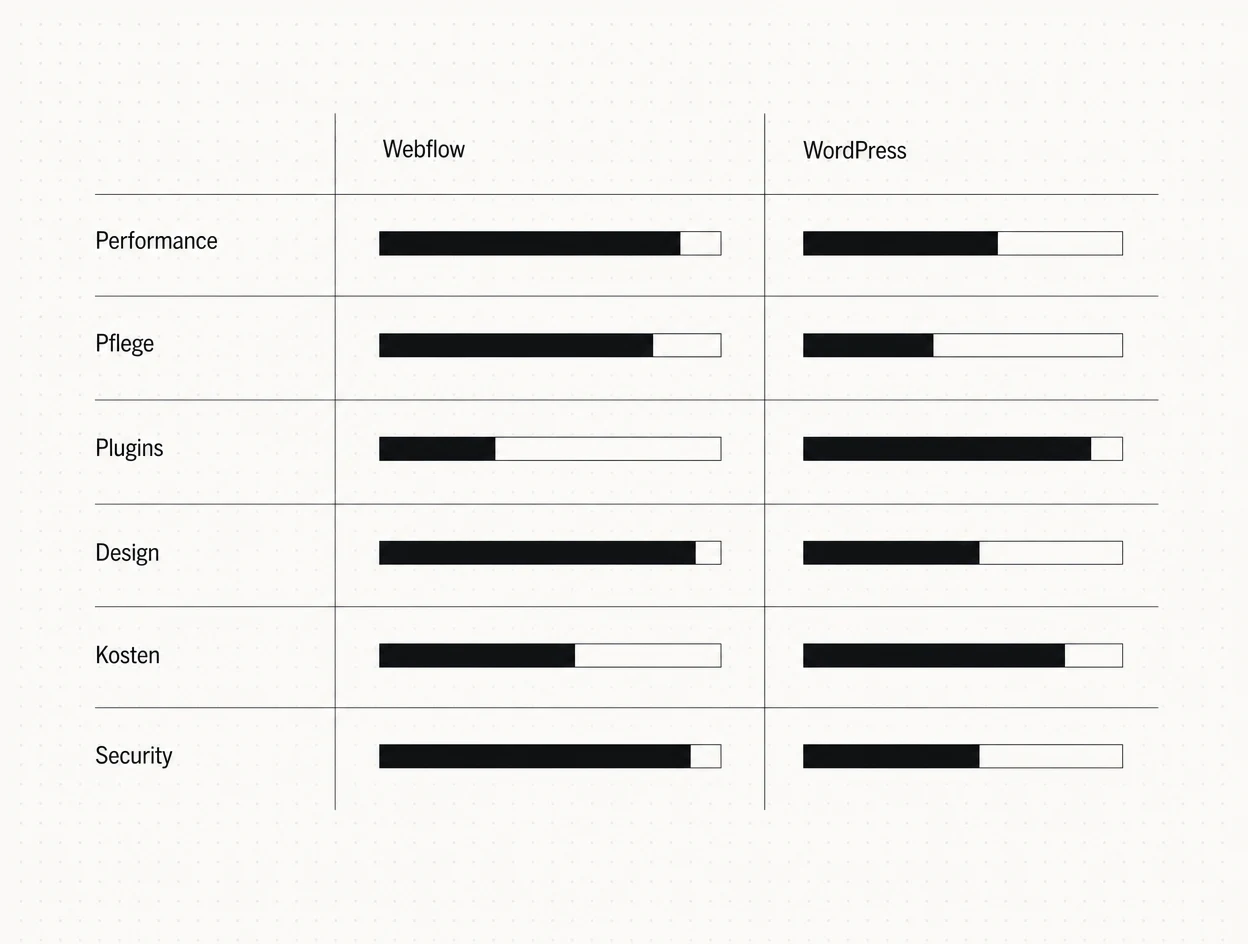
| Criterion | Webflow | WordPress |
|---|---|---|
| Performance | Delivered via a global CDN, lean code out of the box | Highly dependent on theme, plugins and hosting |
| Maintenance | No manual updates required, the platform updates itself | Core, theme and plugins need ongoing updates |
| Functionality | Solid foundation, limits on complex custom logic | Almost anything can be implemented using plugins |
| Design | Full creative control without theme restrictions | Freedom within the theme, development required beyond it |
| Costs | Higher ongoing licence costs, less maintenance | Low licence costs, ongoing maintenance and security costs |
| Security | Handled by the platform | Your responsibility, plugins are the main attack surface |
Performance
Webflow delivers clean code via a global CDN out of the box. You do not need to worry about caching plugins, image compression or server configuration. WordPress can be just as fast, but only with good hosting, a lean theme and a disciplined approach to plugins. In practice, we find that most Core Web Vitals issues stem not from the system itself, but from bloated page builders.
Maintenance and operation
This is the clearest practical difference. A WordPress website needs monthly attention: core updates, plugin updates, PHP versions, backups and compatibility tests. Without a maintenance agreement, it will inevitably become outdated. Webflow takes this cycle off your hands because there are no plugins that can break.
Functionality
WordPress wins here. Member areas, complex shops, multilingual editorial workflows, ERP integrations, hundreds of roles and permissions: there is a proven solution for almost every requirement. Webflow handles standard use cases well, but reaches its limits with extensive custom logic. At that point, you need either external services or a custom-built application.
Design and brand presence
Webflow was built for designers. There are no theme restrictions and no compromises between a design idea and its technical feasibility. Creative freedom is also possible in WordPress, but it requires development: a custom theme rather than an off-the-shelf one. Choosing a standard theme and then trying to make it look bespoke means paying twice in the end.
Costs over three years
Licence costs are the smaller part. What matters is the total cost of licensing, hosting, maintenance and ongoing development.
| Item | Webflow (typical) | WordPress (typical) |
|---|---|---|
| Licence / hosting per year | 300 to 700 € | 100 to 400 € |
| Maintenance per year | low, usually included in the support package | 600 to 2.400 € |
| Risk of unplanned work | low | medium to high |
Over three years, the two systems are closer in cost than their licence prices suggest. What you save on WordPress licensing, you spend on maintenance. You can find a realistic assessment of total costs in our article on website costs and process.
Security
WordPress is by far the most widely used CMS in the world. That makes it the most rewarding target, and the vast majority of successful attacks exploit outdated plugins, not the core. With Webflow, security is the platform's responsibility. For businesses without an in-house IT department, that is a real advantage.
Most clients ask us which system is better. The better question is who will maintain the website in two years. If nobody has a clear answer, Webflow is almost always the choice that brings fewer headaches.
Decision guide: six criteria for your situation
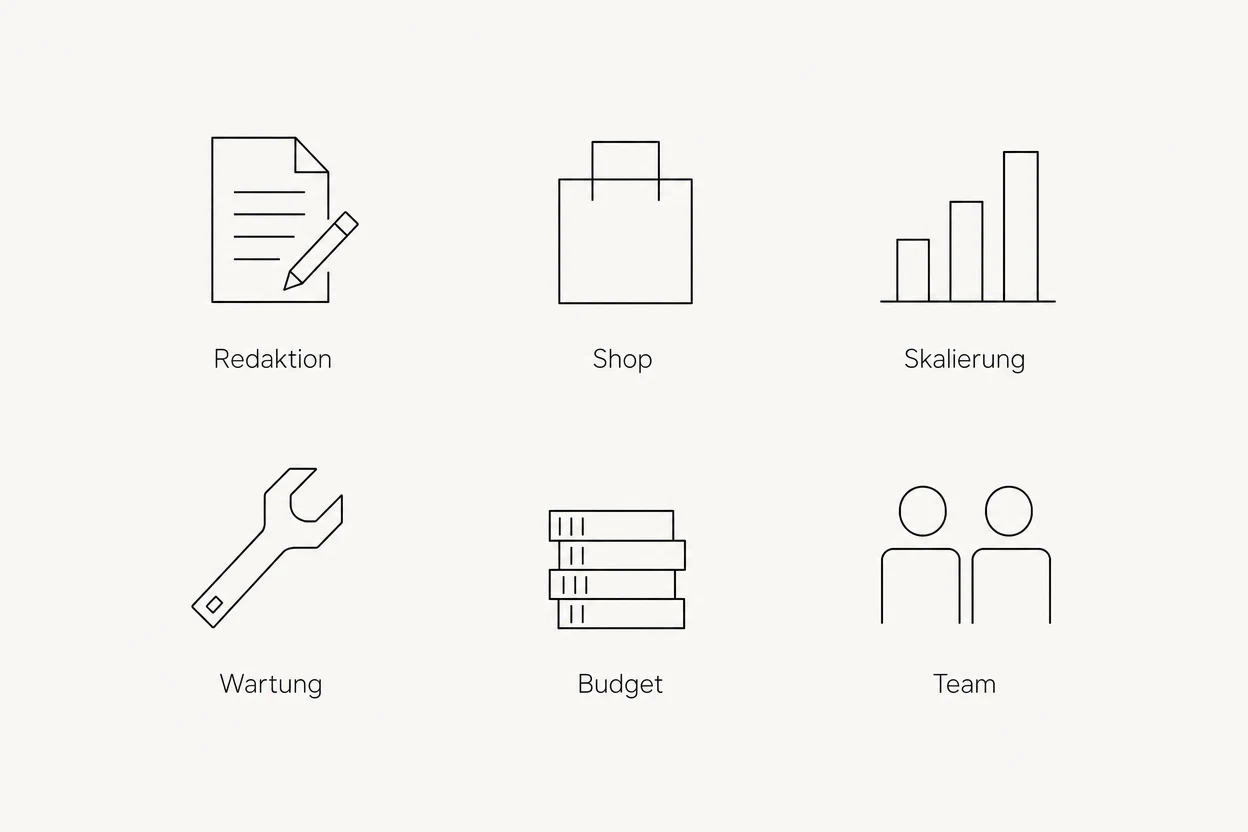
- Content management: How many people maintain content, and how technically skilled are they? A large editorial team with granular permissions points towards WordPress.
- Shop: Are you selling more than a handful of products with simple variants? Then choose WooCommerce or a dedicated e-commerce platform, not Webflow.
- Scalability: Are you planning multiple locations, languages or thousands of detail pages? Check your preferred system's CMS limits before committing.
- Maintenance: Is someone internally responsible for updates? If not, that favours a hosted platform.
- Budget: Calculate costs over three years, not just the launch. The launch is the smaller item.
- Team: Are you working with an agency that provides ongoing support for your system? A perfectly chosen system without support is worthless.
When each system is the right choice
Webflow is a good fit if design and brand presence are central, one to five people maintain content, you want predictable costs and you do not need extensive custom logic. Typical examples: consultancies, law firms, industrial companies, agencies and B2B service providers.
WordPress is a good fit if you have a large editorial team, need to support established integrations, run a full-scale online shop or need functionality that is available as a proven plugin and that you do not want to rebuild.
Neither is a good fit if your website is fundamentally an application: calculators, portals, booking logic or customer accounts with custom logic. In that case, custom development is the more honest answer. Our broader tech stack comparison of Webflow, WordPress and Lovable shows how this fits into the bigger picture.
Practical example: Sourisseaux / Partners
We built a website for the consultancy Sourisseaux / Partners that involved exactly this decision. The content requirements were clearly defined: publications, topics and people, maintained by a small team. At the same time, the brief called for a very precise, understated presence with fine typographic control and subtle motion.
With no shop, membership logic or established integrations involved, we chose a system with full design control and minimal maintenance rather than a plugin-driven setup. The result is a website that remains stable without monthly update cycles.

View the full case study: Sourisseaux / Partners →
Moving from WordPress to Webflow
Migration is not a copy-and-paste exercise. What matters is the structure: URLs, content, internal links and redirects. If you switch, make sure you plan for three things:
- A complete inventory of all indexed URLs before the relaunch
- Proper 301 redirects to the new destinations, not a blanket redirect to the homepage
- Ranking monitoring for at least eight weeks after launch
For a detailed look at what else can go wrong, read our article on website relaunches.
Three mistakes that make your choice of system expensive
Mistake 1: Choosing the system before defining the requirements. Deciding “we are using WordPress" first and gathering requirements afterwards almost always introduces compromises. Clarify day-to-day content workflows, the feature list and the operating model first, then choose the system.
Mistake 2: Budgeting only for the launch. A cheap launch with expensive ongoing operation is not a saving, but a deferral. Calculate licensing, hosting, maintenance and planned development over three years.
Mistake 3: Buying features instead of clarifying processes. Many plugin lists are the result of uncertainty. Every additional plugin is another update dependency and another attack surface. Anything you do not use regularly does not belong on the website.
Once you document your requirements clearly, the choice of system usually becomes obvious. That is precisely why every web project we take on starts with this clarification, not a tool recommendation.
Frequently asked questions
Which is better, Webflow or WordPress?+
Is Webflow more expensive than WordPress?+
Is Webflow worse than WordPress for SEO?+
Can I switch from WordPress to Webflow without losing rankings?+
Is Webflow suitable for an online shop?+
How secure is WordPress compared with Webflow?+
Can staff without technical knowledge maintain Webflow?+
Which system would an agency recommend for medium-sized businesses?+

Josef leads the strategic and creative development of brands at Maluure. For over a decade, he has guided medium-sized businesses from brand positioning to digital delivery.
Managing Director of Maluure GmbH, Cologne. Specialising in corporate design, brand strategy and digital brand experiences.
Weiterlesen
Using a corporate film on social media: twelve weeks of content from one shoot day
A corporate film is not a one-off asset, but a bank of source material. How to turn one shoot into formats for LinkedIn, Instagram, your website and sales, with an editing plan, content calendar and practical example.
Corporate video scripts: storytelling that works in 90 seconds
The script determines whether your corporate video makes an impact or just looks good. Structure, narrative, common mistakes and a shot list that saves the shoot day.

Officially certified: Maluure is a Lovable Partner
Since 16. September 2026, Maluure has been an officially certified Lovable Partner, Expert Website Builder and Expert App Builder. What the certification involves and what it means for your project.
Explore more blog topics
Corporate film or recruitment video: What your company really needs
Both films cost a similar amount but have very different effects. This comparison shows which format suits which goal and how to produce both in a single day of filming.

LinkedIn Video: Formats, Lengths and Best Practices for Businesses
What works for LinkedIn video: formats from 1:1 to 9:16, the right length for each objective, subtitles, hooks and upload strategy. A concise guide for businesses.

Recruitment video: showing employees as they really are
How a recruitment video shows real employees rather than glossy clichés, what it costs and why authenticity brings in more applications.