Commissioning an aftermovie: turning your event into a film
What an aftermovie can do, what it costs, how to prepare for the event day and how to distribute the film afterwards to promote the next edition.
What an aftermovie can do
An aftermovie is the film created after your event: two to three minutes that capture the atmosphere, people and moments so that even someone who could not attend understands what happened. It is not a keepsake video for an internal folder, but your strongest promotional tool for the next edition of your event.
The difference from a brand film is the starting point. With a brand film, you plan every shot; with an aftermovie, you have exactly one day that cannot be repeated. That is why preparation determines the result, not the camera.
Aftermovie, recap or livestream: the differences
| Format | Length | Purpose | Publication |
|---|---|---|---|
| Advance teaser | 10 – 20 Sek. | Generate registrations | Weeks before the event |
| Social recap | 15 – 30 Sek. | Reach on the event day | that same evening |
| Aftermovie | 90 – 180 Sek. | Lasting impact, sponsors, next year | 3 – 10 days afterwards |
| Documentary | 5 – 15 Min. | Internal review, committees, funders | 2 – 4 weeks afterwards |
Most organisers need not one of these formats, but two: a quick recap for social media and the main aftermovie, with more time for editing. Find out which lengths work on LinkedIn in LinkedIn video: formats and lengths.
What an aftermovie costs
For a one-day event with a camera crew, drone and editing, you will generally pay 3.500 to 7.000 Euro excluding VAT. Two cameras, soundbites and several social media cutdowns range from 7.000 to 14.000 Euro. Budget more for multi-day events with stage recordings and sponsor versions.
The biggest cost drivers are:
- Team size: a second camera adds not just a day of filming, but also extra footage review and editing time.
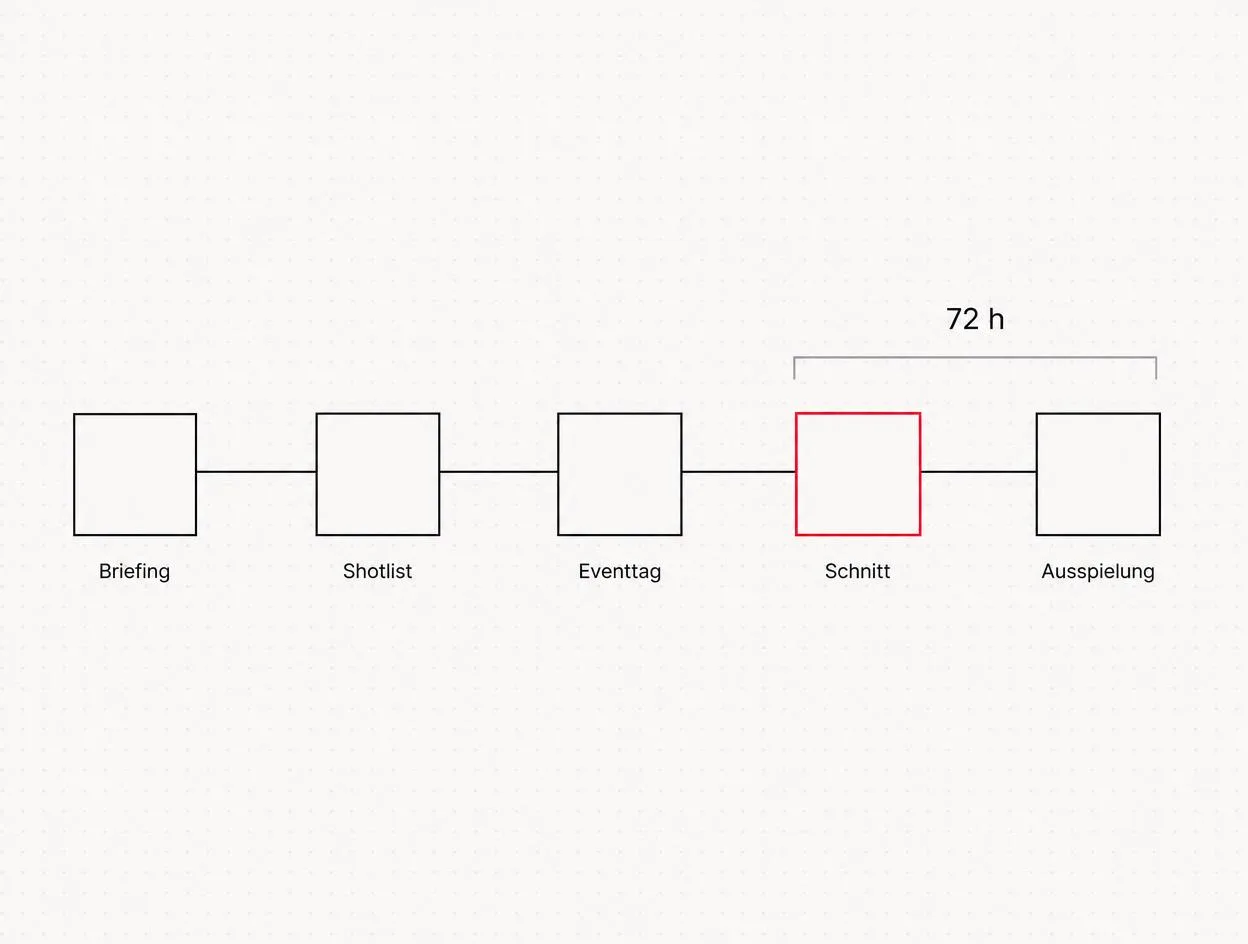
- Turnaround: a film that needs to be online 72 hours after the event requires reserved editing capacity.
- Number of versions: each additional version, whether portrait format, a sponsor edit or English subtitles, involves separate work.
- Music: a suitable licence costs between 100 and 800 Euro, depending on the scope of use.
For a thorough explanation of how pricing works, see our article on brand film costs.
The building blocks of a good production
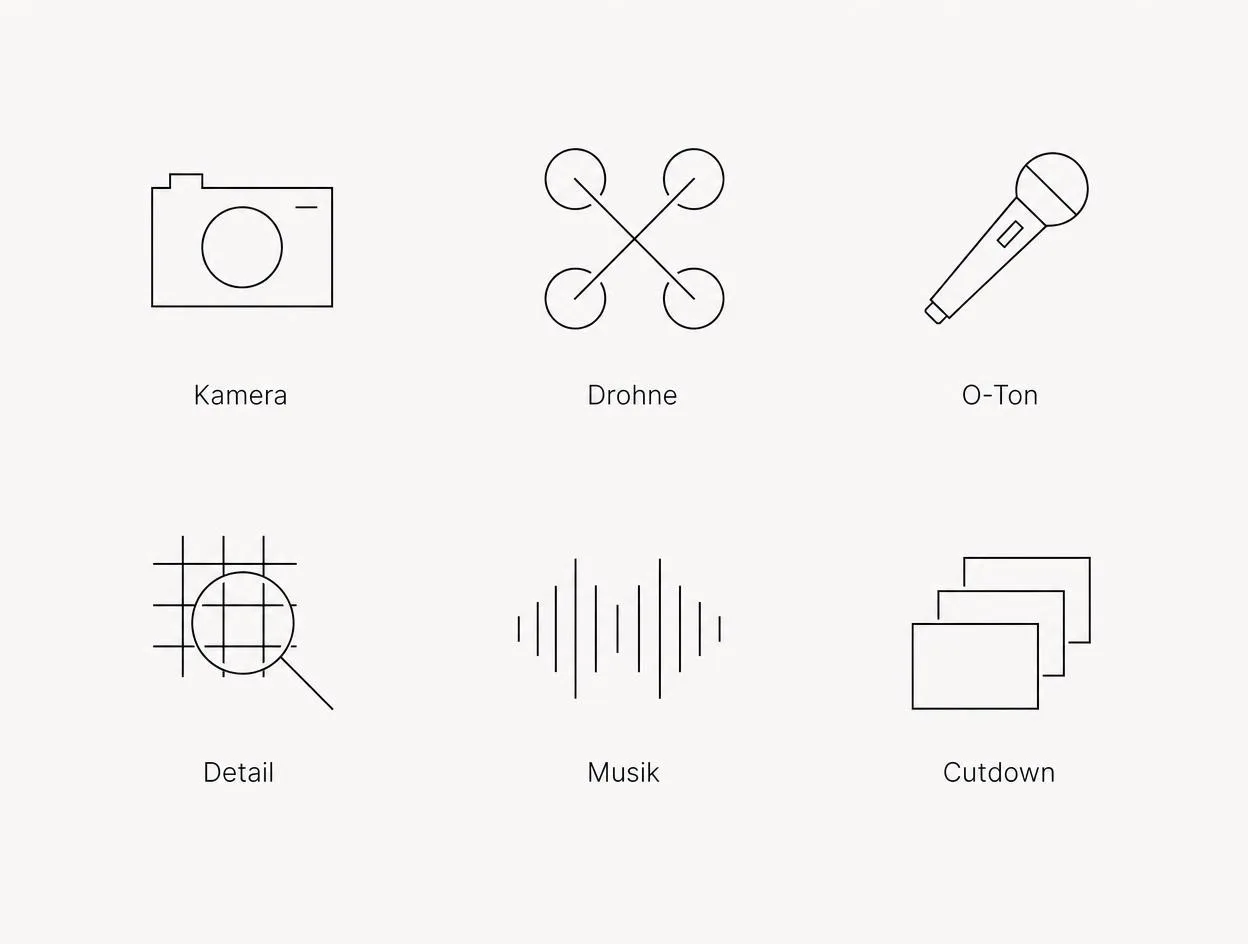
An aftermovie only works if it shows more than full rooms. These elements make the difference:
- Arrival and setup: quiet footage before the bustle gives the film a beginning.
- Faces rather than wide shots: reactions convey emotion; wide-angle shots only convey information.
- Soundbites: three short comments from guests or speakers can replace any explanatory narration.
- Details: catering, signage, materials. This is exactly where your branding visibly pays off.
- A high point: a moment the edit builds towards, rather than a uniform sequence of shots.
The best aftermovie takes shape not on the filming day, but in the briefing two weeks beforehand. If we know which three moments matter and who is allowed to speak on camera, there is no need to rush around on the event day.
Practical example: ZOO Event
For ZOO Event, the events division of Kölner Zoo, we brought together brand, website and video. The starting point was typical of event venues: plenty of impressive spaces, but no material that conveyed the atmosphere of a real event. Instead of producing architectural shots, we showed the venues in use, with guests, lighting and animals in the background. The result now serves as a video layer on the website and is used in communications with corporate clients.
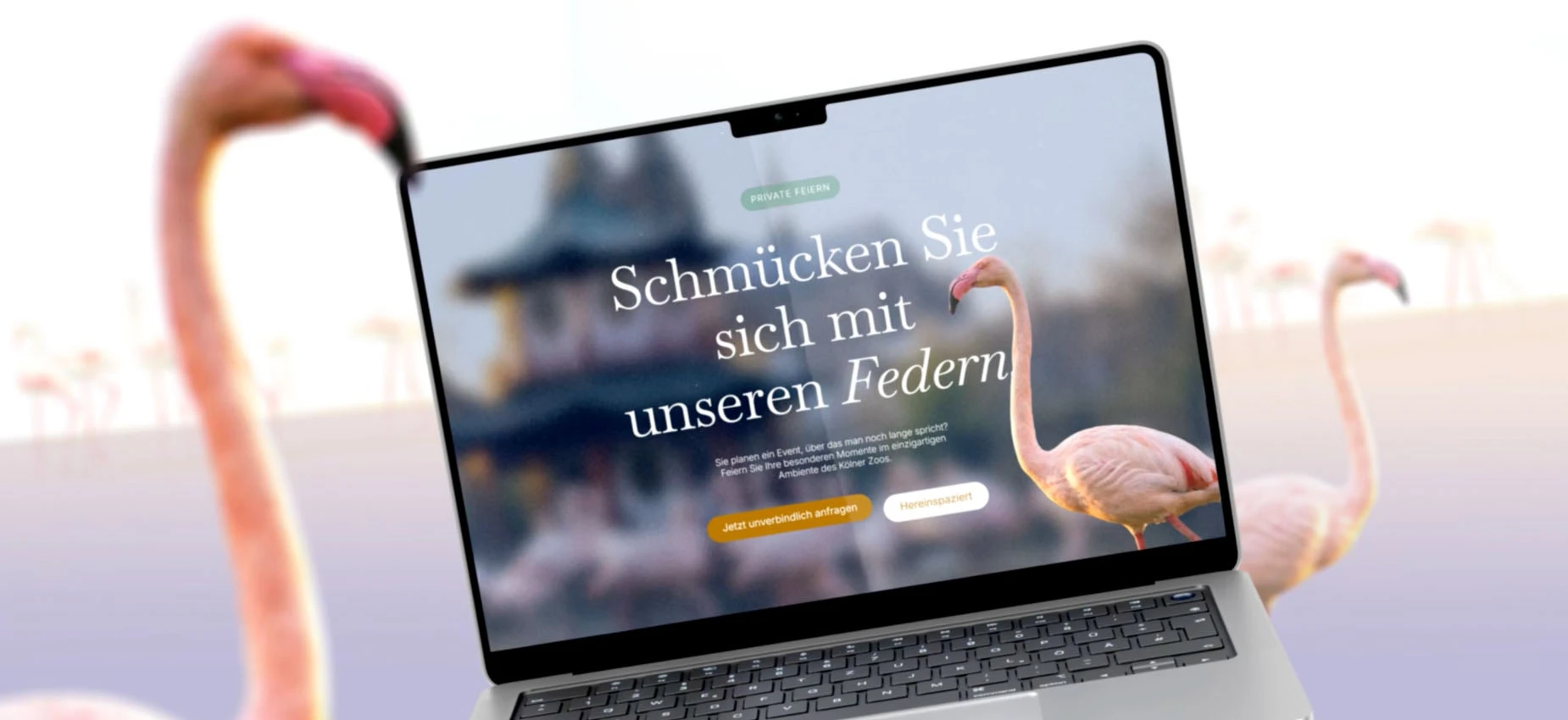
View the full case study: ZOO Event →
Practical example: Recharge Lounge 2025
You can see what a finished aftermovie looks like in our event aftermovie for Recharge Lounge 2025 by LaLinea: one evening with guests and live acts, condensed into two minutes. The full offering is on the Event Aftermovie product page.
Preparation: the checklist before the event day
- Define the goal: registrations for the next edition, evidence of sponsor exposure or recruitment. The goal determines the edit.
- Agree on the shot list: which programme items, rooms and people must be included.
- Approach interviewees in advance, not in a hurried conversation on the event day.
- Clarify image rights: notices on tickets, signage at the entrance, clearly marked camera-free areas.
- Check the technical setup on site: stage lighting, access to the mixing desk for clean audio, drone permission.
- Work backwards from the publication date and reserve editing capacity.
After the event: plan distribution
An aftermovie that only sits on your website is not doing its job. Include distribution in your planning:
- LinkedIn: publish the main version as a native video, not a YouTube link. Subtitles are essential because most people watch without sound.
- Instagram and TikTok: a portrait-format cutdown with the strongest three seconds at the start.
- Website: embed it on the event page, with text underneath so the page provides content for search engines even without video playback.
- Sponsors and partners: a dedicated version with visible brand placement makes negotiations for the next edition easier.
- Newsletter: link a still image with a play icon rather than embedding the video.
Our overview of commissioning a brand film shows how video fits into a broader content strategy.
Common mistakes
- Too long: anything over three minutes loses the attention of people outside your own organisation.
- Music carries the film on its own, with no voices or substance.
- Only going online weeks later, when nobody is talking about the event any more.
- Logos and sponsors only appear in the end credits rather than visibly within the action.
- No portrait format, which means no reach on channels that attract younger audiences.
The event day from the camera's perspective
An aftermovie is not made in the edit, but during the hours when everyone else is celebrating. A realistic schedule for a one-day event:
| Time slot | What is filmed | Why it is needed later |
|---|---|---|
| 2 hours before doors open | Empty venue, setup, details | Calm opening shots and transitions in the edit |
| Doors open, first 30 minutes | Arrivals, first faces, anticipation | The film's emotional opening |
| Main programme | Stage, audience reactions | The high point, usually in the middle of the film |
| Quiet periods | Conversations, sponsor displays, portrait footage | Social cutdowns and evidence of sponsor exposure |
| Final hour | Evening atmosphere, farewells | The closing sequence, often the strongest shot |
If you only arrive for the main programme, you will have no beginning and no ending, just a middle. It shows in every aftermovie.
What typically goes wrong on set
- No contact person on site. If nobody can say when the managing director is speaking, the camera will miss that very moment. One person from the team must be available all day.
- Evening lighting. Indoor spaces are almost always too dark for good footage. A small portable light can save the final hour, but it needs to be planned in advance.
- Stage audio. A recording from the mixing desk sounds ten times better than the camera microphone. A five-minute conversation with the on-site technical team is all it takes.
- No consent. A filming notice at the entrance, plus written consent from everyone who speaks in the film. Without this, publication is open to legal challenge.
- Sponsors only in the end credits. Nobody sees logos that only appear at the end. Footage showing the brand within the action is better.
Music rights for social media
The most common mistake in aftermovies is using a current chart hit. On Instagram and TikTok, a personal profile can use commercial music through the platform library, but a business account cannot. The result is either a muted film or a block. Safe options:
- Licensed music from a library with a commercial licence for social media and web, from around 30 € per track.
- Extended licence as soon as the film is used in paid advertising, usually 150 to 400 €.
- Original composition, from around 800 €, worthwhile for an event series that returns every year.
Clarify the licence before editing. A film edited to one track cannot simply have different music added afterwards; that takes a full day of editing.
One version is not enough
A single filming day should ideally produce several edits, each with its own purpose:
| Version | Length | Format | Use |
|---|---|---|---|
| Main film | 90 to 150 Sek. | 16:9 | Website, YouTube, sponsor report |
| Teaser | 20 to 30 Sek. | 1:1 or 9:16 | Feed and Stories immediately after the event |
| Reel | 15 to 45 Sek. | 9:16 | Reach, younger audiences |
| Sponsor edit | 30 to 60 Sek. | 16:9 | Evidence for partners and funders |
| Teaser for next year | 20 Sek. | 9:16 | Registration launch for the next event |
The teaser should be online within 48 hours, while people are still talking about the event. The main film can take two to three weeks, as its role is long-term anyway.
For ZOO Event, we edited the short teaser that same night and put it online in the morning. It generated more reach than the finished main film three weeks later because people were still caught up in the experience.
What an aftermovie costs and what affects the price
| Scope | Service | Guide price |
|---|---|---|
| Compact | One camera operator, half a day, one 60 Sek. edit | 1.200 to 1.900 € |
| Standard | Full event day, main film plus two cutdowns | 2.500 to 4.500 € |
| Extensive | Two cameras, drone, interviews, five versions | 5.000 to 9.000 € |
| Event series | Multiple dates, recurring format | Framework agreement |
The biggest cost driver is not the equipment, but the number of edits. A second camera operator costs a day rate; five additional formats take several days of editing.
How to get more use from the footage
An aftermovie is really a footage archive that can provide content for months:
- Immediately after the event: teaser and photos, while memories are fresh.
- Two weeks later: main film with thanks to partners and guests.
- After four to six weeks: individual speaking segments as short clips, each usable on its own.
- Three months later: a recap as evidence of reach and quality when approaching sponsors.
- When registration opens for the following year: a short version showing why people should attend.
This way, one filming day pays for not just one film, but a year of communications around the event.
Briefing checklist for your event
Give the crew these details in writing beforehand so the day runs without follow-up questions:
- Schedule with timings and the three most important moments marked
- On-site contact person with mobile number
- List of people who must appear in the film
- Sponsors and partners whose visibility is contractually agreed
- Areas where filming is not permitted
- Target channels and required formats, including the teaser deadline
- Contact for the event technical team to arrange the audio feed
Frequently asked questions
What is an aftermovie?+
How much does an aftermovie cost?+
How long should an aftermovie be?+
How quickly can an aftermovie be finished?+
What is the difference between an aftermovie and a brand film?+
How do you handle image rights at an event?+
Do you need a drone for an aftermovie?+
How do you get good audio at an event?+

Josef leads the strategic and creative development of brands at Maluure. For over a decade, he has guided medium-sized businesses from brand positioning to digital delivery.
Managing Director of Maluure GmbH, Cologne. Specialising in corporate design, brand strategy and digital brand experiences.
Weiterlesen
Using a corporate film on social media: twelve weeks of content from one shoot day
A corporate film is not a one-off asset, but a bank of source material. How to turn one shoot into formats for LinkedIn, Instagram, your website and sales, with an editing plan, content calendar and practical example.
Corporate video scripts: storytelling that works in 90 seconds
The script determines whether your corporate video makes an impact or just looks good. Structure, narrative, common mistakes and a shot list that saves the shoot day.

Officially certified: Maluure is a Lovable Partner
Since 16. September 2026, Maluure has been an officially certified Lovable Partner, Expert Website Builder and Expert App Builder. What the certification involves and what it means for your project.
Explore more blog topics
Corporate film or recruitment video: What your company really needs
Both films cost a similar amount but have very different effects. This comparison shows which format suits which goal and how to produce both in a single day of filming.
LinkedIn Video: Formats, Lengths and Best Practices for Businesses
What works for LinkedIn video: formats from 1:1 to 9:16, the right length for each objective, subtitles, hooks and upload strategy. A concise guide for businesses.
Recruitment video: showing employees as they really are
How a recruitment video shows real employees rather than glossy clichés, what it costs and why authenticity brings in more applications.