Webflow developers: how to recognise genuine expertise
Portfolio, CMS experience, custom code and maintenance: six criteria and the key red flags to help you properly assess a Webflow developer or agency.

Why your choice of Webflow developer determines the project's success
Webflow lowers the barrier to entry. Anyone can buy a template, change the colours and call themselves a “Webflow developer”. The difference between a site that serves you well for two years and one that the editorial team can no longer maintain after three months rarely comes down to design. It lies in the underlying structure: clearly defined classes, a well-planned CMS, well-built interactions and a plan for ongoing operation.
This article shows you how to recognise genuine Webflow expertise, which questions to ask in your first meeting and when a freelancer is enough – and when they are not.
Freelancer or agency: an honest comparison
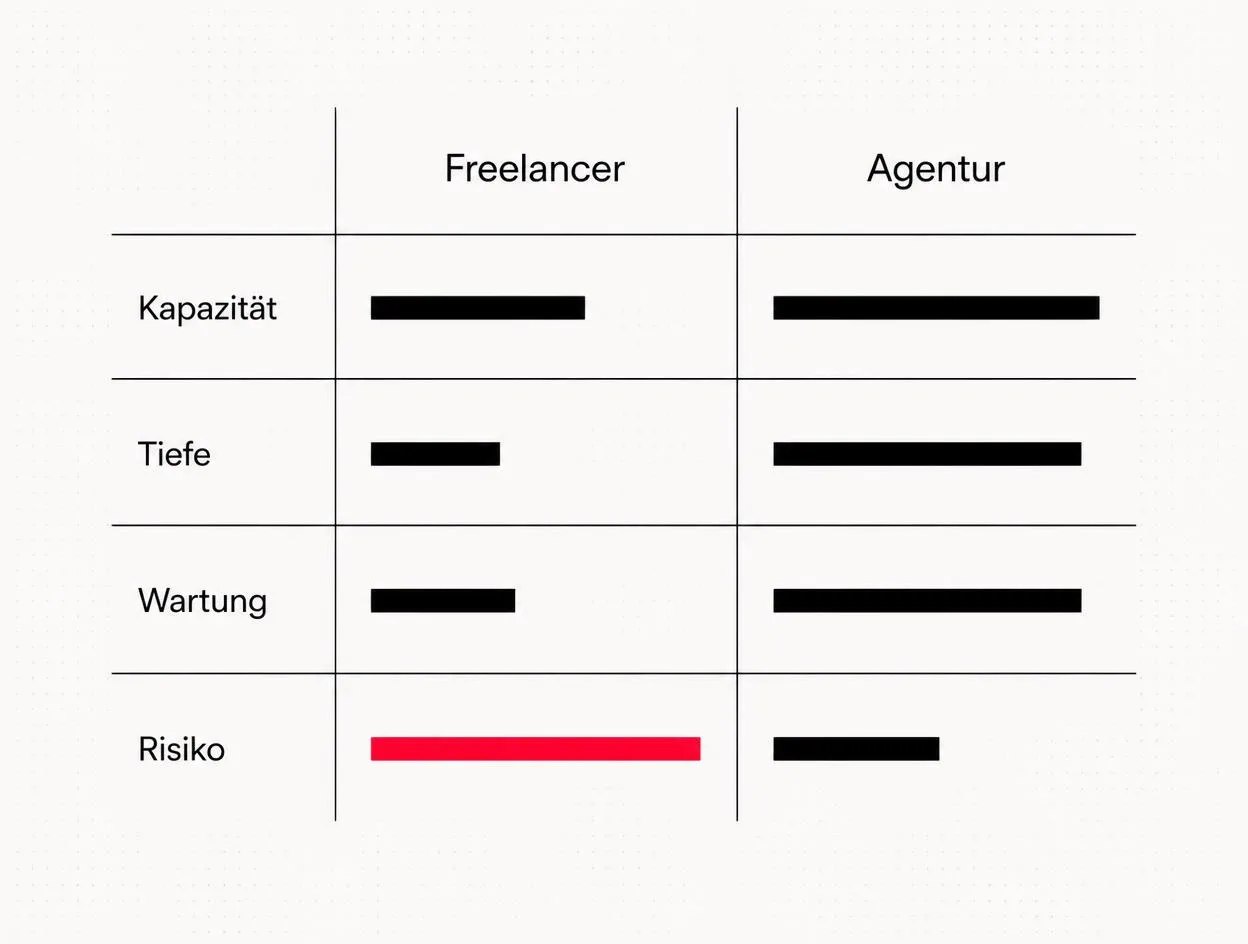
Both can work. The question is how large and complex your project is, and how long it needs to last. As with choosing between an SEO freelancer or agency, it is less about ability than capacity and continuity.
| Criterion | Freelancer | Agency |
|---|---|---|
| Project size | One-page sites to small company websites | CMS projects, migrations, multilingual sites |
| Disciplines | usually one core skill (design or build) | Strategy, design, build, SEO, content in one team |
| Response time | depends on workload and holidays | team cover available, fixed SLA possible |
| Costs | lower day rate | higher day rate, less coordination overhead |
| Continuity risk | high (single point of failure) | low |
| Ongoing operation | often not included in the proposal | maintenance and ongoing development can be planned |
Criterion 1: a portfolio of real Webflow projects
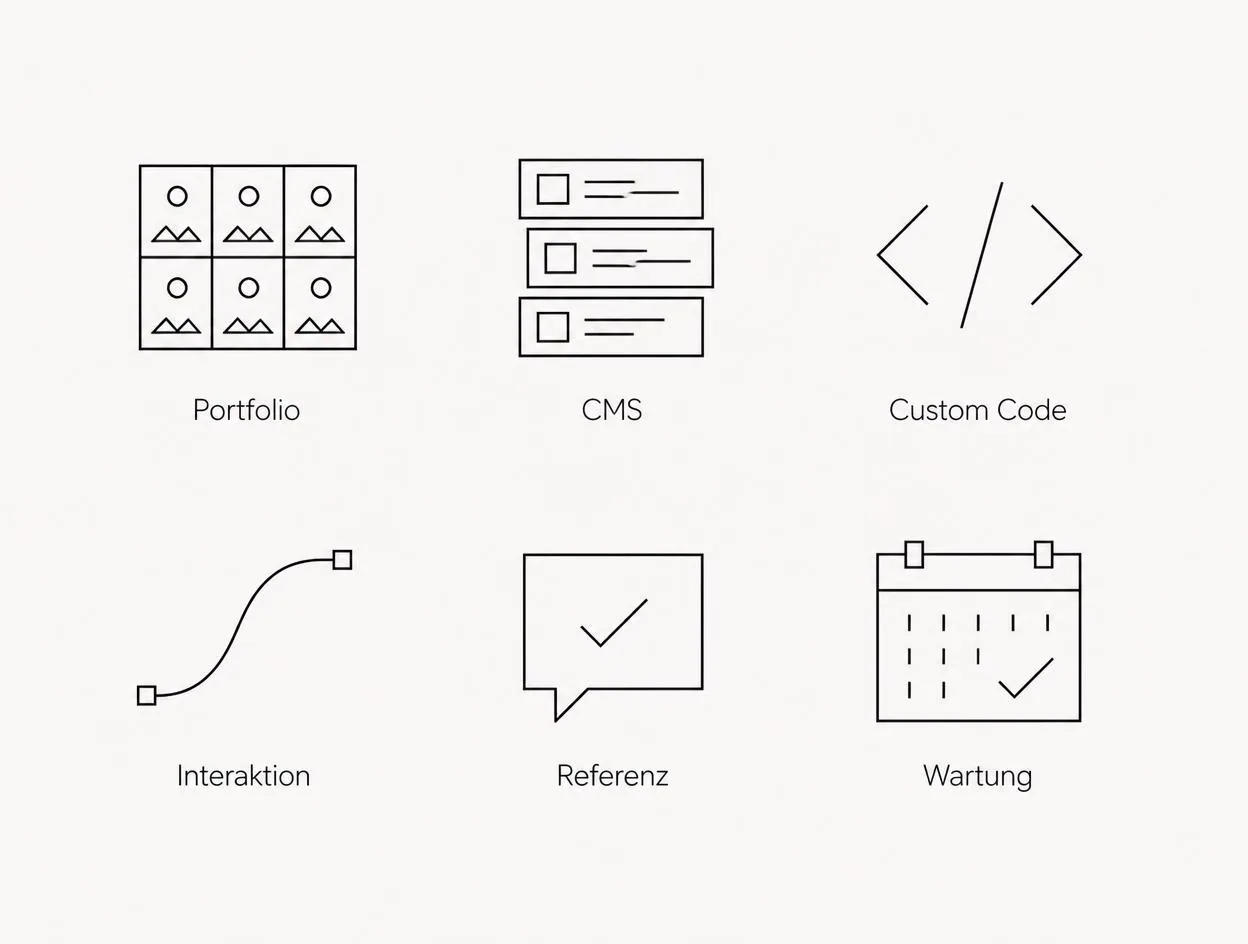
Ask to see live links, not screenshots. Webflow sites are identifiable: the source code contains webflow.js, and the class structure from the Designer appears in the page source. Check three things:
- Are the projects still online and actively maintained?
- Are the sites distinct, or do they look like the same template in three colours?
- Is there at least one project of a similar scale to yours?
Criterion 2: CMS experience, not just design
The Webflow CMS is where beginners and professionals part ways. Ask specific questions:
- How are Collections modelled when content is reused (e.g. author, category, location)?
- How are the CMS limits accounted for – Webflow allows a limited number of Collections and fields per site?
- What does the editorial interface look like? Can someone create a post without knowing how to use the Designer?
Anyone whose only answer is “we'll do that in the Editor” has not yet been responsible for a CMS project.
Criterion 3: custom code and Finsweet
Much of what a business needs falls outside Webflow's standard features: filtering CMS lists, displaying more than 100 items in a list, tables, search and form logic. Finsweet Attributes and custom JavaScript code can handle these requirements. The question is: can your developer use both, and do they know when not to?
- Knowledge of Finsweet Attributes (CMS Load, CMS Filter, CMS Nest)
- custom JavaScript in the page or site custom code, version-controlled and documented
- understanding of the performance implications: every script adds to loading time
The best answer to a question about custom code is not “of course, anything is possible”. It is: “We'll use native features for that, because someone will still need to maintain it in two years.” Anyone who immediately suggests a script has often not looked for the simpler solution.
Criterion 4: interactions in moderation
Webflow interactions are powerful, which is precisely why they carry risks. Good developers build animations that help users find their way: loading states, brief scroll reveals and hover feedback. Poor developers build effects that stutter on smartphones and delay the first visible content. Ask about the mobile performance of a reference project and check it yourself with PageSpeed Insights.
Criterion 5: verifiable references
A reference only counts if you can call the client. Ask for two contacts from completed projects and ask three questions: Was the schedule met? What went wrong, and how was it resolved? Would you work together again?
Criterion 6: ongoing operation after launch
A website is not a project with an end date, but a system that remains in operation. Clarify the following before signing a contract:
- Who owns the Webflow Workspace, and who pays for the hosting plan?
- How are change requests handled – an allocation of hours, a flat fee or ad hoc requests?
- Who regularly checks forms, redirects and loading times?
You can find details of ongoing costs in our Webflow pricing breakdown.
Red flags: how to spot a lack of expertise
| Red flag | Why it is a problem |
|---|---|
| Template customisation with no underlying plan | Structure and content do not fit your business, and disorganised classes remain |
| No questions about goals or target audience | Design becomes a matter of taste rather than informed decisions |
| No maintenance included in the proposal | You are on your own after launch, and every small change becomes a separate job |
| The provider retains access credentials | You cannot access your own site |
| No explanation of SEO fundamentals | Redirects, metadata and structure get overlooked during the relaunch |
| Fixed price without a defined scope | Additional charges and disputes are inevitable |
Practical example: Chaerry GmbH
For Chaerry GmbH, we built a website where animation and structure had to work together: animated visuals above the fold, backed by a clear site architecture that the agency can maintain itself. This is exactly where expertise shows – the animation is the visible part; the maintainable class and content structure is the valuable part.

Read the full case study: Chaerry GmbH →
When an agency is the better choice
Once several disciplines overlap – strategy, design, CMS setup, migration, SEO and editorial work – coordination becomes a service in its own right. An individual developer can build excellent sites, but cannot simultaneously structure content, plan redirects and train the editorial team. That is exactly what teams are for.
If you want to know how a project like this works in practice, what it costs and who works on it, our Webflow agency page covers the scope of services, price ranges and references. For an introduction to the platform itself, start with What is Webflow? and the Webflow vs. WordPress comparison.
Frequently asked questions
What does a Webflow developer do?+
How do I recognise a good Webflow developer?+
Freelancer or agency for Webflow?+
How much does a Webflow developer cost?+
What are Finsweet Attributes, and why do they matter?+
Which red flags should I look out for when choosing a Webflow provider?+
Do I still need a Webflow developer after launch?+
Who owns the Webflow project once it is built?+

Josef leads the strategic and creative development of brands at Maluure. For over a decade, he has guided medium-sized businesses from brand positioning to digital delivery.
Managing Director of Maluure GmbH, Cologne. Specialising in corporate design, brand strategy and digital brand experiences.
Weiterlesen
Using a corporate film on social media: twelve weeks of content from one shoot day
A corporate film is not a one-off asset, but a bank of source material. How to turn one shoot into formats for LinkedIn, Instagram, your website and sales, with an editing plan, content calendar and practical example.

Corporate video scripts: storytelling that works in 90 seconds
The script determines whether your corporate video makes an impact or just looks good. Structure, narrative, common mistakes and a shot list that saves the shoot day.

Officially certified: Maluure is a Lovable Partner
Since 16. September 2026, Maluure has been an officially certified Lovable Partner, Expert Website Builder and Expert App Builder. What the certification involves and what it means for your project.
Explore more blog topics
Corporate film or recruitment video: What your company really needs
Both films cost a similar amount but have very different effects. This comparison shows which format suits which goal and how to produce both in a single day of filming.
LinkedIn Video: Formats, Lengths and Best Practices for Businesses
What works for LinkedIn video: formats from 1:1 to 9:16, the right length for each objective, subtitles, hooks and upload strategy. A concise guide for businesses.

Recruitment video: showing employees as they really are
How a recruitment video shows real employees rather than glossy clichés, what it costs and why authenticity brings in more applications.