Recruitment video: showing employees as they really are
How a recruitment video shows real employees rather than glossy clichés, what it costs and why authenticity brings in more applications.
Why recruitment videos matter right now
Skilled professionals now compare employers as they would products: they check reviews, scroll through LinkedIn and click through careers pages before even reading a job advert. According to a study by the Bundesagentur für Arbeit, most companies expect continued difficulties finding skilled staff in the medium term[1]. In this environment, a recruitment video is not a nice-to-have, but a way to build trust.
The reason is simple: text can make claims; video has to show evidence. When three employees explain on camera why they stay, a candidate is more likely to believe them than any sentence on a careers page. This is an opportunity, particularly for small and medium-sized businesses, where company culture is often the strongest advantage over large corporations.
Authentic rather than glossy: the most important principle
The most common mistake in recruitment videos is trying to look perfect. Memorised lines, staged high-fives, a meeting room where nobody ever works. Candidates spot this immediately, and the video achieves the opposite: distrust.
In practice, authenticity means:
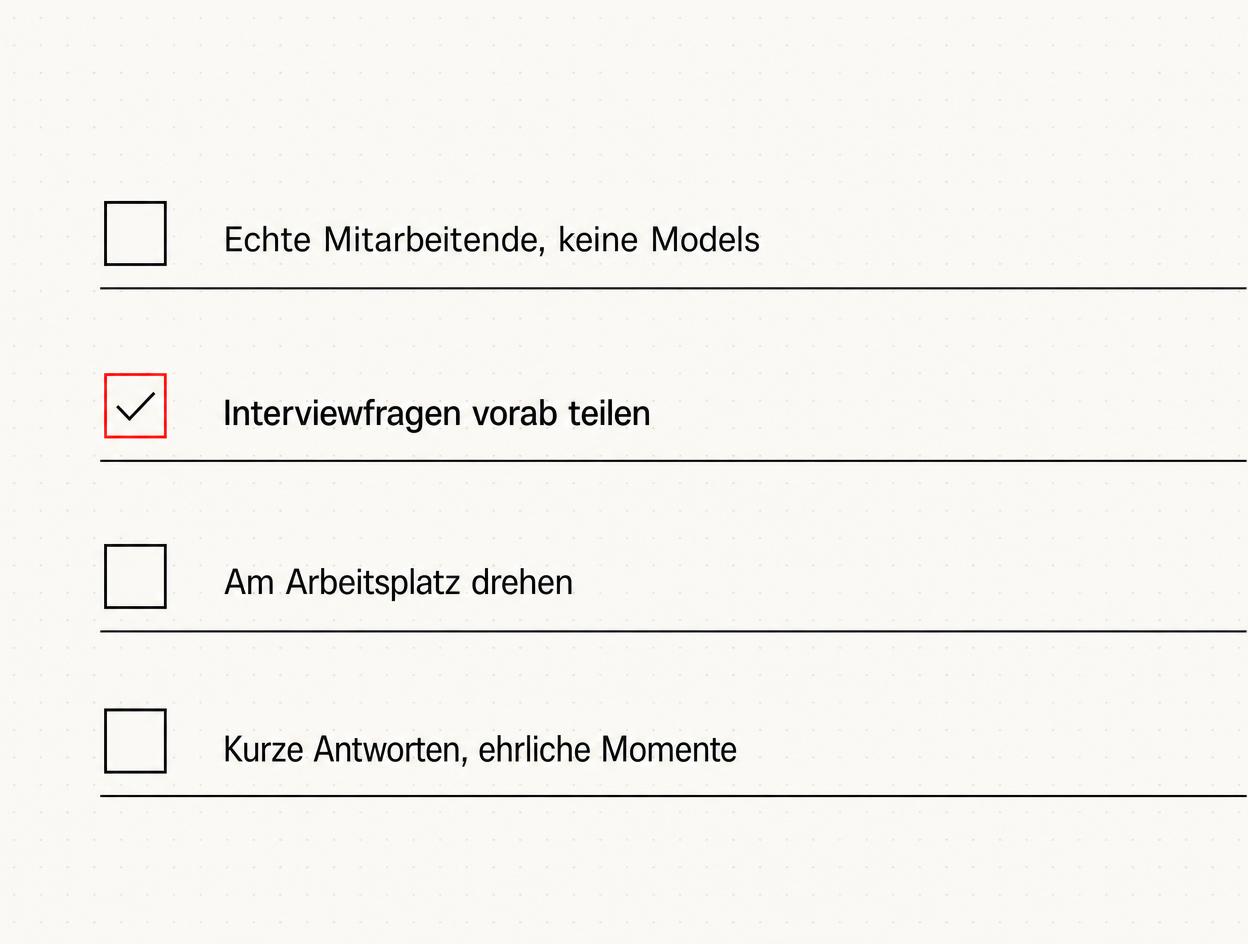
- Real employees rather than models. No actors, no apprentices repeating lines from management.
- Honest answers rather than advertising slogans. The answer to "What sometimes annoys you?" belongs in the video too. These are precisely the moments that build credibility.
- The real workplace. Workshop, office, construction site, practice. Not the most attractive studio, but the place where the work actually happens.
- Everyday life rather than events. An ordinary Tuesday is more convincing than a summer party highlights reel.
How a recruitment video is made: the process
A good recruitment video needs less filming time than most people think. Preparation is what matters.
- Concept and selection. We establish which roles need filling and who the video needs to reach. Then we work together to select three to five employees from different departments and levels of seniority.
- Interview questions in advance. Everyone involved receives the questions one to two weeks before filming. Nobody should be caught off guard, but nobody memorises answers. For example, we ask: What does your typical day look like? What persuaded you to apply? What advice would you give a new colleague?
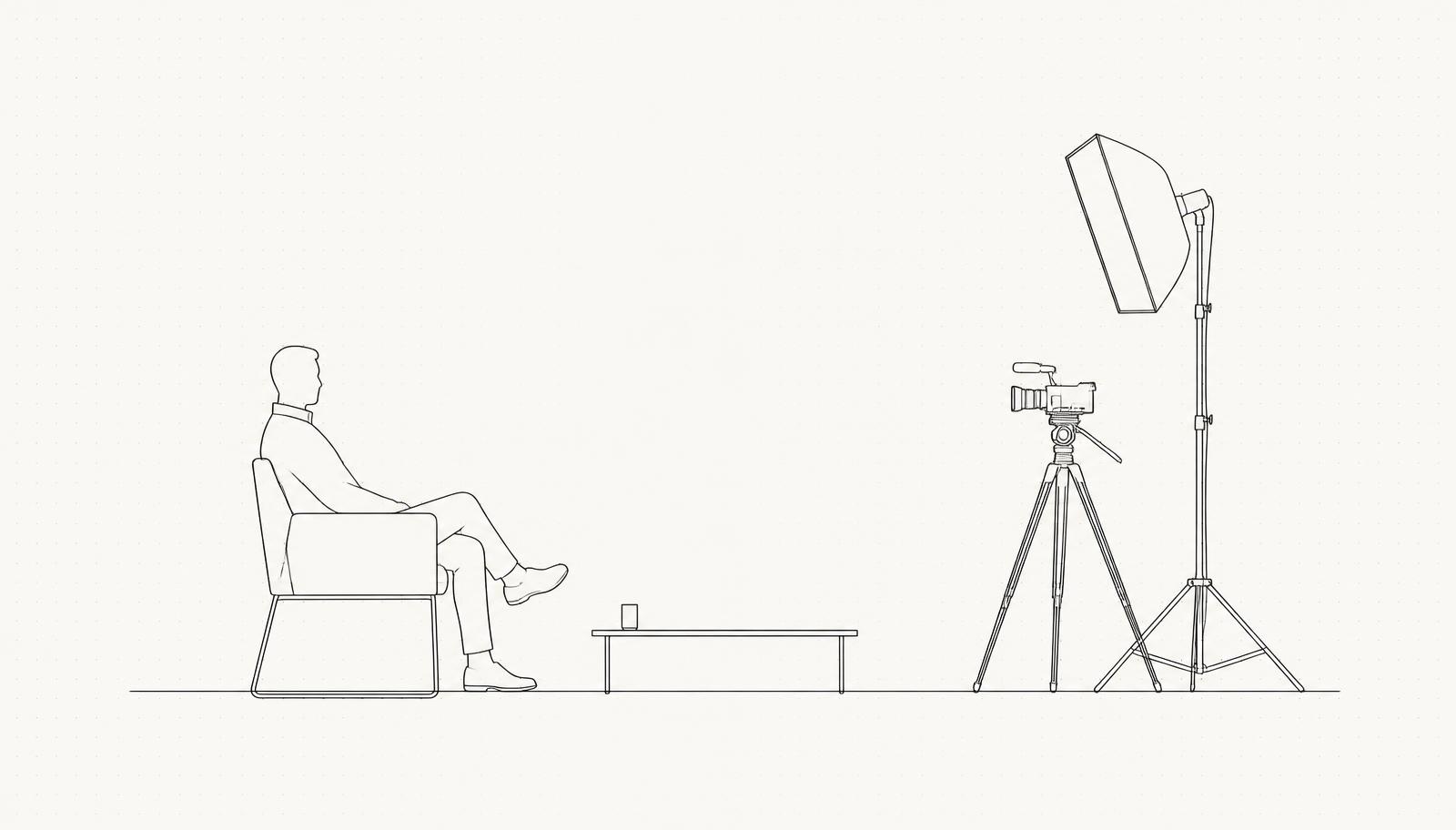
- The filming day. We allow 45 to 60 minutes per person: a brief warm-up, an interview in a relaxed setting, then supporting footage at their workplace. We deliberately keep the crew small so nobody feels as though they are on stage.
- Editing and distribution. A main film of two to three minutes for the careers page, plus short versions of 30 to 60 seconds for LinkedIn, Instagram and job boards. Subtitles are always included, as most people watch without sound[2].

How much does a recruitment video cost?
A recruitment video costs less than a traditional corporate film because it does not need elaborate staging. As a guide:
| Scope | Content | Price range |
|---|---|---|
| Compact | 3 interviews, 1 filming day, main film plus 2 short versions | 2.500 to 4.500 Euro |
| Standard | 4 to 6 interviews, 1 to 2 filming days, main film plus 4 to 6 short versions | 4.500 to 8.000 Euro |
| Series | Several filming days throughout the year, ongoing social media content | from 1.500 Euro per month |
We have broken down the costs behind film production in detail in our article Corporate film costs: what a professional corporate film really costs. Our article Video production in Cologne shows exactly how a production with us in Cologne works.
These five mistakes ruin any recruitment video
- Only management speaks. Candidates want to hear from future colleagues, not the executive team.
- Memorised scripts. If answers sound as though they are being read aloud, everything feels staged. Better: know the questions, answer in your own words.
- Only showing the good side. Hiding drawbacks creates expectations that everyday reality cannot meet, and you lose new employees during their probation period.
- No specific next step. Every video needs a clear call to action at the end: job adverts, careers page, direct contact.
- One film for everything. A five-minute film does not work on LinkedIn. Plan short versions from the outset.
The best lines in our recruitment videos were never planned. They happen when someone forgets the camera is running. Our job is to protect those moments, not edit them out.
The interview guide: questions that get real answers
The quality of a recruitment video comes down to the questions. Closed or promotional questions produce advertising lines. These work:
- Describe your last ordinary working day, from morning to evening.
- What surprised you during your first few weeks here?
- What was really demanding recently, and how did it turn out?
- What does your team help you with without you having to ask?
- What would you say to someone who is thinking about applying here and is genuinely unsure?
- What do you do here that you could not do elsewhere?
Ask each question twice. The first answer is the prepared one; the second is the real one. And leave three seconds of silence after the answer instead of speaking again straight away. Those three seconds often produce the line that ends up in the film.
What to leave out: Questions about company values, the mission statement and what makes the company special. Nobody answers those convincingly.
Process and time required per person
| Step | Duration | Note |
|---|---|---|
| Preliminary chat without a camera | 10 Min. | Eases nerves, establishes topics |
| Setup at the workplace | 15 Min. | Lighting and sound, not at the conference table |
| Interview | 20 to 30 Min. | Produces 45 to 90 Sek. in the film |
| Filming work in progress | 15 Min. | Cutaway footage, usable without sound |
| Signing the consent form | 5 Min. | On site straight away, not later |
Four to five people in one filming day is realistic. If you plan six or more, you will get tired interviews by the afternoon.
The legal side, brief and practical
Consent must be obtained in writing, be voluntary and revocable at any time, and specify where and for how long the film will be shown. Three points that cause problems in practice:
- Withdrawal of consent after leaving. It happens. Plan the film so individual people can be edited out, rather than having one person carry the entire film.
- Voluntary participation. Nobody should feel obliged. Anyone who does not want to take part is not filmed, even in the background.
- Usage period. Two to three years is common and fair. Unlimited use sounds convenient, but consent is withdrawn more often.
Practical example: NSB Polymers
At NSB Polymers, an industrial company with products that need explaining and a need for skilled staff, the starting point was typical: candidates could not picture what working there actually looked like. Instead of a glossy production, we showed the real manufacturing process, with the people who work there every day, speaking in their own words. The effect is less about the number of applications than how well they fit: those who get in touch know what to expect.

Read the full case study: NSB Polymers →
In industry, we often hear that the workplace needs to look better than it really is. The opposite is true. Show the factory floor as it looks and sounds, and you get applications from people looking for exactly that, saving yourself three candidates dropping out after a trial day.
Where to distribute the video
A recruitment video that only sits on the careers page does not reach people who have not yet applied. Useful distribution channels:
- Careers page, at the top, not hidden below the list of vacancies.
- The job advert itself, as many job boards allow embedded videos.
- LinkedIn and Instagram, but as a short portrait-format version under 60 seconds, as described in the article on LinkedIn video formats.
- Application process, as a link in the acknowledgement email, which reduces dropouts before the interview.
- Google Ads and Meta Ads, if the role is hard to fill.
What a recruitment video costs
| Scope | Service | Guide price |
|---|---|---|
| Single interview | One person, half a filming day, one clip | 900 to 1.600 € |
| Compact package | Three to four people, one filming day, main film plus short clips | 2.800 to 4.500 € |
| Careers series | Two filming days, several departments, a series of eight clips | 6.000 to 10.000 € |
Compare the cost with an unfilled position: depending on the role, a vacant specialist position costs several thousand Euro per month in lost output and extra work for the team. In that context, a video that reduces time to hire by a few weeks is not communications spending, but a recruitment measure.
Common mistakes that undermine the impact
- Only letting managers speak. Candidates want to see the people they will actually work with.
- Memorised lines. Someone reading a script seems less credible than someone who hesitates.
- Overly perfect visuals. A tidy office without people says nothing about the work.
- No specific information about the role. By the end, it must be clear what someone does there all day.
- No explanation of how to apply. A sentence at the end and a link are enough, but are missing surprisingly often.
One video or a series?
A single film has a one-off impact; a series has a lasting one. If you recruit regularly, a series of short clips works better: one person per department, one answer per role to the question of what a normal day looks like. These clips can be used individually in job adverts and stay relevant longer because you can replace individual parts without producing the whole film again. In practice, this means filming five people in one day, then editing the footage into five standalone clips and one main film.
Conclusion
A recruitment video is not an advert for your company, but an honest look inside it. Show real employees in their real workplace and give them room for candid answers, and you will attract applications that fit your culture. If you have vacancies and are considering a video, get in touch. Together, we will look at which format suits your roles, from a single employee interview to an ongoing video series. You can find more on the bigger picture on our page Commission a corporate film.
Frequently asked questions
What is a recruitment video?+
How much does a recruitment video cost?+
How long should a recruitment video be?+
Who should appear in the recruitment video?+
How do I prepare employees for filming?+
Do the answers in the video have to be perfect?+
Where is a recruitment video used?+
Recruitment video or corporate film: which do I need?+
Sources
- Fachkräfteengpassanalyse, Bundesagentur für Arbeit (2025)
- Video-Nutzung und Untertitel in sozialen Netzwerken, ARD/ZDF-Onlinestudie (2025)

Josef leads the strategic and creative development of brands at Maluure. For over a decade, he has guided medium-sized businesses from brand positioning to digital delivery.
Managing Director of Maluure GmbH, Cologne. Specialising in corporate design, brand strategy and digital brand experiences.
Weiterlesen
Using a corporate film on social media: twelve weeks of content from one shoot day
A corporate film is not a one-off asset, but a bank of source material. How to turn one shoot into formats for LinkedIn, Instagram, your website and sales, with an editing plan, content calendar and practical example.

Corporate video scripts: storytelling that works in 90 seconds
The script determines whether your corporate video makes an impact or just looks good. Structure, narrative, common mistakes and a shot list that saves the shoot day.

Officially certified: Maluure is a Lovable Partner
Since 16. September 2026, Maluure has been an officially certified Lovable Partner, Expert Website Builder and Expert App Builder. What the certification involves and what it means for your project.
Explore more blog topics
Corporate film or recruitment video: What your company really needs
Both films cost a similar amount but have very different effects. This comparison shows which format suits which goal and how to produce both in a single day of filming.
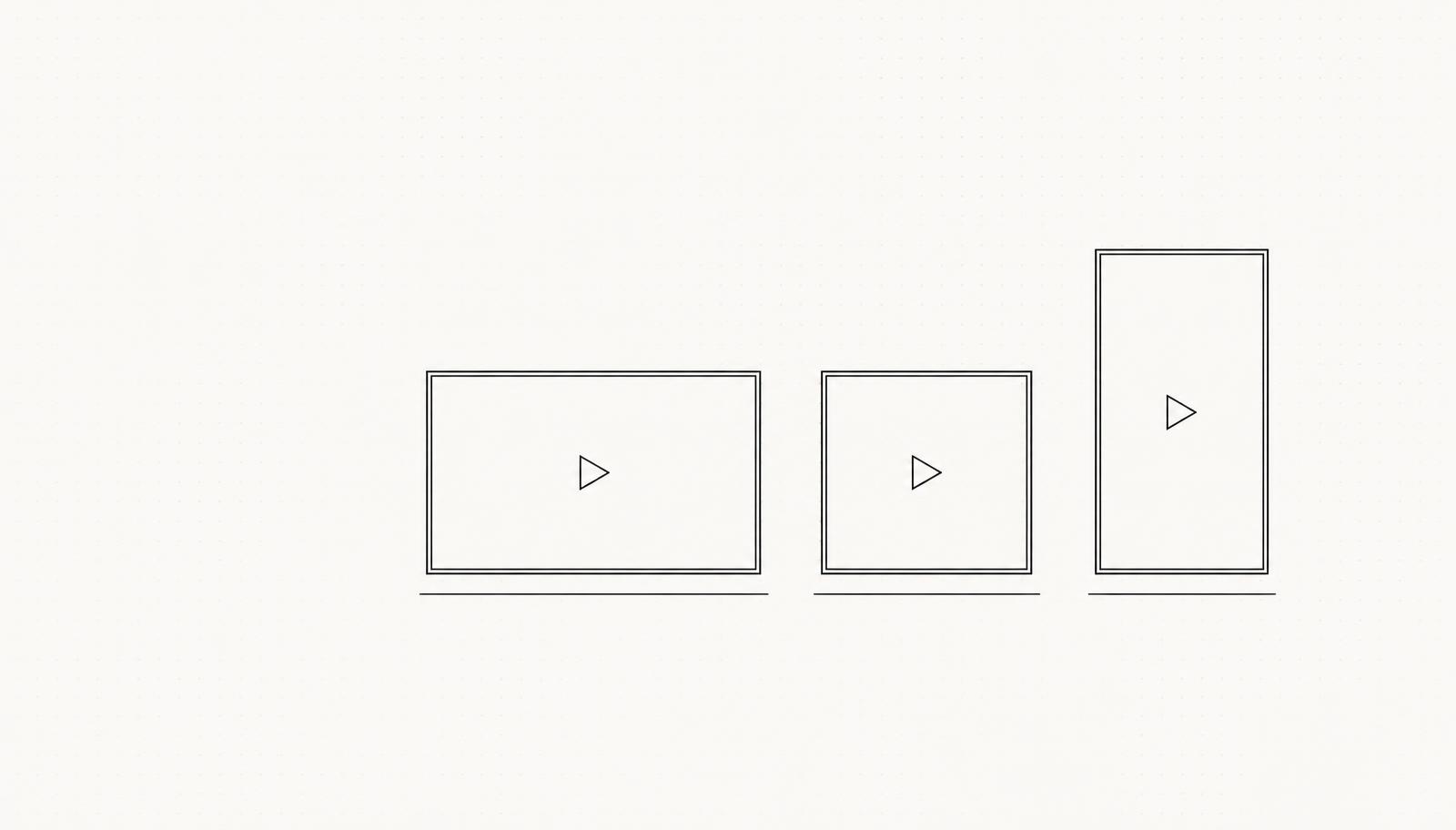
LinkedIn Video: Formats, Lengths and Best Practices for Businesses
What works for LinkedIn video: formats from 1:1 to 9:16, the right length for each objective, subtitles, hooks and upload strategy. A concise guide for businesses.
Video production in Cologne: corporate and event films from the Rhineland
What defines video production in Cologne, which filming locations the city offers and how to recognise a good film agency in the Rhineland.