Google Ads costs: budget, agency fees and what you can realistically achieve
What Google Ads really cost: media spend and agency fees explained separately, realistic costs per click, minimum budgets for SMEs and common budget drains.

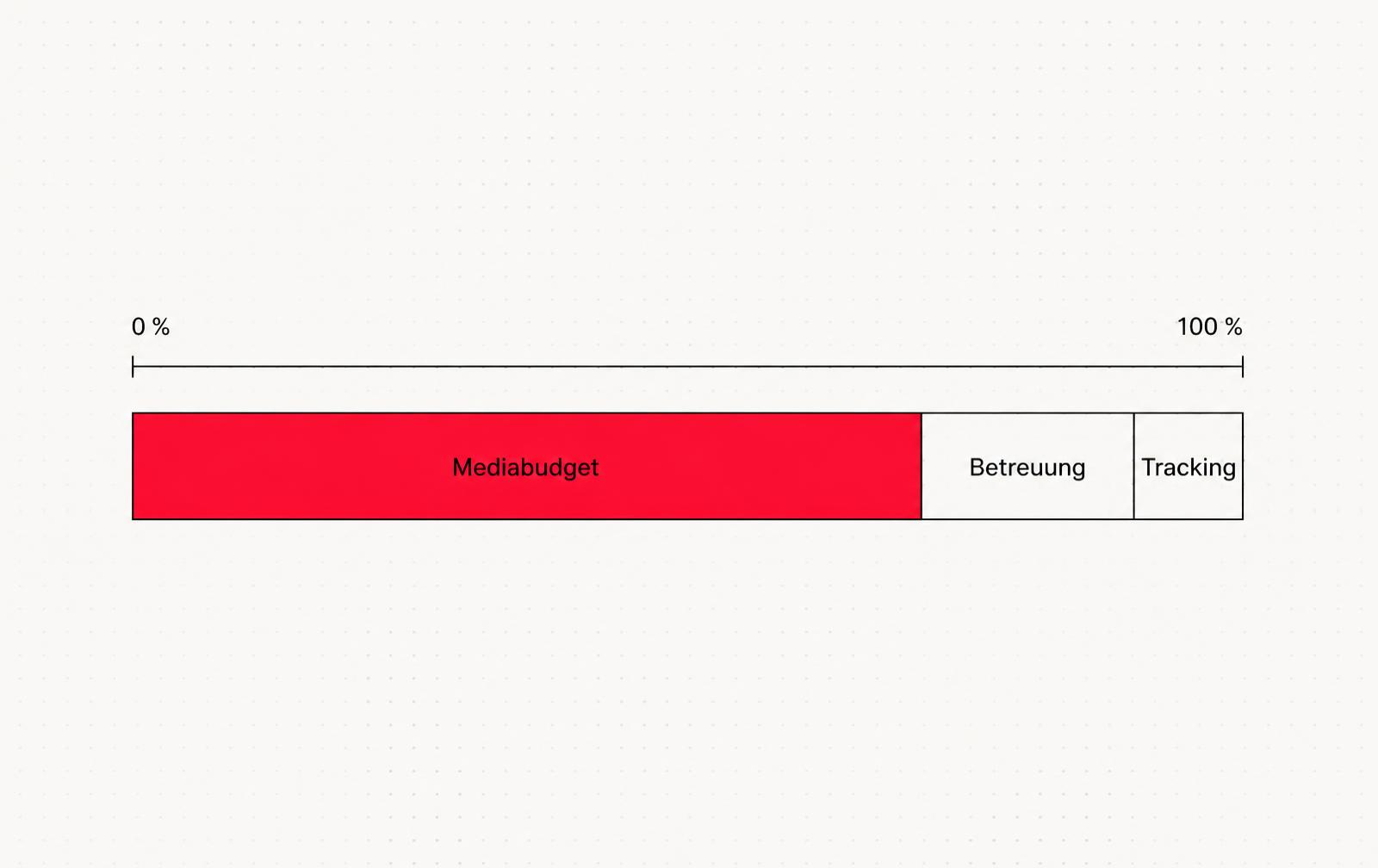
Two cost categories that are constantly confused
When someone asks “What do Google Ads cost?", they almost always mean two completely different things rolled into one figure. This is why quotes are difficult to compare and budgets regularly get out of hand.
There are exactly two categories:
- Media spend – the money that goes directly to Google. You pay per click, not per impression. Once spent, this money is gone, whether the campaign performs well or badly.
- Management – the fee for setup, structure, ad copy, bid management, negative keyword lists and reporting. This money determines how efficiently category 1 works.
Then there is a third, often forgotten item: tracking and landing page. Without reliable conversion tracking, all optimisation is guesswork, and without a suitable landing page, you waste clicks you have already paid for.
What a click realistically costs in Germany
The cost per click (CPC) is determined by an auction. It depends on how many competitors bid on the same keyword, how relevant your ad is and how well the landing page matches the search query. That is why there is no “average price", only ranges for each sector.
| Sector type | Typical CPC | What this means |
|---|---|---|
| Local trades, local services | 0,80 – 2,50 € | Low-cost clicks, but limited local search volume |
| E-commerce, consumer goods | 0,40 – 1,50 € | High volume, fierce price competition, margins are decisive |
| B2B, software, industry | 3 – 12 € | Few searches, but high order values |
| Legal, finance, insurance | 8 – 25 € | The most expensive auctions, budgets below 2.000 € rarely make sense |
| Agency and marketing terms | 8 – 20 € | Providers bid against providers, wide variation |
For context: for the term “google ads kosten", Semrush reports a CPC of around 15 US-Dollar in the German market, with roughly 1.300 searches per month[1]. This is not an outlier, but typical of search terms with clear commercial intent.
Run the numbers before you start. At 4 € CPC and 250 clicks, your media spend is 1.000 €. If 3 % of those clicks turn into enquiries, that is around 7 enquiries at roughly 140 € each. Whether that is good or bad depends entirely on your order value.
What budget makes Ads worthwhile for SMEs
There is a firm lower limit below which Google Ads cannot be managed on a statistical basis. Not because the money is insufficient in itself, but because there are too few clicks to support data-driven decisions.
- Under 500 € per month: only worthwhile with very low-cost local clicks and a single, tightly defined search term. Anything else spreads the budget too thinly.
- 500 – 1.500 € per month: the usual starting point for local SMEs. One or two campaigns, a tightly defined keyword set, a focus on search terms with purchase intent.
- 1.500 – 5.000 € per month: meaningful optimisation becomes possible here. Enough conversions for bidding strategies to work, with room to test ads and landing pages.
- Over 5.000 € per month: worthwhile for sales beyond your local region, multiple product lines or expensive B2B auctions.
The second question matters more than the budget size: how much can you afford to pay for an enquiry? If your average order brings in 4.000 € and one in three prospects buys, you can comfortably pay 200 € per enquiry. With an order value of 300 €, things look very different – Ads are often the wrong channel, and organic visibility will serve you better.
We do not launch an Ads account until we know what a customer is worth to our client. Without that figure, you are optimising for clicks rather than revenue, and that is the most expensive mistake of all.
What agencies charge for management
Three management fee models have become established. All three are legitimate, but they create different incentives.
| Model | Typical amount | Advantage | Risk |
|---|---|---|---|
| Percentage of media spend | 10 – 20 % | Scales with the account | Incentive to increase the budget |
| Fixed monthly fee | 300 – 1.500 € | Predictable, independent of budget | Relatively expensive for small accounts |
| Setup plus management | 800 – 2.500 € one-off, then a fixed fee | Pays for a properly structured start | Higher initial investment |
For small and medium budgets, a fixed fee is usually the most transparent option. An account with 800 € in media spend needs roughly as much attention as one with 3.000 € – so a percentage does not reflect the actual work involved.
Check what the fee actually includes. These items should be covered, otherwise you pay twice:
- Keyword research and account structure setup
- Ad copy, including ongoing variant testing
- Weekly reviews of search terms and negative keyword lists
- Conversion tracking and monitoring
- Monthly reporting on cost per enquiry, not just clicks and impressions
- A review meeting where decisions are made
Anyone who only sends a PDF with click figures is documenting, not managing.
Common budget drains
Almost every account we take over loses money in the same six places.
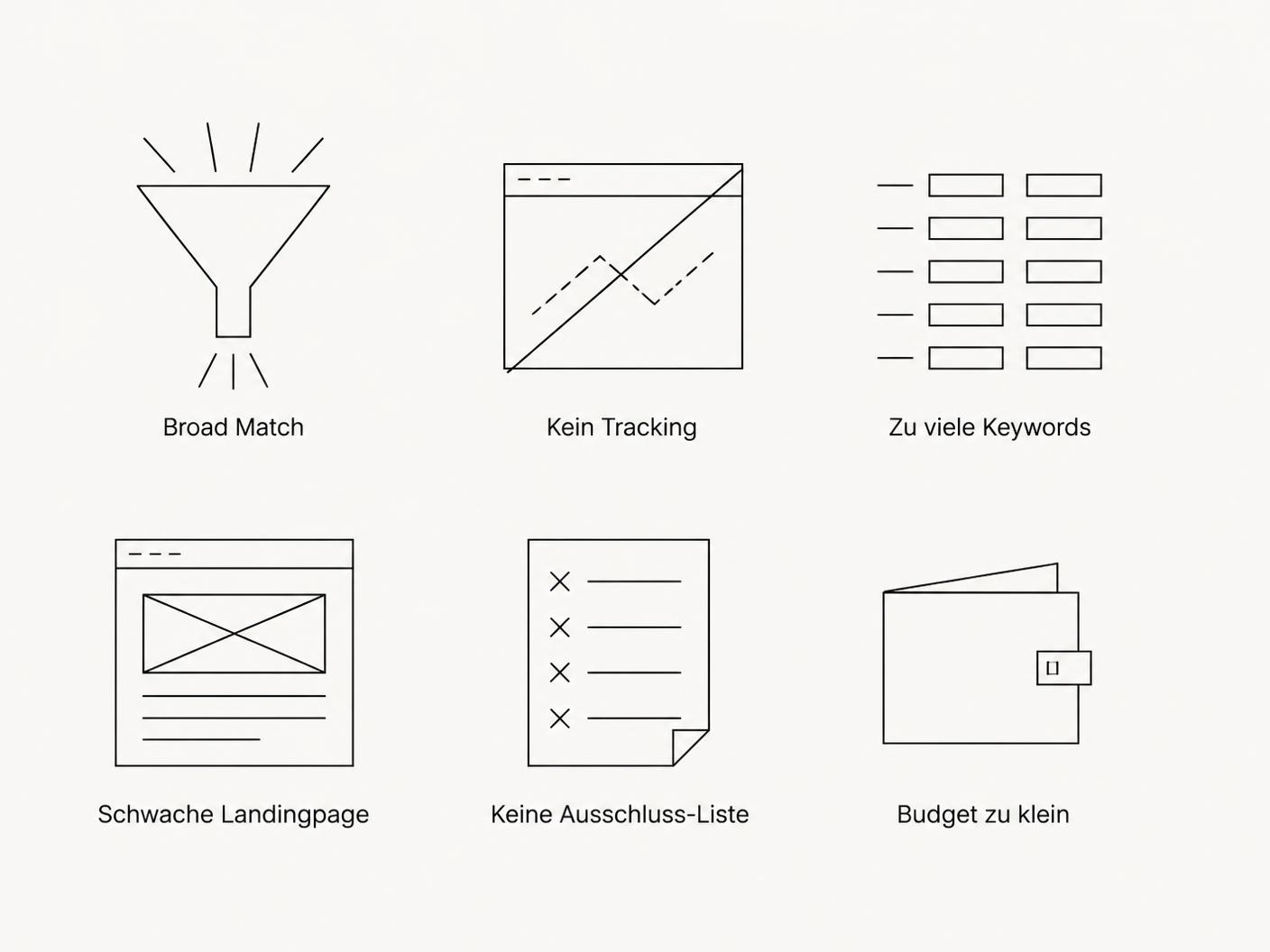
- Broad match keywords without oversight. Google interprets your terms liberally. Without a negative keyword list maintained weekly, you pay for searches that have nothing to do with your offering.
- No conversion tracking. Without tracked enquiries, the bidding strategy optimises for clicks. That is the most expensive way to buy traffic.
- Too many keywords in one campaign. The budget gets spread too thinly, no ad group gathers enough data, and nothing ever improves.
- Ads lead to the homepage. People searching for a specific service who land on a generic homepage leave. The click is paid for, but the enquiry never comes.
- Campaigns keep running unattended. In our experience, an account without regular management loses noticeable efficiency within a few months as competition and search behaviour change.
- Budget too small for the chosen auction. At 12 € CPC and a monthly budget of 300 €, you buy 25 clicks. That is not enough to make decisions.
Practical example: Dekorent GmbH
We have been the central marketing and design partner for Dekorent GmbH, the #Eventsupporter in hospitality supplies, since the company was founded. This arrangement shows exactly why Ads rarely work in isolation: we develop the brand, website, imagery and campaigns together, rather than having an Ads agency send traffic to a site someone else built.
The practical effect is simple but crucial. When ad copy, landing page and offering speak the same language, relevance in the auction increases, the cost per click falls and fewer paid visitors leave without taking action. This is where the difference emerges between an account that costs money and one that generates enquiries.

View the full case study: Dekorent GmbH →
How to calculate your budget in five steps
- Determine the order value. What contribution margin does an average customer generate?
- Estimate your close rate. How many enquiries do you need for one order?
- Calculate the maximum cost per enquiry. Divide the contribution margin by the number of enquiries needed, then take no more than a third of that figure.
- Check the cost per click in your niche. Get a rough estimate using Keyword Planner or a short test period.
- Calculate the minimum budget. You need at least 30 measurable conversions per month in the campaign to manage it effectively. Fewer means letting it run longer before making changes.
If you need an initial figure for your plans, you can put one together using the Google Ads cost calculator. It separates media spend from management fees straight away and shows what your setup will cost each month.
When Google Ads is the wrong answer
Ads amplify an offering; they do not replace one. We advise against them in three cases:
- Your offering is not clearly explained online. You are then buying visitors for a page that fails to convince them. First get your website in order, then buy traffic.
- There is simply no search demand for your product. If people are not actively searching, search ads will not reach them.
- Your budget will consistently fall short of 30 conversions per month, and you do not have the patience for six months of groundwork. You are better off investing in local visibility and content.
Ads deliver data and enquiries quickly. They do not deliver a brand, positioning or an advantage built on trust. Those things take longer to develop and last longer.
Frequently asked questions
How much do Google Ads cost per month?+
How much does a click on Google Ads cost?+
How much does a Google Ads agency cost?+
What budget makes Google Ads worthwhile?+
Do you pay per click or per impression on Google Ads?+
How can I reduce my Google Ads costs?+
How long does it take for Google Ads to work?+
Are Google Ads better than SEO?+
Do I need a dedicated landing page for Google Ads?+
Sources

Josef leads the strategic and creative development of brands at Maluure. For over a decade, he has guided medium-sized businesses from brand positioning to digital delivery.
Managing Director of Maluure GmbH, Cologne. Specialising in corporate design, brand strategy and digital brand experiences.
Weiterlesen

Using a corporate film on social media: twelve weeks of content from one shoot day
A corporate film is not a one-off asset, but a bank of source material. How to turn one shoot into formats for LinkedIn, Instagram, your website and sales, with an editing plan, content calendar and practical example.

Corporate video scripts: storytelling that works in 90 seconds
The script determines whether your corporate video makes an impact or just looks good. Structure, narrative, common mistakes and a shot list that saves the shoot day.

Officially certified: Maluure is a Lovable Partner
Since 16. September 2026, Maluure has been an officially certified Lovable Partner, Expert Website Builder and Expert App Builder. What the certification involves and what it means for your project.
Explore more blog topics

Corporate film or recruitment video: What your company really needs
Both films cost a similar amount but have very different effects. This comparison shows which format suits which goal and how to produce both in a single day of filming.

LinkedIn Video: Formats, Lengths and Best Practices for Businesses
What works for LinkedIn video: formats from 1:1 to 9:16, the right length for each objective, subtitles, hooks and upload strategy. A concise guide for businesses.

Recruitment video: showing employees as they really are
How a recruitment video shows real employees rather than glossy clichés, what it costs and why authenticity brings in more applications.