Structuring a blog post for SEO: length, E-E-A-T and keyword coverage
How to structure an individual blog post so it ranks: appropriate length, a layout aligned with search intent, genuine E-E-A-T signals and keyword coverage without keyword stuffing.

How long does a blog post need to be to rank?
Length is not a ranking factor, but an indicator. Google assesses whether a page fully satisfies search intent [1]. An article that does this is almost never 400 words long, and rarely 5.000 words long either. A useful rule of thumb: look at what ranks in the top 10 and cover the same breadth of topics without adding filler.
| Article type | Target range | When it fits |
|---|---|---|
| Definition article | 700–1.000 words | A clearly defined question, low competition |
| Guide / How-to | 1.200–2.000 words | Multiple subquestions, comparisons, steps |
| Money-keyword article | 1.800–2.500 words | Costs, choosing a provider, purchase decisions |
| Pillar page | 2.500–4.000 words | Overview page for a topic cluster |
What matters is the information density of each paragraph. If you can remove a paragraph without losing any information, it was filler, and filler reduces dwell time.
What content belongs in every article?
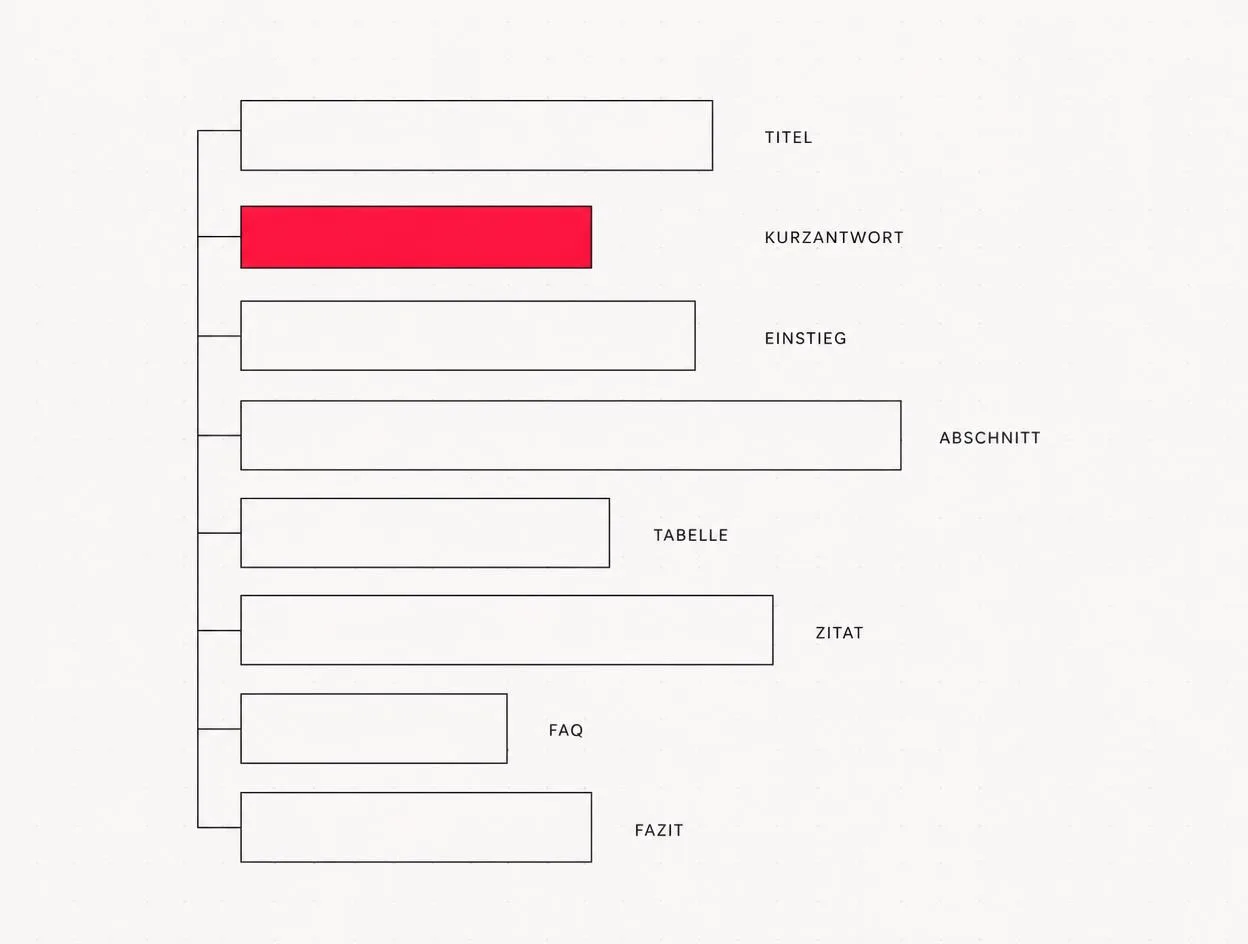
Regardless of the topic, articles that rank follow a recurring structure:
- A short answer at the top. Three to five sentences that directly answer the question in the title. This is precisely the block that ChatGPT, Perplexity and Google AI Overviews prefer to cite.
- One H2 per subquestion, phrased as a question. This covers “People also ask".
- At least one table with real figures or criteria. Tables win featured snippets.
- At least one ordered list for processes or criteria.
- A practical example from your own work, not from other blogs.
- An FAQ at the end with six to ten questions, marked up with FAQ schema.
- One clear next step, not three competing CTAs.
What are E-E-A-T signals and how do you incorporate them?
E-E-A-T stands for Experience, Expertise, Authoritativeness and Trust and comes from Google's Quality Rater Guidelines [2]. It is not a direct ranking factor, but an assessment framework that Google approximates through many individual signals. For an individual blog post, this means providing evidence that the writer has actually done the work they describe.
Experience: the difference almost everyone leaves out
Experience is the newest of the four criteria and the most valuable for agencies. It does not ask “Do you know this?", but “Have you done this yourself?". In practical terms, include:
- A real project with a name, starting point and outcome, linked to the case study.
- Figures from your own work rather than third-party studies, clearly identified as your own experience.
- Screenshots from real tools, proposals or analyses, not stock libraries.
- Honest limitations: when does your approach not work?
Expertise, Authoritativeness, Trust
| Signal | Implementation in the article | Implementation on the site |
|---|---|---|
| Expertise | Named author with their role, depth of knowledge rather than generalities | Author profile with professional background, Person schema |
| Authoritativeness | Cited primary sources with dates and publishers | Internal links from the topic cluster, external mentions |
| Trust | Visible publication and update dates | Legal notice, contact details, HTTPS, clear pricing |
We do not write articles about things we have not built ourselves. This is not about sticking to principles for their own sake, but simple economics: content without first-hand experience eventually stops ranking, and then the work was wasted.
Why E-E-A-T has become more important since AI answers arrived
Language models need sources they can cite. An article that provides a specific figure, a named originator and a date is cited more often in AI Overviews and chat responses than content that makes the same point vaguely. In practice, this means writing sentences that can be quoted word for word without needing surrounding context.
How many keywords does a blog post need?
An article serves one search intent and therefore one focus keyword. Everything else is a variation, not an additional target. If you put two focus keywords into one article, both compete for the same page and neither wins. This is the most common mistake on company blogs.
A realistic keyword distribution per article
| Level | Number | Where in the text |
|---|---|---|
| Focus keyword | 1 | H1, short answer, first H2, meta title, slug, hero image alt text |
| Secondary keywords | 3–6 | Each in its own H2 or H3, naturally in the body text |
| Semantic terms | 15–30 | Distributed throughout the text, without counting |
| Long-tail questions | 6–10 | FAQ block |
Semantic terms are words that inevitably appear when someone genuinely understands the subject. For “structuring a blog post for SEO", these might include search intent, snippet, internal linking, indexing and schema markup. You do not need to place them deliberately; you just need not to avoid them.
How do you cover a keyword fully?
- Determine search intent. Informational, commercial or transactional? The top 10 will tell you in thirty seconds.
- Read the SERP structure. Which H2s do the first five results use? Which “People also ask" questions does Google show? That is your outline.
- Find the gap. What is missing from all ten results? Usually: specific figures, a real example or an honest limitation.
- Write the outline before the article. One H2 per subquestion, no duplication.
- Check after writing. Does the text answer every question from step 2 clearly and in an easy-to-find place?
Keyword density: the short answer
There is no target value. Google has worked semantically rather than through term frequency for years [3]. In practice: place the focus keyword in structurally important positions (title, short answer, one H2, slug, one alt text), then use it as often as feels natural. If you notice a word appearing too often as you read, it is appearing too often.
Which technical details also matter?
The best content is useless if the page delivers it poorly. We check these points for every article we publish:
- Server-side rendering. The content must be in the HTML, not loaded later via JavaScript. Otherwise, many AI crawlers see nothing.
- Exactly one H1, followed by a clean H2/H3 hierarchy with no skipped levels.
- Article and FAQPage schema, plus breadcrumbs. Generate the FAQ schema automatically from the FAQ field, not manually.
- Meta title under 60, description under 160 characters, with the focus keyword at the start.
- Images in WebP format with descriptive alt text and defined dimensions to prevent layout shifts.
- Internal links: two to four per article, with descriptive anchor text, plus a link back from the pillar page.
- Publication and update dates visible on the frontend and in the schema.
To learn how to connect these articles into a structure rather than leave them standing alone, read our post on topic clusters and content clusters. And if an existing blog is holding you back technically, the relaunch checklist will help you put things in order.
How do you get the article indexed?
Published does not mean indexed. Without actively submitting it, Google can take weeks to find a new post, especially on newer domains. That is why this step should be a fixed part of your workflow:
- Publish the article and check the live URL in your browser (status 200, content visible in the source code).
- Open URL Inspection in Google Search Console and paste in the full URL.
- Click Test live URL and check whether the page is reported as indexable.
- Click Request indexing. It usually takes hours to a few days after that.
- After two weeks, check the “Pages" report to confirm that the URL has actually been indexed.
- Check the sitemap: the article must appear in
sitemap.xml, otherwise the crawler will not find it automatically on its next pass.
Which layout fits which search intent?
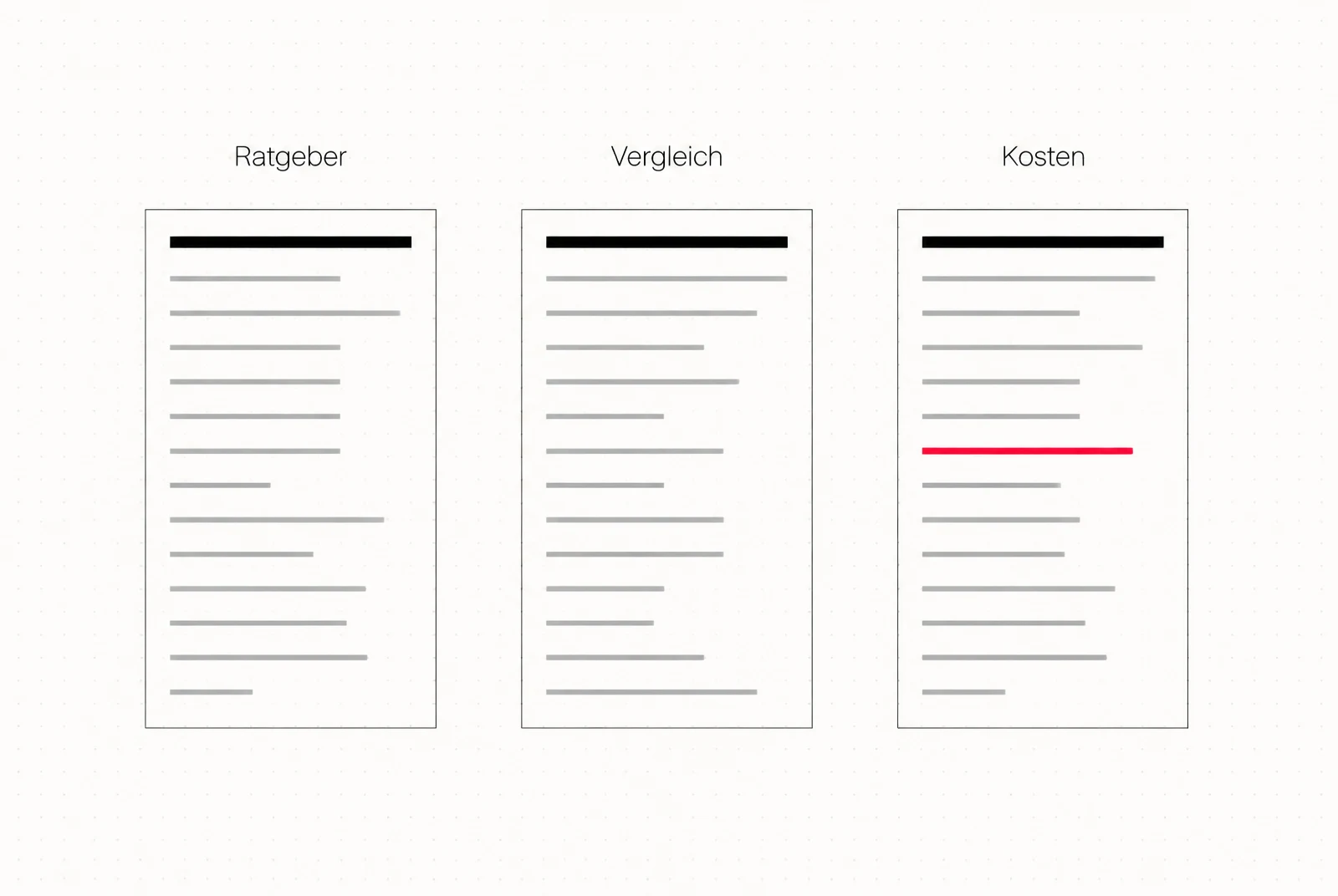
The same text does not work in every format. Someone asking about costs wants a table, not prose. Someone comparing options wants criteria side by side. That is why we decide on the layout before writing the first sentence.
| Search intent | Typical query | What must appear at the top | Essential elements |
|---|---|---|---|
| Informational | “what is …", “how does … work" | Definition in two sentences | Short answer, step-by-step lists, FAQ |
| Commercial | “… comparison", “… providers" | Recommendation with a condition | Comparison table, criteria, limitations |
| Transactional | “… costs", “have … created" | Specific figure or range | Pricing table, worked example, clear CTA |
| Local | “… Cologne", “… near me" | Location, accessibility, reference project | Local case studies, directions, LocalBusiness data |
How do you write paragraphs that can be cited?
Language models and featured snippets extract paragraphs, not articles. A citable paragraph meets three conditions: it answers a question fully, it works without the preceding paragraph, and it contains at least one specific detail. In practice: the first sentence gives the answer, the second the figure or condition, and the third the limitation. Everything after that adds depth.
Practical example: BxC Security, from relaunch to content structure
We rebuilt the website for BxC Security using exactly the sequence described here: first clarify which search intent each page serves, then define the structure and layout, then create the copy and imagery. The starting point was a site that said a lot about the company and little about the questions prospective customers bring with them.
The implementation: a clear page hierarchy with exactly one H1 per page, service content presented as standalone answers rather than a list, visible contact options and a technical setup that delivers text in the HTML rather than loading it later via JavaScript. Applied to the blog, this means each article gets a question as its title, a short answer and a layout that matches the intent.

Read the full case study: BxC Security →
Before we write an article, we decide which sentence we want someone to quote from it. If we cannot formulate that sentence, the topic is not yet clearly defined enough, and adding length will not help.
How do you keep an article up to date?
Publishing an article is half the work. Here is what to schedule afterwards:
- After four weeks, review the search queries in the performance report. Is the article ranking for the intended search intent or a different one?
- After three months, check its position. Reworking content is most worthwhile between positions 11 and 20, because the jump to page one is shortest.
- With every update, check figures, years and sources, and visibly change the update date.
- Add new secondary keywords, when Search Console shows queries that the text does not yet clearly answer.
- Add internal links, whenever a new article on a related topic is published.
Conclusion: structure beats word count
An SEO-optimised blog post is not longer content, but better-organised content. It fully answers one search intent, supports its claims with first-hand experience and genuine sources, naturally covers one focus keyword and related terms, and is delivered through a sound technical setup. Work consistently across these four areas and you do not need tricks.
Prefer to leave it to us?
Individual articles only reach their full potential when they are part of a structure. Learn how to plan topic clusters in topic clusters on your blog. If you want to hand over the planning, writing and technical work: as an SEO agency in Cologne, we do this for small and medium-sized businesses.
Frequently asked questions
How long should an SEO blog post be?+
How many keywords belong in a blog post?+
What exactly does E-E-A-T mean?+
What is the ideal keyword density?+
How do I cover a keyword fully?+
How do I demonstrate Experience if I have only completed a few projects?+
Do I need FAQ schema for every blog post?+
How long does it take for a new blog post to rank?+
Do I need to request indexing in Search Console?+
Should I update old blog posts instead of writing new ones?+
Sources
- Creating helpful, reliable, people-first content, Google Search Central (2025)
- Search Quality Rater Guidelines, Google (2025)
- SEO Starter Guide: Keyword-Dichte ist kein Rankingfaktor, Google Search Central (2025)

Josef leads the strategic and creative development of brands at Maluure. For over a decade, he has guided medium-sized businesses from brand positioning to digital delivery.
Managing Director of Maluure GmbH, Cologne. Specialising in corporate design, brand strategy and digital brand experiences.
Weiterlesen

Using a corporate film on social media: twelve weeks of content from one shoot day
A corporate film is not a one-off asset, but a bank of source material. How to turn one shoot into formats for LinkedIn, Instagram, your website and sales, with an editing plan, content calendar and practical example.

Corporate video scripts: storytelling that works in 90 seconds
The script determines whether your corporate video makes an impact or just looks good. Structure, narrative, common mistakes and a shot list that saves the shoot day.

Officially certified: Maluure is a Lovable Partner
Since 16. September 2026, Maluure has been an officially certified Lovable Partner, Expert Website Builder and Expert App Builder. What the certification involves and what it means for your project.
Explore more blog topics

Corporate film or recruitment video: What your company really needs
Both films cost a similar amount but have very different effects. This comparison shows which format suits which goal and how to produce both in a single day of filming.

LinkedIn Video: Formats, Lengths and Best Practices for Businesses
What works for LinkedIn video: formats from 1:1 to 9:16, the right length for each objective, subtitles, hooks and upload strategy. A concise guide for businesses.

Recruitment video: showing employees as they really are
How a recruitment video shows real employees rather than glossy clichés, what it costs and why authenticity brings in more applications.