Web & Design

    Commissioning a restaurant website: What to look out for

    Manage your own menu, showcase reviews and get found locally: What a restaurant website really needs to do, with two projects from Cologne.
    of Josef Kujawski8 min read1.448 Words
    Commissioning a restaurant website: What to look out for
    Short answer
    A good restaurant website answers four questions in under ten seconds: What is there to eat, when are you open, where are you, and how do I book? The menu belongs in the system as editable content, not as a PDF. Reviews, photos of the actual spaces and accurate local details determine whether Google and AI assistants recommend you at all. Realistically, professional restaurant websites cost between 4.000 and 20.000 Euro, depending on reservations, locations and event operations.
    Restaurant websites are almost always built under time pressure and then left untouched for years. You know the result: a homepage with an atmospheric photo, a menu as a PDF from 2019, opening hours that are no longer correct, and a contact form nobody answers. For guests, these are not minor details. On their phones, they decide within seconds whether to visit you or the place two streets away.
    This article explains what matters when building a website for restaurants, traditional brewery pubs and event venues with catering, what it costs, and how we approached it in two projects in Cologne.

    Why do so many restaurant websites fail?

    Because they are conceived as brochures rather than tools. A brochure is finished when it looks good. A restaurant website is only finished when your team can maintain it without an agency.
    The four most common mistakes we find in our audits:
    1. Menu as a PDF. On a phone, guests have to zoom and scroll around. Google finds the content harder to read, and AI assistants usually cannot read it at all.
    2. No way to make updates. Every price change requires a request to the agency, so it never happens.
    3. Hidden reservations. The most important button is in the footer rather than always visible in the header.
    4. Generic images. Stock photos of pasta you do not serve. Guests notice immediately.
    Kernaussage
    A restaurant website is not a brochure but an operational tool. If your team cannot maintain it themselves, it starts becoming outdated on launch day.

    What belongs on a restaurant website?

    Organise the content around what guests actually look for, not what you want to tell them. This order has proven effective:
    PriorityContentWhy
    1Food and drinks menusThe most common reason for visiting, must be readable without zooming
    2Opening hours and kitchen hoursThe second most common question, should also be stored as structured data
    3ReservationsAn always-visible button, not just in the footer
    4Directions, parking, accessibilityOften decides the choice between two venues
    5Reviews and awardsSocial proof, makes guests more confident about booking
    6Spaces, events, groupsDrives revenue from celebrations and corporate clients
    7Team and historyBuilds the brand, but comes after the facts
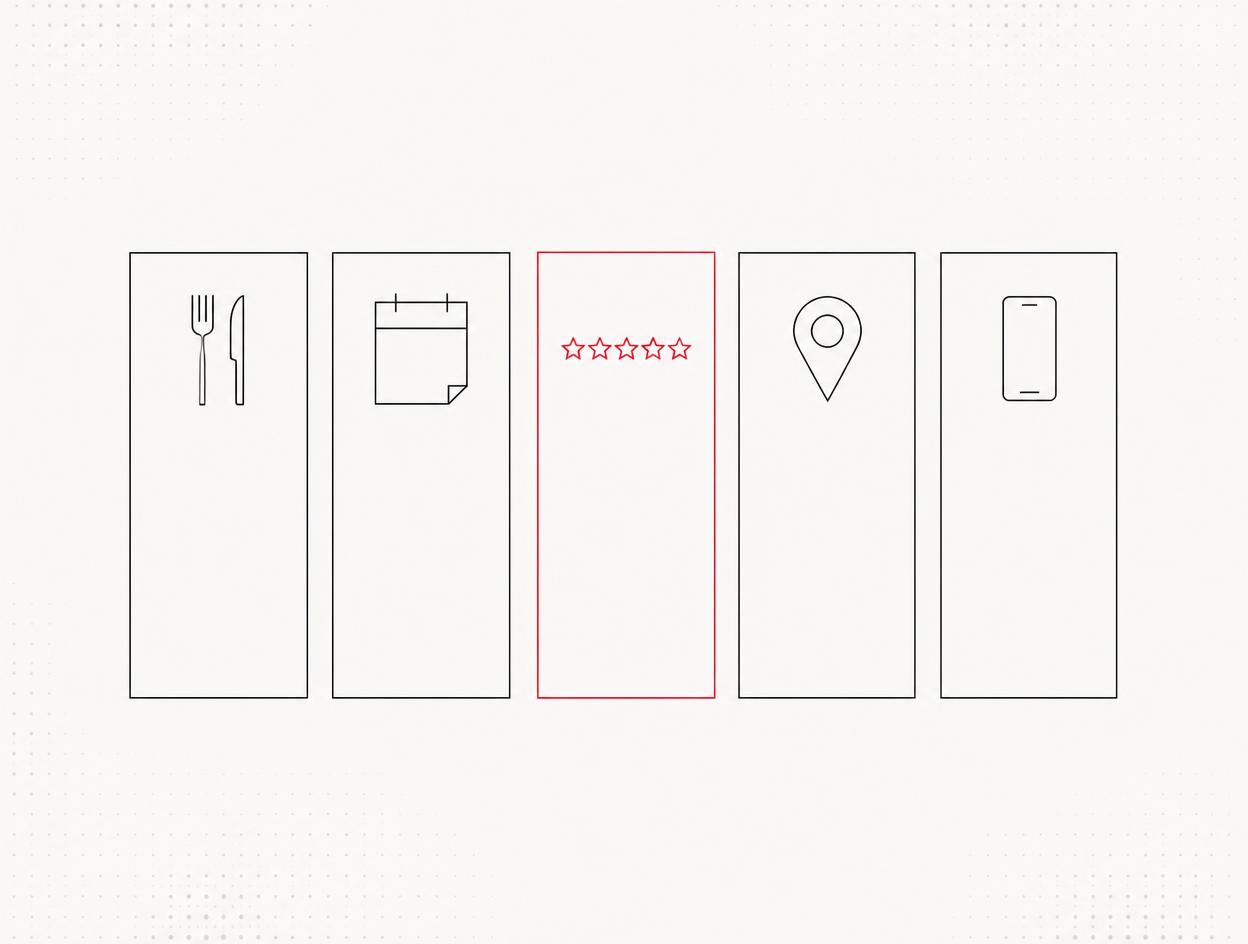
    Schaubild mit fünf Bausteinen einer Restaurant-Website: Speisekarte, Termine, Bewertungen, Standort, mobile Nutzung
    Fünf Bausteine, die auf keiner Restaurant-Website fehlen dürfen. Bewertungen sind der am häufigsten unterschätzte davon.

    How can you manage the menu yourself?

    The menu is central. It changes seasonally, sometimes weekly, which is precisely why it should not be a document that someone has to upload again.
    Here is what a well-designed solution looks like:
    • Each dish has its own record with a name, description, price, allergens and labels such as vegetarian or vegan.
    • Dishes can be assigned to menus, such as lunch, dinner, seasonal menus or drinks.
    • A menu can be switched on or off without deleting anything.
    • Your team changes prices in the browser, and the website is up to date seconds later.
    • The menu is displayed as actual text so that search engines and voice assistants can read it.
    An added benefit: when dishes are stored as structured data, you can also publish them to your Google Business Profile, printed notices and social media without typing everything three times [1].

    How do you make reviews and awards visible?

    Hospitality is a business built on trust. A rating is often the final reason someone decides to book. Yet many businesses hide their 4,6 stars from 2.000 reviews somewhere in the footer.
    A better approach:
    • Display the overall rating and number of reviews prominently on the homepage, with the date they were last updated.
    • Quote individual, genuine reviews with a first name and initial, rather than anonymously rewriting them.
    • Show awards as photos of the actual certificates rather than graphic badges. This makes them feel verifiable, not decorative.
    • Give satisfied guests a clear way to leave a review, helping your average rating continue to improve.

    Practical example: Gertrudenhof am Neumarkt, Cologne
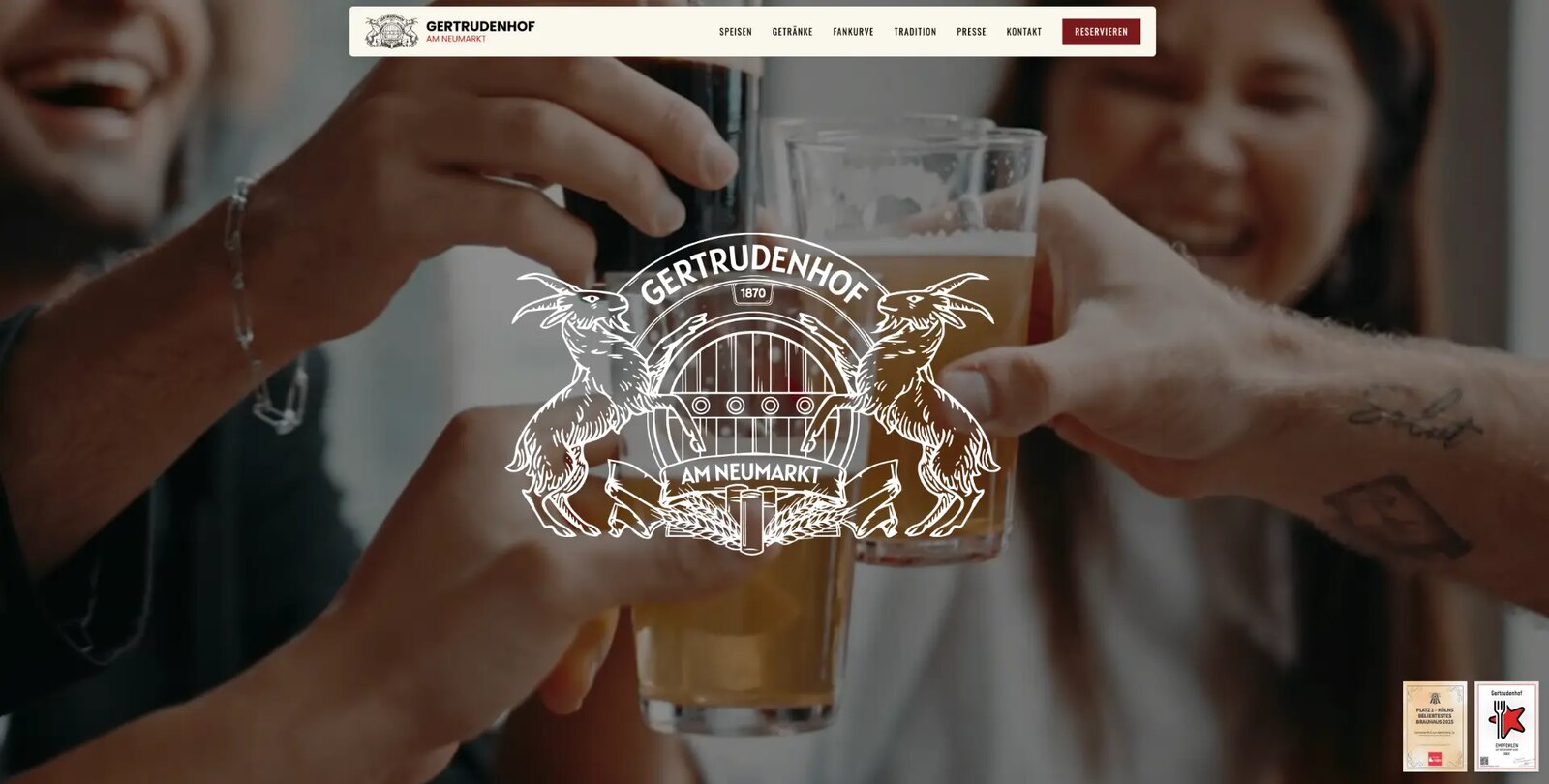
    For the brewery pub Gertrudenhof am Neumarkt, we put these two points at the centre of the project. The website opens with footage from the venue itself, with the crest overlaid as the brand mark, and navigation leading straight to food, drinks and reservations. No detours, no image gallery before the first useful information.
    Startseite des Brauhauses Gertrudenhof am Neumarkt in Köln mit Videohintergrund, Wappen und Reservierungsbutton
    Gertrudenhof am Neumarkt: Speisen, Getränke und Reservierung liegen direkt im Kopfbereich, umgesetzt von der Maluure GmbH.
    The team manages the menu themselves. New dishes, daily specials and price changes go online within minutes without our help, including allergen information. That is the difference between a menu that is accurate and one that is roughly accurate.
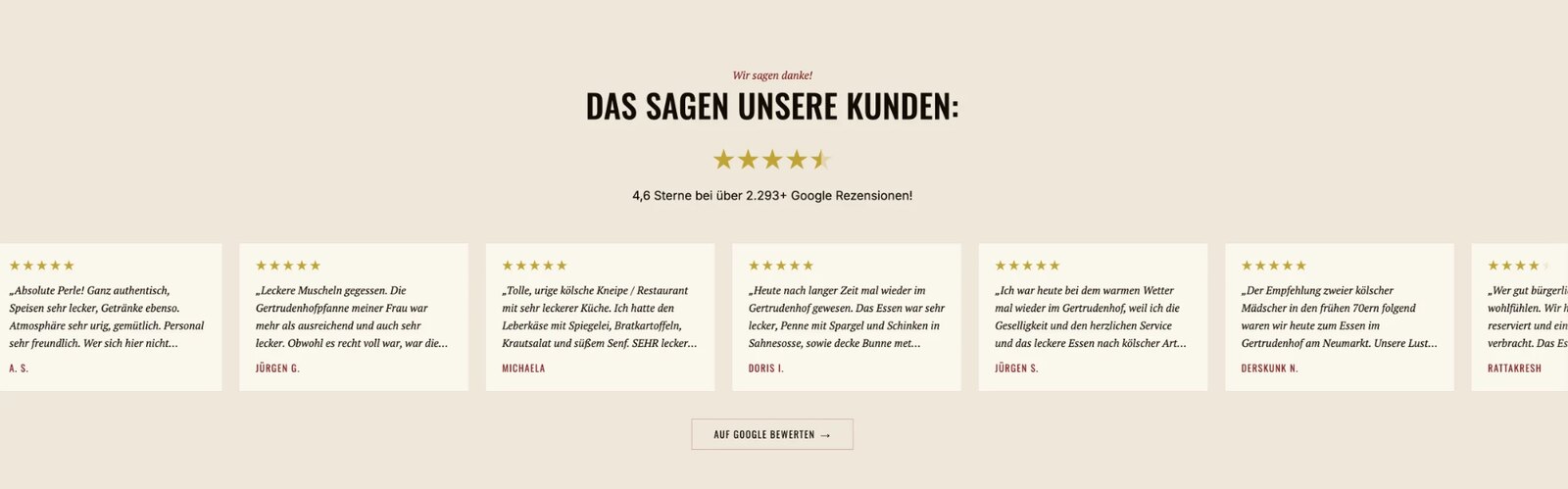
    Then there is the social proof: 4,6 stars from over 2.293 Google reviews appear on the site alongside quotes from real guests, complemented by awards as Cologne's most popular brewery pub and the recommendation from Restaurant Guru, photographed as actual certificates.
    Bewertungssektion der Gertrudenhof-Website mit 4,6 Sternen aus über 2.293 Google-Rezensionen und Gästezitaten
    Bewertungen als eigener Abschnitt statt als Fußnote. Der Schnitt und die Anzahl stehen direkt neben den Zitaten.
    In hospitality, it is not the most beautiful website that wins, but the most honest. Real spaces, a real menu, real reviews. Guests will notice anything else by their first visit at the latest.
    Josef Kujawski, Geschäftsführer Maluure GmbH

    Practical example: ZOO Event, Cologne

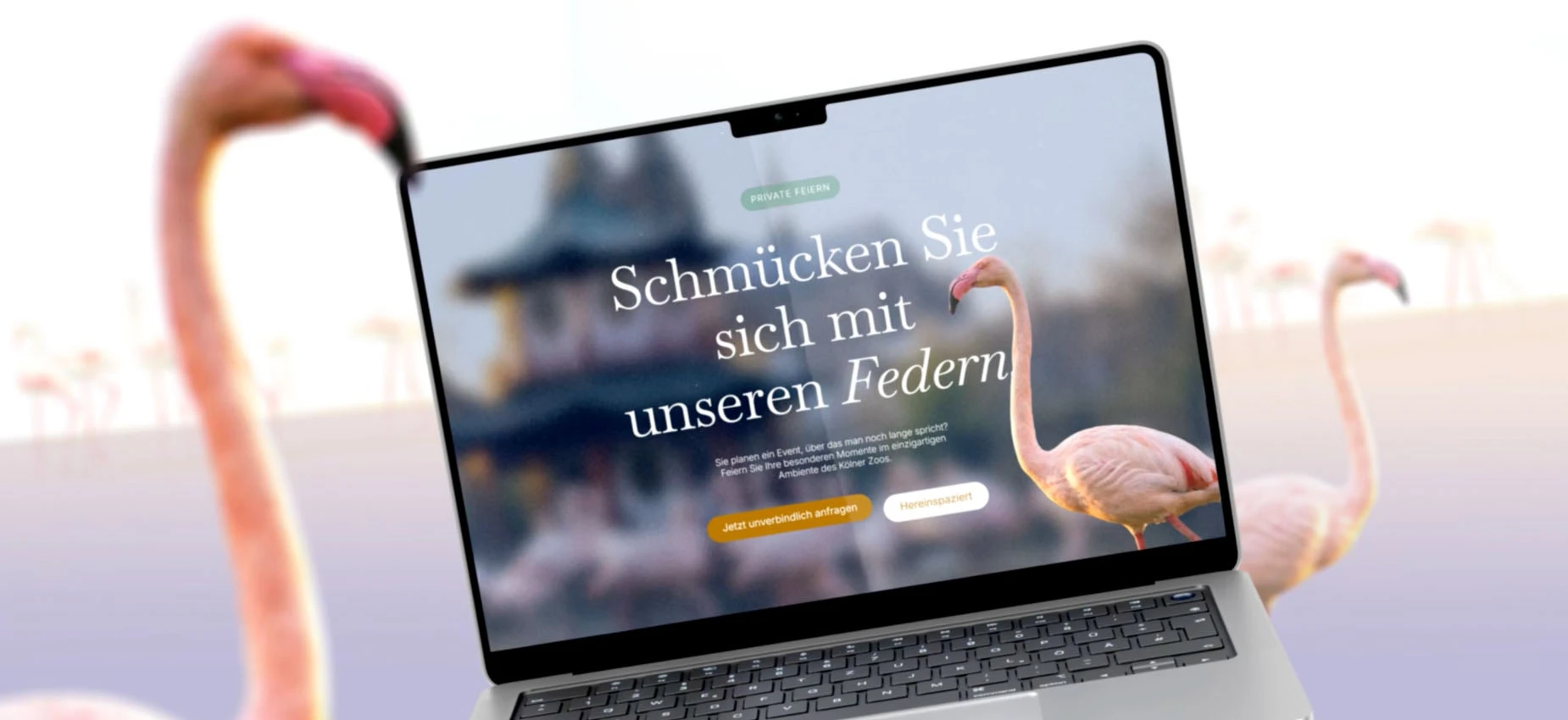
    ZOO Event hires out and operates some of Cologne's most unusual event venues, complete with its own catering. Here, the focus was not just on table reservations but on enquiries for celebrations, corporate events and conferences, which means significantly higher booking values.
    Website-Relaunch für ZOO Event Köln mit Premium-Design für Eventlocations und Gastronomie
    ZOO Event: Relaunch mit Event-Planer zur Lead-Qualifizierung und 3D-Raumtouren, umgesetzt von der Maluure GmbH.
    We rebuilt the website from the ground up: clear typography, generous imagery and a structure that guides visitors logically through occasions, venues and food. We added an event planner that pre-qualifies enquiries, plus 3D tours of the main venues so prospective clients can explore the spaces before enquiring. For businesses hosting events, this is the most effective approach because it reduces follow-up questions and filters out unsuitable enquiries.

    How do you get found locally?

    Most guests search on mobile and by location: brewery pub Cologne Neumarkt, restaurant nearby, corporate party venue Cologne. To appear in those results, you need three things:
    1. Consistent location details. Your name, address, phone number and opening hours must be identical on your website, Google Business Profile and business directories.
    2. Structured data. Restaurant markup with opening hours, price range, cuisine and menu, so search engines can reliably extract the facts [2].
    3. Dedicated pages for revenue-generating services. Corporate parties, Christmas parties, weddings, lunch. Each of these searches deserves its own page with real images and indicative pricing, not a list on the homepage.
    If you want to explore this further: in Local SEO Cologne, we explain how to build regional visibility systematically.

    What does a restaurant website cost?

    The range is broad because a bistro has different needs from an event venue with five rooms. Realistic budgets from our projects:
    ScopeBudgetIncluded
    Compact, one location4.000 to 8.000 €Homepage, editable menu, opening hours, contact details, reservation link
    Expanded8.000 to 15.000 €Plus event pages, gallery, reviews, careers section, local SEO basics
    Event venues with catering or multiple locations15.000 to 25.000 €Location pages, enquiry and planning flows, 3D venue tours, reservation integration
    Ongoing maintenance is additional. Allow a modest monthly amount for updates, security and backups, or take out a maintenance agreement so the site does not become technically outdated in its first year.

    How do you recognise a well-built website?

    Check these seven points before commissioning the work:
    • Can you change the menu, prices and opening hours yourself, with a live demonstration during the proposal meeting?
    • Does the homepage load on a phone over a mobile network in under three seconds?
    • Can visitors reach the reservation option from any page with one click?
    • Are real photos of your spaces, team and dishes included in the plan, along with a photo shoot?
    • Are allergens and labels stored in a clear, easy-to-update format?
    • Is the site accessible in practice, with sufficient contrast and keyboard navigation?
    • Will you own the website and receive all access credentials, without depending on the provider?
    Kernaussage
    The best question to ask during a proposal meeting is: please show me on a real project how I would change a menu price tomorrow morning.
    Planning a relaunch for your restaurant, brewery pub or event venue? We will review your menu, reservations and visibility together before any design work begins.
    Projekt besprechen

    Frequently asked questions

    What does a restaurant website cost?+
    Compact websites for a single location cost between 4.000 and 8.000 Euro. Expanded sites with an events section and local SEO cost 8.000 to 15.000 Euro. Websites for event catering businesses with multiple venues and enquiry flows start at around 15.000 Euro.
    Should the menu be included as a PDF?+
    No. A PDF is hard to read on a phone, and search engines and AI assistants find it harder to process. The menu belongs in the system as editable content and should be displayed as actual text.
    Can my team manage the menu themselves?+
    Yes, if the website is built that way. Dishes, prices, allergens and entire menus can be changed in the browser and go online seconds later, without an agency.
    How important are Google reviews on the website?+
    Very important. The overall rating, number of reviews and genuine guest quotes make people more confident about booking and should be visible on the homepage, not in the footer.
    How long does a hospitality website project take?+
    From kick-off to launch, we allow four to six weeks for compact projects and eight to twelve weeks for event venue websites with enquiry flows and 3D tours. Photos and menu content are usually what determines the timeline.
    Does my restaurant need a dedicated page for celebrations and events?+
    Yes, if you cater for groups and corporate clients. Searches such as Christmas party or wedding venue deserve dedicated pages with images, capacities and indicative pricing rather than a line on the homepage.
    How can I make my restaurant easier to find locally?+
    Consistent location details on your website and Google Business Profile, structured data for opening hours and menus, and dedicated pages for the most important occasions. Recent reviews further strengthen the effect.
    Does a restaurant website need to be accessible?+
    For many businesses, accessible design will become standard from 2025, if only to serve their customers better. Sufficient contrast, keyboard navigation and menus that are readable without zooming make sense anyway because they help every guest.
    What happens after launch?+
    Updates, security, backups and small content changes are covered by a maintenance agreement. Without maintenance, the site becomes technically outdated faster than the menu changes.

    Sources

    1. Google-Unternehmensprofil: Speisekarte und Gerichte hinzufügen, Google (2026)
    2. Schema.org: Restaurant, Schema.org (2026)

    #Restaurant Website#Gastronomie#Webdesign#Speisekarte#Local SEO
    Josef Kujawski
    Author
    Josef Kujawski
    Managing Director & Creative Director at Maluure

    Josef leads the strategic and creative development of brands at Maluure. For over a decade, he has guided medium-sized businesses from brand positioning to digital delivery.

    Managing Director of Maluure GmbH, Cologne. Specialising in corporate design, brand strategy and digital brand experiences.

    Newsletter

    New articles straight to your inbox.

    A newsletter when we genuinely have something new to share. No noise.

    Weiterlesen

    Explore more blog topics