Psychology & Decisions
    Fundamentals

    Zeigarnik Effect: Why unfinished tasks stay on your mind

    Open tasks do not let us go. What is behind the Zeigarnik Effect, how robust it is and how websites can use it fairly.
    of Josef Kujawski3 min read
    Zeigarnik Effect: Why unfinished tasks stay on your mind
    Short answer
    The Zeigarnik Effect goes back to psychologist Bluma Zeigarnik, who observed in 1927 that interrupted tasks are remembered better than completed ones. Later studies mainly confirm the related Ovsiankina Effect: people want to finish tasks they have started. The memory advantage itself is less clearly supported. On websites, progress indicators, checklists and multi-step forms use this drive to complete, applied fairly without artificial pressure.

    The problem: drop-offs just before the finish

    A visitor fills in your enquiry form halfway. Then the phone rings. Do they come back? Often not, if nothing reminds them that something is still open. At the same time you know the feeling yourself: a task you have started will not leave your mind until it is done.
    Psychology described exactly this feeling almost a hundred years ago.

    The principle: open loops

    In the 1920s in Berlin psychologist Bluma Zeigarnik had participants solve simple tasks and interrupted some of them. Later, participants recalled the interrupted tasks considerably more often than the completed ones. [1] Her teacher Kurt Lewin's explanation: a started task creates inner tension that only eases once it is completed.
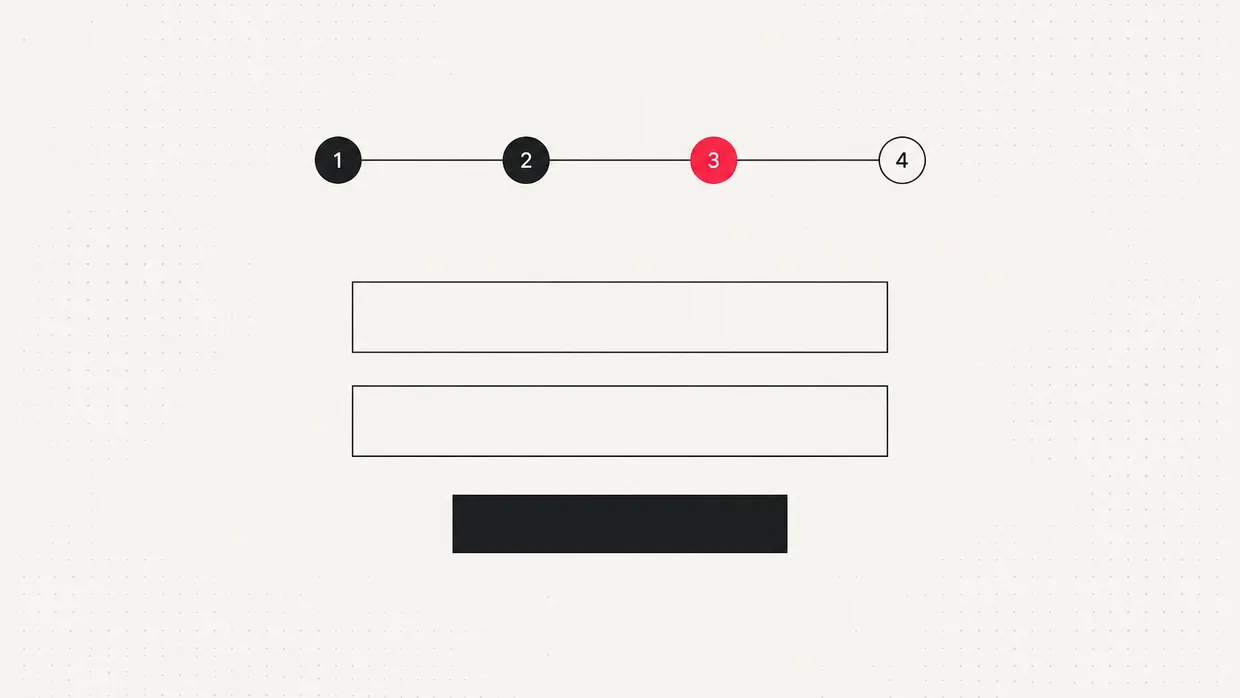
    Multi-step form with a four-step progress indicator, step three active
    Visible progress makes the open loop tangible.

    What research says today

    The Zeigarnik Effect is often quoted as if it were undisputed. It is not quite that simple. A 2025 meta-analysis reached a nuanced result: [2]
    EffectClaimSupported?
    Zeigarnik EffectUnfinished tasks are remembered betterNot reliably demonstrated
    Ovsiankina EffectInterrupted tasks are resumedClearly supported
    For practice this is good news: the useful part is the robust one. People want to finish what they have started.
    Kernaussage
    The strong effect is not remembering but the wish to complete what was begun. That is what you should build on.

    How websites can use the effect fairly

    1. Progress indicators in forms. "Step 3 of 4" shows the goal is close and lowers drop-off.
    2. An easy first step. Once people start, they are more likely to continue. Begin with a simple question rather than name, address and phone number.
    3. Saved state. Filled fields or carts are kept when someone returns later.
    4. Checklists. In onboarding or profiles, a partly ticked list shows what is still missing.
    5. Series with a preview. An article pointing to the next part creates curiosity. [3]
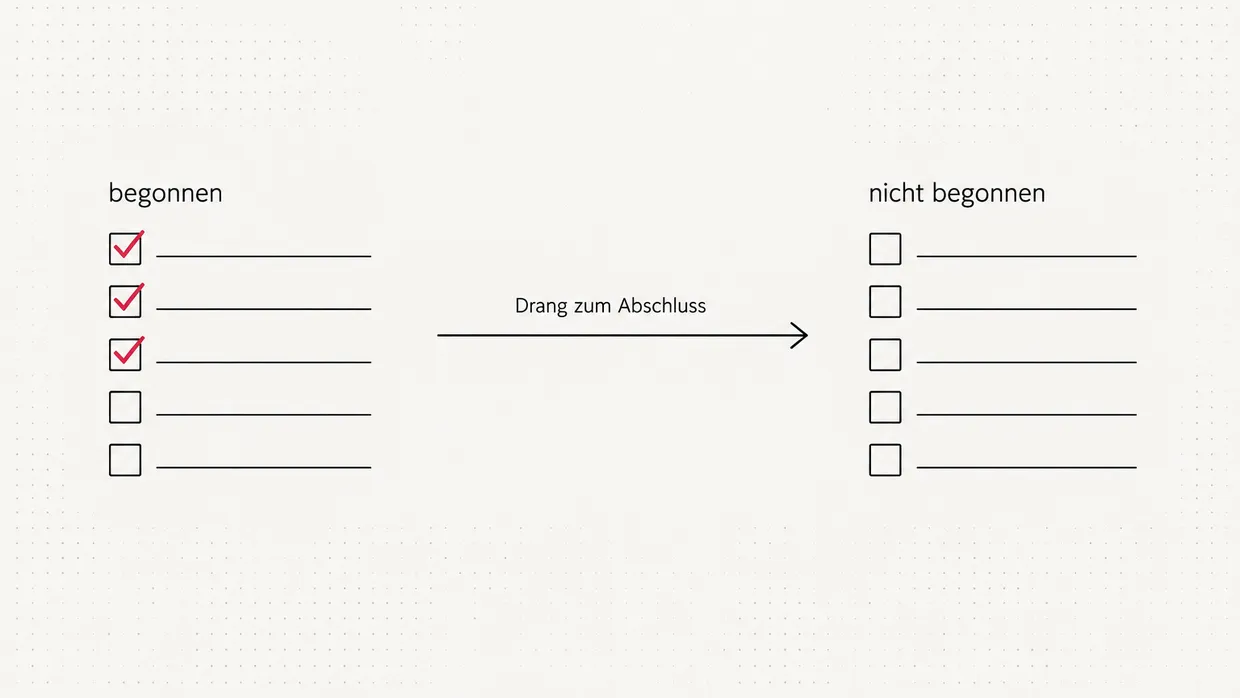
    Two checklists: one started with three ticks and one empty
    A started list pulls harder than an empty one.

    Where the line is

    Creating open loops artificially squanders trust. A progress bar stuck at 90 percent, endless reminder emails or teasers without resolution feel manipulative. Fair means: the effect helps users reach their own goal, not yours at their expense.
    Kernaussage
    Make progress visible, make starting easy and save the state. Avoid artificial pressure.
    How the end of a flow shapes the memory of the whole experience is described by the Peak-End Rule. Why long forms belong in meaningful groups is explained by Miller's Law. And why every step should respond immediately is shown by the Doherty Threshold.
    A good form feels like a conversation that keeps going on its own. When visitors see they are almost done, they finish.
    – Josef Kujawski, Managing Director Maluure GmbH

    Quick check

    • Does your form show how many steps are left?
    • Is the first question easy to answer?
    • Is entered data kept if someone briefly leaves the page?
    • Do your articles point to suitable next content?
    Linking content into series that guide readers onward is what we do every month in our SEO editorial service.

    Frequently asked questions

    What is the Zeigarnik Effect?+
    The Zeigarnik Effect describes the observation that interrupted or unfinished tasks stay in memory better than completed ones.
    Who was Bluma Zeigarnik?+
    A Soviet psychologist who researched under Kurt Lewin in Berlin in the 1920s. Her study was published in 1927.
    Is the Zeigarnik Effect scientifically proven?+
    Partly. A 2025 meta-analysis found no reliable memory advantage for unfinished tasks, but a clear tendency to resume interrupted tasks.
    What is the Ovsiankina Effect?+
    The urge, described by Maria Ovsiankina, to resume and complete an interrupted task. It is considered more robustly supported than the memory effect.
    How do websites use the Zeigarnik Effect?+
    With progress bars, profile checklists, multi-step forms or saved carts. They make visible that something has been started but is not yet finished.
    When does the effect become manipulative?+
    When artificial open loops are created, such as fake progress indicators or endless notifications. Fair use helps users reach their own goal.
    Does the Zeigarnik Effect help content marketing?+
    Article series, teasers for the next part or a clear outline with a preview can create curiosity. The promise has to be kept, though.

    Sources

    1. Das Behalten erledigter und unerledigter Handlungen, Psychologische Forschung (1927)
    2. The Zeigarnik and Ovsiankina effects: A systematic review and meta-analysis, Ghibellini & Meier, Humanities and Social Sciences Communications (2025)
    3. Laws of UX: Zeigarnik Effect, Jon Yablonski, Laws of UX (2024)

    #Psychology#Motivation#Forms#Onboarding
    Josef Kujawski
    Author
    Josef Kujawski
    Managing Director & Creative Director at Maluure

    Josef leads the strategic and creative development of brands at Maluure. For over a decade, he has guided medium-sized businesses from brand positioning to digital delivery.

    Managing Director of Maluure GmbH, Cologne. Specialising in corporate design, brand strategy and digital brand experiences.

    Newsletter

    New articles straight to your inbox.

    A newsletter when we genuinely have something new to share. No noise.