Psychology & Decisions
    Fundamentals

    Miller's Law: 7 ± 2, chunking and good menu structures

    The famous 7 ± 2 is often misquoted. What Miller's Law really says and how to structure content so it sticks.
    of Josef Kujawski3 min read
    Miller's Law: 7 ± 2, chunking and good menu structures
    Short answer
    Miller's Law goes back to George A. Miller, who showed in 1956 that short-term memory can only hold a few units at once, often quoted as 7 ± 2. More recent research puts the limit closer to about four units. What matters is not the exact number but chunking: bundling information into meaningful groups. For websites this means grouping content rather than rigidly cutting every menu to seven items.

    The problem: too much at once

    You open a website and see a menu with 14 equal items. Or a services page listing twelve offers in a single block of text. By the third item you have forgotten the first. That is not your fault but the architecture of your working memory.

    The principle: working memory is small
    In 1956 psychologist George A. Miller published one of the most cited papers in psychology: "The Magical Number Seven, Plus or Minus Two". [1] He showed that people can hold only a limited number of units in short-term memory at once, roughly seven, sometimes more, sometimes fewer.
    Later research corrected the number. In 2001 Nelson Cowan concluded that the actual capacity is closer to four units. [2] Miller's seven arise mainly because people bundle information unconsciously.
    This bundling is the genuinely useful part: chunking.
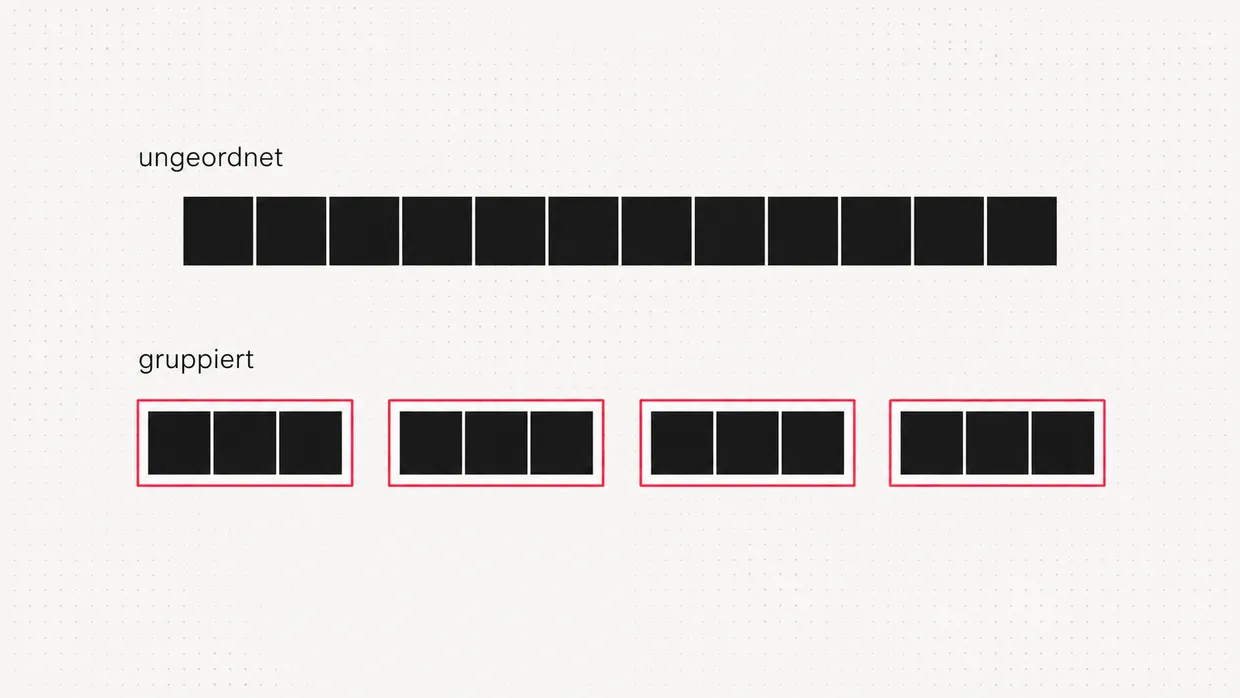
    Diagram: twelve squares in a row compared with the same twelve squares in four groups
    Same amount, easier to grasp: chunking into four groups.
    Kernaussage
    The exact number matters less than the insight behind it: people take in information in groups. Good structure beats any rigid upper limit.

    The biggest misunderstanding: the seven-item menu rule

    In web design Miller's Law is often quoted as a rule that a menu may have at most seven items. That falls short. A menu is visible, nobody has to memorise it. The working memory limit only applies indirectly there. [3]
    What actually helps:
    1. Group instead of cutting. Combine related items under clear headings.
    2. Understandable labels. "Services" beats a creative made-up name.
    3. Order by importance. Most important first, contact easy to reach.
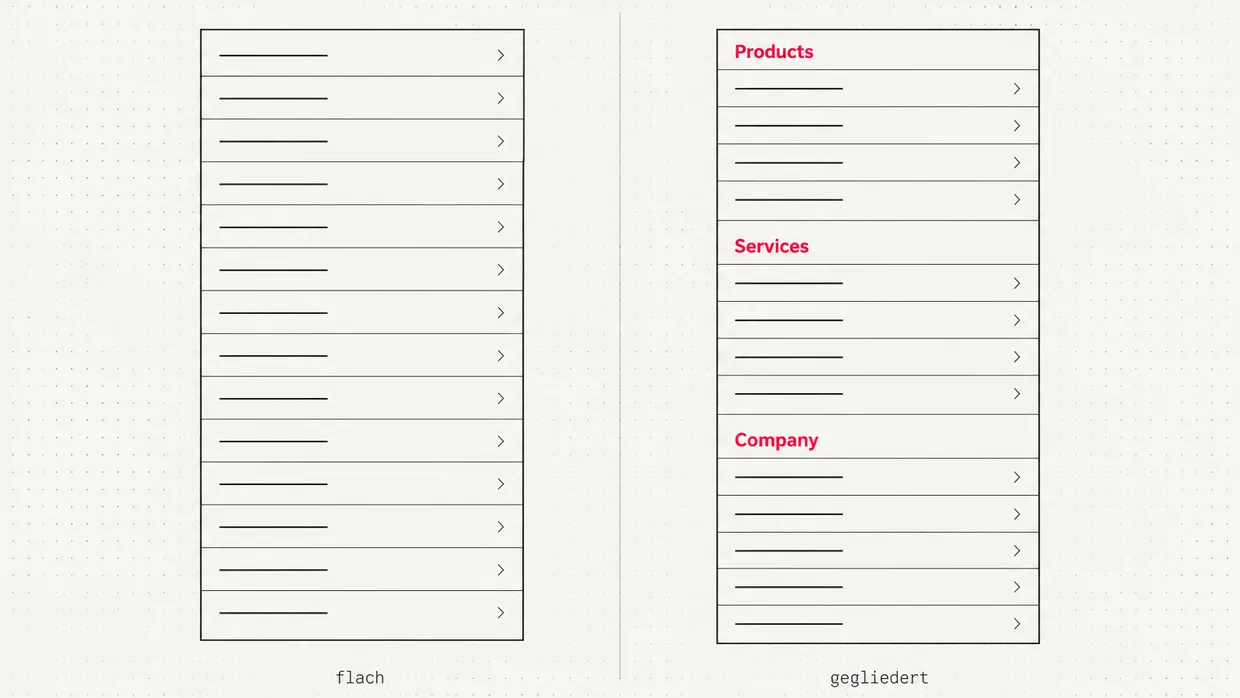
    Wireframe comparison: a long flat menu list and the same items in three groups with headings
    The same entries, organised into three groups, are understood faster.

    Where chunking works on websites

    AreaWithout chunkingWith chunking
    Navigation14 equal menu items3 to 5 groups with sub-items
    Body copyWall of textShort paragraphs, subheadings
    ServicesListed in one sentenceCards or a list with one key message each
    Forms20 fields on one pageThematic steps
    Numbers, codesDE89370400440532013000DE89 3704 0044 0532 0130 00
    Kernaussage
    Wherever people read, compare or enter something, grouping helps. Especially on services pages, pricing overviews and forms.
    Miller's Law describes how much you keep in mind at once. How the number of options affects decision time is explained by Hick's Law. Why too much choice even paralyses is shown by the Paradox of Choice. And how easily the chosen target can then be reached is described by Fitts' Law.
    Before we design a page, we sort the content. When the groups are right, the navigation almost builds itself. When they are not, no beautiful design can save it.
    – Josef Kujawski, Managing Director Maluure GmbH

    Quick check

    • Can your menu items be arranged into a few clearly named groups?
    • Does each paragraph carry only one key message?
    • Are long forms split into steps?
    • Are numbers and codes displayed in blocks?
    Clean structure also helps search engines. In an SEO audit we review information architecture and internal linking alongside the technical side.

    Frequently asked questions

    What does Miller's Law say?+
    Miller's Law describes that short-term memory can hold only a limited number of units at once. In 1956 George A. Miller named the order of magnitude 7 ± 2.
    Is 7 ± 2 still correct?+
    Only roughly. Nelson Cowan concluded in 2001 that the real capacity is closer to about four units once chunking is accounted for.
    What is chunking?+
    Chunking means combining individual pieces of information into meaningful groups. A phone number in blocks or a menu in categories is easier to grasp than a long sequence.
    Should a menu have only seven items?+
    No, that is a common misunderstanding. Menus are visible and do not need to be memorised. Clear groups, understandable labels and a sensible order matter more.
    How does Miller's Law help with website copy?+
    Short paragraphs, subheadings, lists and tables bundle information into bites. Readers can scan and remember more.
    What is the difference between Miller's Law and Hick's Law?+
    Miller's Law concerns how much you can hold in mind at once. Hick's Law describes how decision time increases with the number of options.
    Where is Miller's Law relevant in forms?+
    Long forms can be split into steps or thematic blocks. IBANs, phone numbers and codes are easier to enter and check in groups.

    Sources

    1. The magical number seven, plus or minus two: Some limits on our capacity for processing information, Psychological Review (1956)
    2. The magical number 4 in short-term memory: A reconsideration of mental storage capacity, Behavioral and Brain Sciences (2001)
    3. How Chunking Helps Content Processing, Nielsen Norman Group (2016)

    #Psychology#Working memory#Navigation#Information architecture
    Josef Kujawski
    Author
    Josef Kujawski
    Managing Director & Creative Director at Maluure

    Josef leads the strategic and creative development of brands at Maluure. For over a decade, he has guided medium-sized businesses from brand positioning to digital delivery.

    Managing Director of Maluure GmbH, Cologne. Specialising in corporate design, brand strategy and digital brand experiences.

    Newsletter

    New articles straight to your inbox.

    A newsletter when we genuinely have something new to share. No noise.