Solomon's Paradox: Why You Decide More Wisely for Others Than for Yourself
Solomon's Paradox explains why we judge other people's problems more wisely than our own. With the Grossmann and Kross study, the principle of self-distancing, and concrete rules for your website.

The Problem: You Spot It Instantly in Others
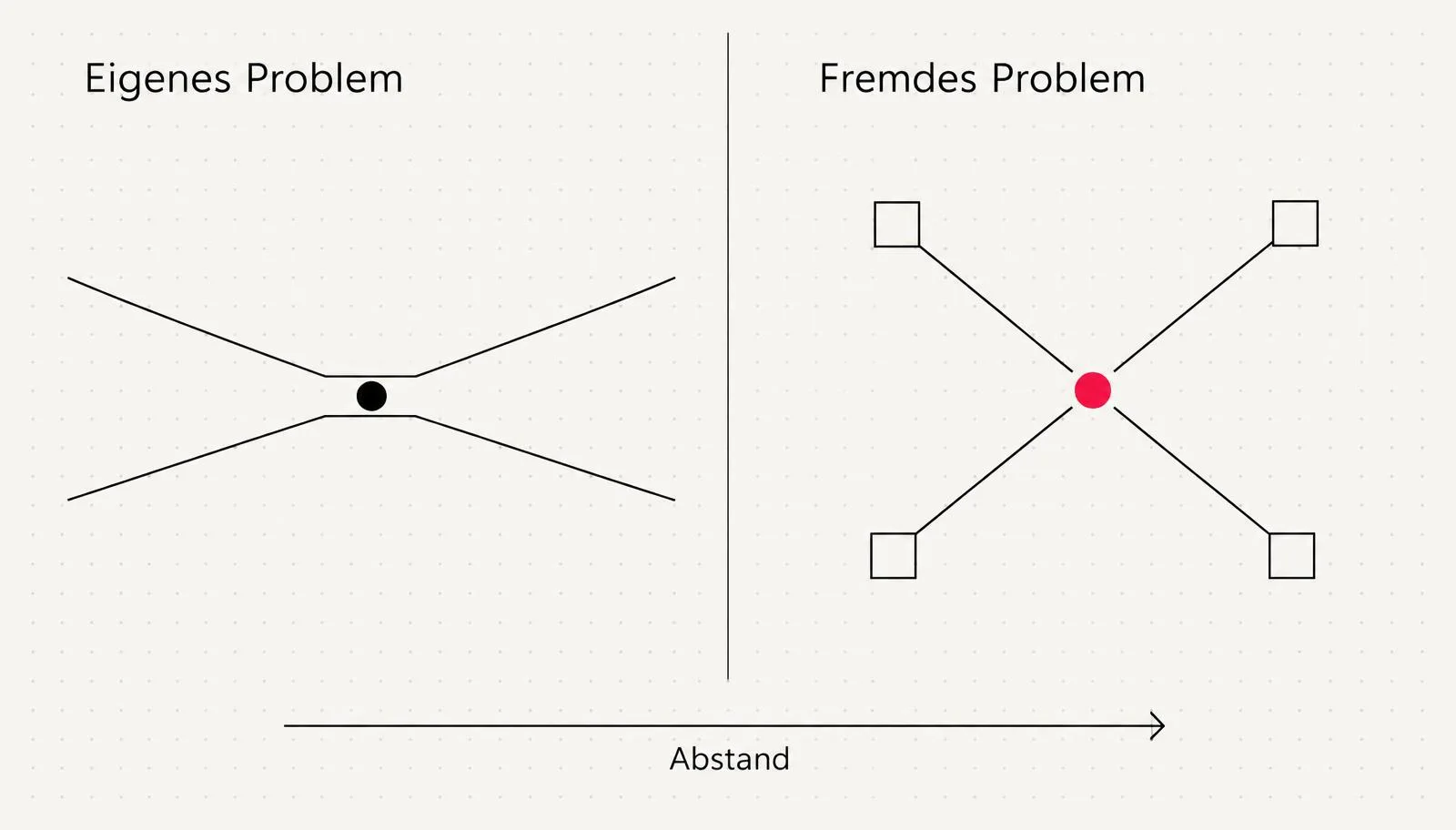
The Principle: Wise for Others, Blind to Yourself
- Recognizing the limits of your knowledge: I do not know everything about this situation.
- Considering other perspectives: How does the other side see it?
- Seeking compromise: Is there a solution that is fair to both?
- Anticipating change: How might the situation develop?
Origin and Context
- Age does not protect you. Younger (20 to 40) and older participants (60 to 80) showed the same effect. The saying "with age comes wisdom" does not help with your own problems.
- Distance removes the effect. Participants asked to view their own situation from an outsider's perspective reasoned just as wisely as about someone else's problem. The asymmetry disappeared completely.
Application to Digital Products
- Your own homepage: You know every service and do not want to leave any out. An outsider only sees too many messages at once.
- Copy written from the inside: Jargon, internal product names, and "we" sentences seem obvious to you; for visitors they are hurdles.
- Positioning: With competitors you notice immediately when they sound interchangeable. For yourself, it is hard to put what makes you special into one sentence.
- Feature decisions: In your own product you cling to features you built yourself, even when users do not need them.
| Situation | Inside view | Outside view |
|---|---|---|
| Homepage | "Everything matters" | "What is the one message?" |
| Copy | Jargon feels precise | Jargon feels off-putting |
| Positioning | "We are unique" | "Sounds like everyone else" |
| Relaunch | Keep the existing structure | Rethink structure from the visitor's side |
The Solution: Create Distance Deliberately
- Ask what you would advise a client. Phrase your problem as if an acquaintance had described it to you. The answer is often surprisingly clear.
- Speak in the third person. "What should Company X say on its homepage?" instead of "What should we say?" It sounds odd, but research shows it works.
- Think ahead. How will you judge this decision in a year? Temporal distance works much like spatial distance.
- Get a real outside view. User tests, an audit, or a workshop with outsiders provide the distance you can only give yourself to a limited extent.
The Maluure Approach
Most clients know exactly what they are doing. What they lack is an outside view of their own company. That distance is exactly what we bring, and it is often more valuable than any design idea.
Related Articles
- The Homepage That Wants to Say Everything at Once
- The Paradox of Choice: Why More Options on Your Website Mean Less Revenue
- The Peak-End Rule: What Visitors Really Remember About Your Website
Frequently asked questions
What is Solomon's Paradox?+
Why is the effect named after King Solomon?+
What does wise reasoning mean in the study?+
Are older people less affected by Solomon's Paradox?+
What is self-distancing?+
How can I overcome Solomon's Paradox in everyday life?+
What does Solomon's Paradox have to do with my website?+
Is Solomon's Paradox the same as the bias blind spot?+
Sources
- Grossmann, I. & Kross, E.: Exploring Solomon's Paradox. Self-Distancing Eliminates the Self-Other Asymmetry in Wise Reasoning About Close Relationships in Younger and Older Adults. Psychological Science, 25(8), Association for Psychological Science (2014)
- Distance From a Conflict May Promote Wiser Reasoning (Pressemitteilung), Association for Psychological Science (2014)
- Kross, E. et al.: Self-Talk as a Regulatory Mechanism. How You Do It Matters. Journal of Personality and Social Psychology, 106(2), American Psychological Association (2014)
- Grossmann, I. et al.: Training for Wisdom. The Distanced-Self-Reflection Diary Method. Psychological Science, 32(3), Association for Psychological Science (2021)

Josef leads the strategic and creative development of brands at Maluure. For over a decade, he has guided medium-sized businesses from brand positioning to digital delivery.
Managing Director of Maluure GmbH, Cologne. Specialising in corporate design, brand strategy and digital brand experiences.
Related articles

The Homepage That Wants to Say Everything at Once
Many company homepages don't fail because of design, they fail because of the message: they try to tell every visitor everything. Why that doesn't work, and how to arrive at a clear core message.
The Paradox of Choice: Why More Options on Your Website Mean Less Revenue
The paradox of choice explains why visitors faced with too many options decide nothing at all. With the jam experiment, the limits of the effect, and concrete rules for navigation, pricing pages, and forms.

The Peak-End Rule: What Visitors Really Remember About Your Website
The peak-end rule explains why people judge experiences by their peak and their ending, not by the average. With Kahneman's experiments and concrete rules for checkout flows, contact forms, and farewell pages.