Maluure Principle: Never Automate a Bad Process
Automation makes good workflows faster and bad workflows faster at being bad. Our first Maluure principle explains why order matters and how to tell if a process is ready for automation.
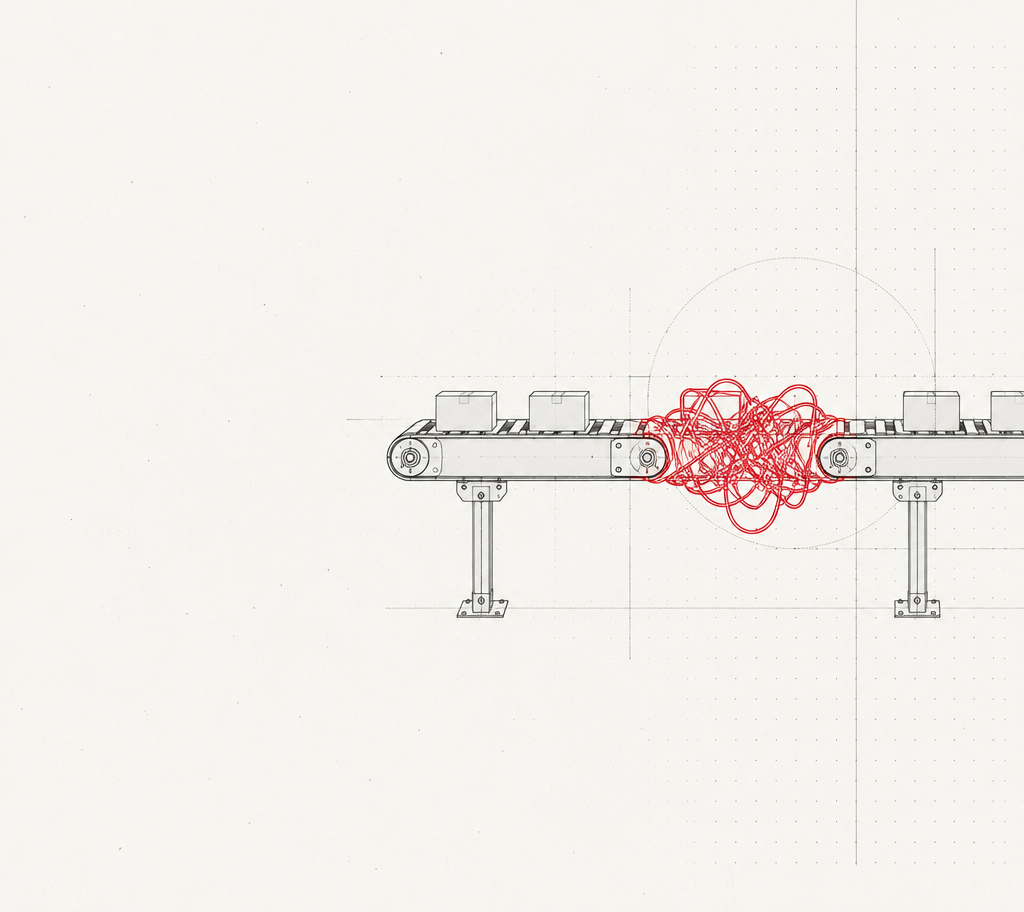
The observation: automation as an accelerator without direction
The principle
Context: where this principle comes from
Application: the three-stage test
- Understand: Can someone on the team explain the process in five sentences, including the exceptions? If not, it hasn't been understood.
- Simplify: Which steps would disappear if you reinvented the process today? Often it's thirty to fifty percent.
- Stabilize: Does the simplified process run stably by hand for a few weeks? Only then is automation an investment instead of a risk.
The solution: process first, then tool
- Write down the process before choosing a tool. The tool shouldn't define the workflow, it should be the other way around.
- Cut steps before you automate them. An automated unnecessary step is still an unnecessary step.
- Keep a manual fallback. Every automated process needs a documented way to work without it.
- Schedule reviews. Automated processes age. What made sense two years ago can be dead weight today.
| Question | Good sign | Warning sign |
|---|---|---|
| Is the process documented? | A notice, a wiki entry | "Only Sabine knows that" |
| Are there exceptions? | Listed and rare | "It depends" |
| How often does it run? | Weekly or more often | Twice a year |
| What does an error cost? | Little, correctable | A lot, hard to correct |
The Maluure approach
The most expensive automation is the one that cements a process nobody questions anymore. Simplify first, then stabilize, then automate. In that order, always.
Related articles
Frequently asked questions
Why is it bad to automate a bad process?+
How do I know if a process is ready for automation?+
What does premature automation mean?+
Should I buy a tool first and then adjust the process?+
How much can you save through simplification before automation?+
Does every automated process need a manual fallback?+
How often should automated processes be reviewed?+
Sources
- Bill Gates: The Road Ahead (Automatisierung effizienter und ineffizienter Abläufe), Viking Press (1995)

Josef leads the strategic and creative development of brands at Maluure. For over a decade, he has guided medium-sized businesses from brand positioning to digital delivery.
Managing Director of Maluure GmbH, Cologne. Specialising in corporate design, brand strategy and digital brand experiences.
Related articles
The Peak-End Rule: What Visitors Really Remember About Your Website
The peak-end rule explains why people judge experiences by their peak and their ending, not by the average. With Kahneman's experiments and concrete rules for checkout flows, contact forms, and farewell pages.
The Paradox of Choice: Why More Options on Your Website Mean Less Revenue
The paradox of choice explains why visitors faced with too many options decide nothing at all. With the jam experiment, the limits of the effect, and concrete rules for navigation, pricing pages, and forms.

Core Web Vitals: What Google Measures on Your Website and Why It Costs Revenue
Core Web Vitals are Google's yardstick for loading speed, responsiveness, and stability of a website. What LCP, INP, and CLS mean, which thresholds apply, and how to improve the scores concretely.