Productivity & Processes
    Fundamentals

    Useful illegality: why organisations need small rule violations

    Niklas Luhmann and Stefan Kühl show that without pragmatic deviations from rules, organisations would be paralysed. What this means for processes and digital projects.

    of Josef Kujawski4 min read
    Useful illegality: why organisations need small rule violations
    Short answer
    Useful illegality, also called functional illegality, describes deviations from internal rules that benefit an organisation. Niklas Luhmann coined the term in 1964, Stefan Kühl adapted it for today's practice. No set of rules covers every situation, and without pragmatic shortcuts many organisations would be paralysed. Laws, data protection and customer interests always remain off-limits. Frequent workarounds are a good pointer to where a process should be improved.

    The problem: rules that would paralyse everything

    Imagine everyone in your company followed every single rule to the letter from tomorrow. Every approval goes the official route, every order waits for the second signature, nobody takes a shortcut. Sounds tidy. In practice, much of the work grinds to a halt within days. Unions use exactly this as leverage: work-to-rule is almost as effective as a strike.
    That leads to an uncomfortable insight: organisations don't work despite small rule violations, but often because of them.

    The principle: useful illegality

    In 1964, sociologist Niklas Luhmann coined the term useful illegality (brauchbare Illegalität). [1] It describes deviations from formal rules that benefit the organisation. "Illegal" doesn't mean criminal here, but: not covered by the organisation's own official rules. The idea is also known as functional illegality.
    Luhmann's observation: no organisation can regulate every situation in advance. Formal structures are rigid, reality is not. The gap is filled by people who interpret rules pragmatically, take short paths and solve problems before they are officially reported.
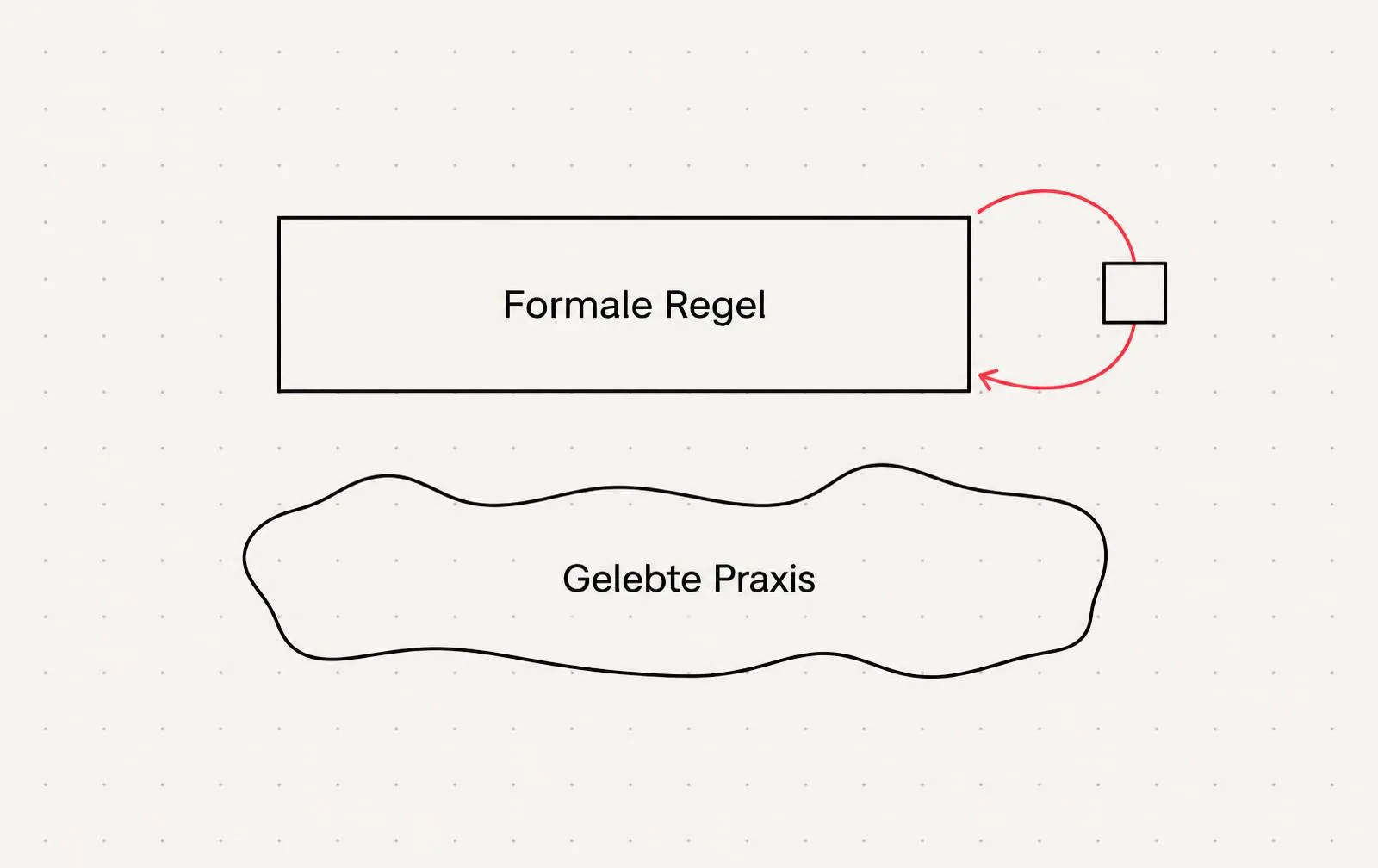
    Diagram: a red arrow bypasses an obstacle at the formal rule, below it the lived practice
    Next to every formal rule, a lived practice emerges.

    What Stefan Kühl makes of it

    Organisational sociologist Stefan Kühl has adapted Luhmann's ideas for today's practice. [2] His core thesis: every organisation has three sides.
    SideWhat it showsExample
    Formal sideOfficial rules, processes, responsibilitiesApproval process with two signatures
    Informal sideLived practice, shortcuts, agreementsA quick call instead of a ticket
    Display sideThe image presented to the outsideA clean process chart in the proposal
    Useful illegality lives on the informal side. It isn't an accident, but a sign that people take responsibility where the rule doesn't help.
    Kernaussage
    Rule deviations aren't automatically a problem. Often they show you exactly where your official process misses reality.

    Where the line is

    Not every rule violation is useful. Kühl and Luhmann clearly distinguish between deviations that help the organisation and those that harm it or others.
    Scale with three fields: allowed, grey zone, taboo; the grey zone is marked red
    Useful illegality happens in the grey zone, never in the taboo area.
    1. Useful: An employee approves a small website correction directly instead of waiting three days for the official review.
    2. Borderline: A team permanently bypasses a process because it's annoying. Usually the process is the problem, not the team.
    3. Taboo: Anything that violates laws, data protection, security or customers' interests. That isn't useful illegality, it's simply wrong.

    What this means for digital projects

    In website and software projects you encounter this principle all the time:
    • Approval loops: If every text change has to pass five people, unofficial shortcuts appear. Better: clear areas where the team decides on its own.
    • Workarounds in systems: If staff maintain data in Excel although there is a CMS, that reveals a gap in the tool. Look closer instead of banning it.
    • Style guides: A design system that allows no exceptions will be quietly bypassed. Plan room for flexibility on purpose.
    • Process automation: Before automating a process, understand the lived practice, not just the org chart. Otherwise you automate a workflow that doesn't really exist.
    Kernaussage
    Before you ban a workaround, ask which problem it solves. It's often the best pointer to a better process.
    Why you shouldn't simply digitise bad workflows is shown in Never automate a bad process. How postponed shortcuts become expensive in software is explained by Technical Debt. And why too many options paralyse is described by the Paradox of Choice.
    When a team keeps working around a rule, we don't see a discipline problem, but an invitation to rethink the process.
    – Josef Kujawski, Managing Director Maluure GmbH

    Quick check

    • Where do people in your team regularly bypass an official workflow?
    • Which real problem do these shortcuts solve?
    • Is it clear where flexibility is allowed and where it isn't?
    • Would your business keep running under work-to-rule?

    Frequently asked questions

    What does useful illegality mean?+
    Useful illegality describes deviations from an organisation's formal rules that benefit it. It doesn't mean breaking the law, but pragmatically bypassing internal rules.
    Who coined the term?+
    Niklas Luhmann introduced the term in 1964 in his book "Funktionen und Folgen formaler Organisation". Stefan Kühl later adapted it for today's organisational practice.
    Is functional illegality the same as useful illegality?+
    Yes, both terms essentially mean the same: rule deviations that serve a function for the organisation and keep it able to act.
    Why do organisations need rule-breaking?+
    Formal rules can never cover every situation. Without pragmatic deviations many workflows would stall, as work-to-rule demonstrates.
    Is useful illegality a licence to break the law?+
    No. Violations of laws, data protection, security or customer interests are never useful. It only concerns internal rules with room for interpretation.
    What are the three sides of an organisation according to Stefan Kühl?+
    Kühl distinguishes the formal side with official rules, the informal side with lived practice and the display side, the image shown to the outside.
    How should managers deal with workarounds?+
    First ask which problem the workaround solves. It often points to a better official process.
    What does this have to do with websites and software?+
    Anyone digitising or automating processes needs to know the lived practice. Otherwise the system maps workflows that don't really exist.

    Sources

    1. Funktionen und Folgen formaler Organisation, Duncker & Humblot (1964)
    2. Brauchbare Illegalität. Vom Nutzen des Regelbruchs in Organisationen, Campus Verlag (2020)

    #Organisation#Processes#Sociology#Leadership
    Josef Kujawski
    Author
    Josef Kujawski
    Managing Director & Creative Director at Maluure

    Josef leads the strategic and creative development of brands at Maluure. For over a decade, he has guided medium-sized businesses from brand positioning to digital delivery.

    Managing Director of Maluure GmbH, Cologne. Specialising in corporate design, brand strategy and digital brand experiences.

    Newsletter

    New articles straight to your inbox.

    A newsletter when we genuinely have something new to share. No noise.