Productivity & Processes
    Fundamentals

    When the horse is dead, dismount: Why we cling to what has failed

    The Dead Horse Theory, the sunk cost effect and escalation of commitment explain why teams keep riding dead horses. And how to dismount in time.

    of Josef Kujawski4 min read
    When the horse is dead, dismount: Why we cling to what has failed
    Short answer
    "When you discover you are riding a dead horse, dismount" advises ending ventures that can no longer work. The often claimed origin as Dakota wisdom is not documented. Why we keep riding anyway is explained by the sunk cost effect and escalation of commitment: money already spent and pride keep us in the saddle. Predefined goals, stop criteria and asking whether you would start the project today all help.

    The saying everyone knows

    "When you discover that you are riding a dead horse, the best strategy is to dismount." It is often quoted as Dakota tribal wisdom. That origin is not documented; there is no historical source for it. The line became famous mainly as a management joke, the so-called Dead Horse Theory: a list of absurd strategies organisations use to keep riding a dead horse anyway.
    You may know the list: buy a stronger whip, change riders, form a task force to analyse the dead horse, change the criteria for when a horse counts as dead. It is only funny because it feels so familiar.

    The principle behind it

    The rule itself is trivial. What is interesting is why we follow it so rarely. Research describes two well-studied mechanisms.
    1. The sunk cost effect. Hal Arkes and Catherine Blumer showed in 1985 that people are more likely to continue a venture the more they have already put into it. [1] Rationally, only the future matters. Money already spent is gone, whatever you decide.
    2. Escalation of commitment. Barry Staw observed in 1976 that decision makers invest even more after a failure when they made the original decision themselves. [2] Dismounting then feels like admitting you were wrong.
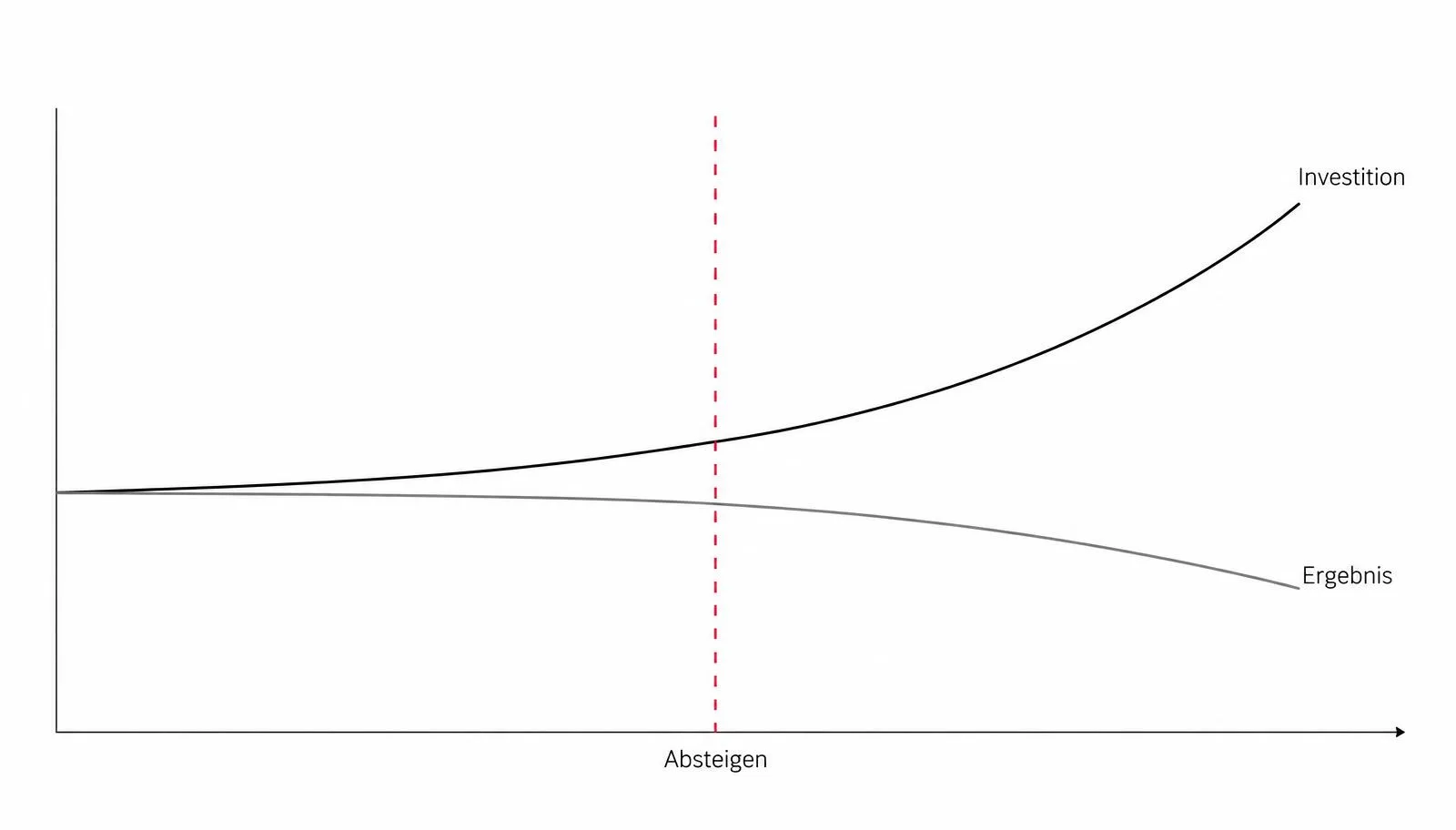
    Line chart: investment rises, results fall, a red line marks the moment to dismount
    The longer you wait, the wider the gap between effort and result.
    Kernaussage
    The dead horse is rarely the problem. The problem is pride and the money already spent, which keep you in the saddle.

    How to spot a dead horse

    Not every horse that is moving slowly is dead. Persistence is often exactly right. Clear signals make the difference:
    SignalLame horseDead horse
    MetricsMoving slowly in the right directionStagnating or falling despite fixes
    AssumptionsStill validProven wrong
    Team reasoning"It needs more time" with a concrete plan"We have already invested so much"
    Next stepTargeted correctionAn even stronger whip
    The most telling sentence is the last one: if the only argument for continuing is the past, you are probably riding a dead horse.

    What this means for websites and digital projects

    Dead horses show up constantly in digital work. A few typical examples:
    • The CMS nobody can use. Every new page needs a developer, yet it keeps getting patched because the rollout was expensive.
    • The campaign without impact. Budgets go up, ads get rewritten, but the landing page fundamentally fails to convince.
    • The feature nobody uses. It is maintained, tested and explained although the data has shown for months that nobody clicks.
    • The relaunch that never ships. Instead of cutting scope, new requirements keep being added.
    This is often closely tied to technical debt: the longer a system is kept alive artificially, the more expensive every further step becomes. And automating a broken workflow just means riding the dead horse faster. More on that in the principle Never automate a bad process.

    How to dismount in time

    Dismounting is easier if you make the decision in advance instead of in the moment of failure.
    1. Name the goal clearly. What exactly should the project achieve? Without a goal you cannot notice that the horse is dead.
    2. Define stop criteria upfront. For example: if the conversion rate has not improved after eight weeks, we stop and rebuild.
    3. Review regularly with fresh eyes. Ask yourself: would we start this today if we were starting from zero? If not, that is a strong signal.
    4. Get an outside perspective. We spot dead horses faster in others than in ourselves. That is also what Solomon's Paradox describes.
    5. Treat dismounting as a success. An early stop saves budget and nerves. Teams that reward it instead of punishing it make more honest decisions.
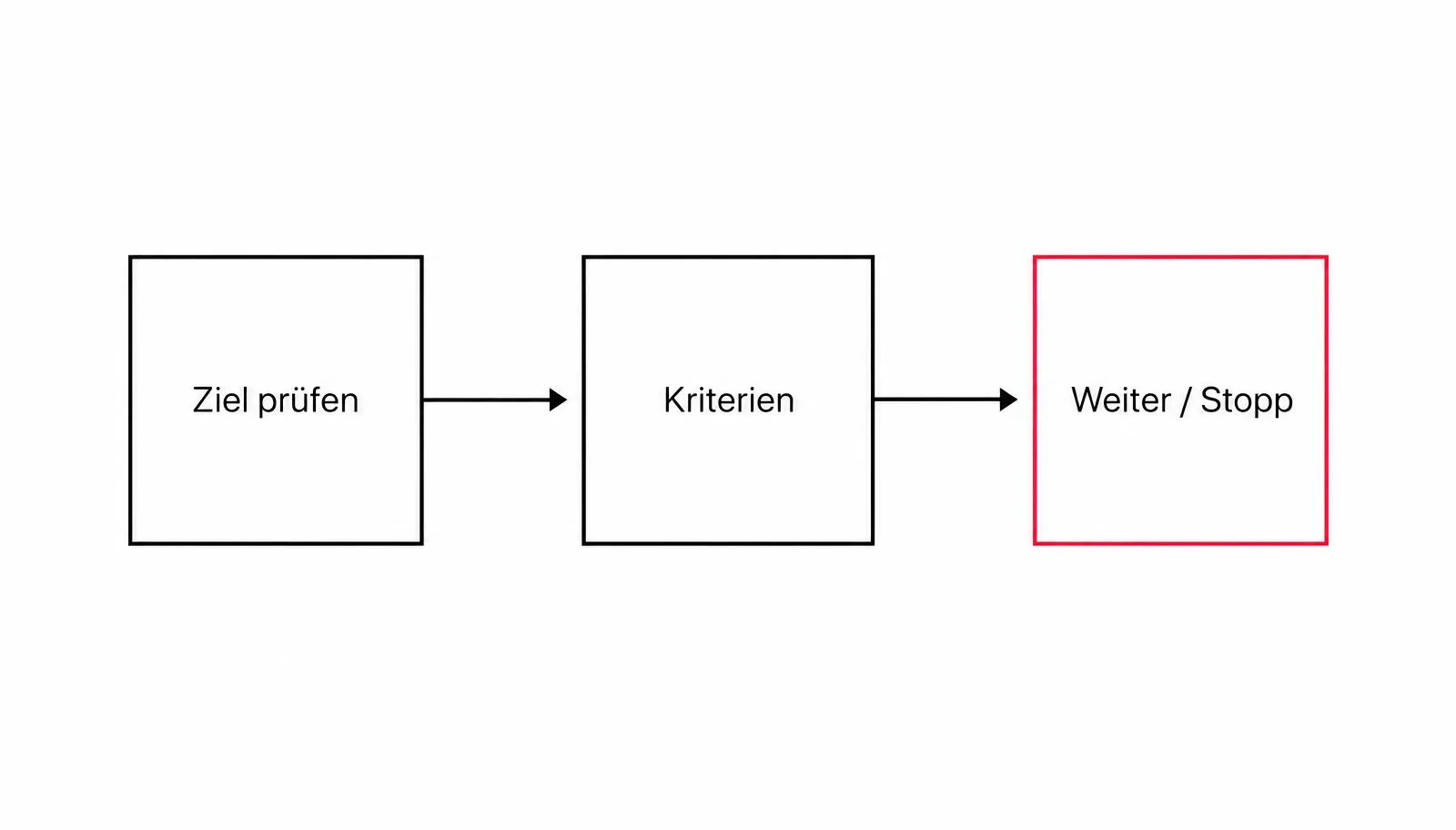
    Three-step decision flow: check goal, criteria, continue or stop
    If you set criteria in advance, you do not have to negotiate with your own pride at the decisive moment.
    Kernaussage
    The key question is not "What have we already invested?" but "Would we start this the same way today?"
    Sometimes the most valuable advice we can give a client is not another optimisation, but the honest sentence: let's rethink this.
    – Josef Kujawski, Managing Director, Maluure GmbH

    Conclusion

    The dead horse rule is simple; acting on it is not. Sunk costs and hurt pride keep us in the saddle. If you set goals and stop criteria in advance and review them regularly with fresh eyes, you spot dead horses earlier and can put time and budget into something that actually runs.

    Frequently asked questions

    What does "when the horse is dead, dismount" mean?+
    It advises ending a venture as soon as it is clear it cannot work, instead of pouring more time and money into it.
    Is it really Dakota wisdom?+
    That is often claimed but not documented. There is no historical source for the attribution; the line became known mainly as a management joke.
    What is the Dead Horse Theory?+
    A satirical list of strategies organisations use to keep riding a dead horse, such as buying a stronger whip or forming a task force. It exposes avoidance behaviour in organisations.
    How does this relate to the sunk cost effect?+
    The sunk cost effect describes how we stick with projects because we have already invested a lot. That is exactly what keeps us on the dead horse, even though past costs should not matter for the future.
    What is escalation of commitment?+
    Barry Staw showed that decision makers often invest even more after failures to justify their original decision.
    How can I tell a project is a dead horse?+
    When metrics do not improve despite fixes, key assumptions have been disproven and the only argument for continuing is the investment so far.
    Isn't persistence important too?+
    Yes. A lame horse with a clear plan and progress deserves patience. The key is setting criteria in advance that separate the two cases.
    How do I apply this to my website?+
    Set goals and stop criteria for relaunches, campaigns or features upfront and regularly check whether you would start the project today.

    Sources

    1. The psychology of sunk cost, Arkes & Blumer, Organizational Behavior and Human Decision Processes (1985)
    2. Knee-deep in the big muddy: A study of escalating commitment to a chosen course of action, Staw, Organizational Behavior and Human Performance (1976)

    #Decisions#Processes#Psychology#Leadership
    Josef Kujawski
    Author
    Josef Kujawski
    Managing Director & Creative Director at Maluure

    Josef leads the strategic and creative development of brands at Maluure. For over a decade, he has guided medium-sized businesses from brand positioning to digital delivery.

    Managing Director of Maluure GmbH, Cologne. Specialising in corporate design, brand strategy and digital brand experiences.

    Newsletter

    New articles straight to your inbox.

    A newsletter when we genuinely have something new to share. No noise.